IP Control and Management Strategies
June 18, 2026Key Takeaways
IP control means owning three things — the data, the decisions, and the operating system that runs the function. Most growth-stage companies have ceded at least two of these to outside counsel without realizing it.
The historical operating model has outside counsel holding prosecution history, strategic context, and process data. The company gets the output — patents — and pays for everything else.
Taking control back is not about ending outside counsel relationships. It is about restructuring the operating model so the company owns the system of record, and the firms operate against it rather than holding it.
IP governance — who decides what, on what cadence, with what reporting — is the most under-developed component of most growth-stage IP functions. Without governance, even strong operating systems produce inconsistent outcomes.
The cost of running on outside counsel’s operating systems compounds. Every quarter the company defers building its own system of record adds to the volume of data that will need to be migrated, the institutional knowledge that lives in someone else’s portal, and the decisions that get made without strategic context.
The strongest IP functions in 2026 are running on integrated operating systems they control, with outside counsel as specialized partners for the work that genuinely requires it.
Why most companies have lost more IP control than they realize
The default operating model for IP at growth-stage companies looks like this: the company hires outside counsel to handle prosecution. The firm builds the portfolio, files the patents, prosecutes through to grant, and tracks the docket. The company pays bills, gets patents, and trusts the firm to do good work. The model is familiar, professional, and structurally bad.
The bad structure is hidden by the fact that the work itself is being done. Patents are issuing. The portfolio is growing. Quarterly reports come from the firm. From inside the company, the IP function appears to be functioning. From outside the company — from a fundraise diligence team, an M&A acquirer, or a competitor watching for opportunities — the function is operating on someone else’s infrastructure, with someone else’s data, on someone else’s decision rhythms.
This guide covers what taking control back actually means. It is aimed at IP and legal leaders at growth-stage companies — Series B to pre-IPO — who have inherited an outside-counsel-centric operating model and need to restructure it without disrupting the prosecution work in flight.
What IP control and management actually means
IP control is the operating discipline of owning the three things that determine whether an IP function is the company’s asset or the firm’s: the data, the decisions, and the operating system. Each is independent. All three matter.
The components every working IP control framework includes:
- Data ownership. Every prosecution event, every filing decision, every office action response, every strategic rationale lives in a system the company owns. The firm executes work; the data does not stay with the firm.
- Decision rights documentation. Who decides on filing, who decides on continuation strategy, who decides on jurisdiction, who decides on abandonment, who decides on outside counsel allocation. Explicit, documented, and known to the firms doing the work.
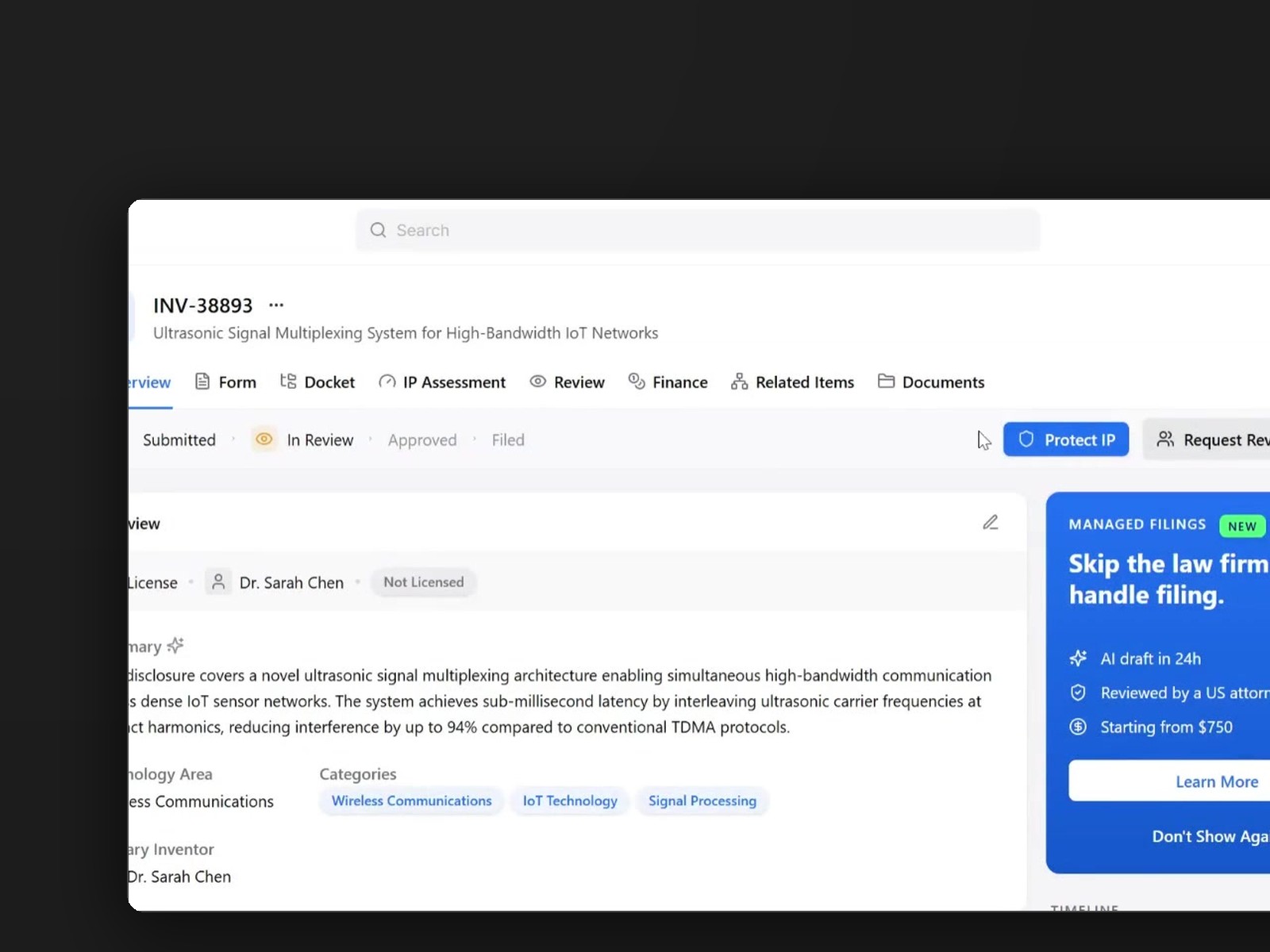
- System of record. A single platform where the IP function operates. Outside counsel works inside it or feeds structured data into it. The IP leader has one view; the firms do not.
- Governance cadence. A documented operating rhythm — daily, weekly, monthly, quarterly — that runs the function. Without cadence, control is theoretical.
- Outside counsel as service providers, not partners. The relationship is structured as procurement, not as partnership. Firms compete for work based on observable output. Allocation shifts based on performance.
- Reporting that flows to the company, not from the firms. The reporting infrastructure produces outputs that match the company’s stakeholder needs rather than the firm’s billing structure.
Each component is independently valuable. The integration of all six is what produces a function the company controls.
The seven disciplines that establish IP control
The disciplines below are the ones we see consistently in IP functions that operate as company-controlled rather than firm-controlled. They are interdependent — weakening any one weakens the others.
Make data ownership non-negotiable from day one
The first decision in restructuring an IP function is data ownership. Every new engagement with outside counsel, every new project, every new filing operates under explicit data ownership terms — the data belongs to the company, the firm has access to perform the work, structured data flows back to the company’s system of record on a regular cadence.
For existing engagements, the data ownership conversation is harder but unavoidable. Firms accustomed to holding the data do not enjoy the renegotiation. The conversation is part of the restructuring, not a separate exercise.
Document decision rights explicitly
Most growth-stage IP functions have implicit decision rights. The IP leader handles most decisions, the GC weighs in on the high-stakes ones, outside counsel makes operational decisions in the gray areas. The implicit model produces inconsistency — decisions get made by whoever has bandwidth, in whatever way they think the company would want.
The discipline is documenting decision rights explicitly. A two-page document covering filing decisions, continuation strategy, jurisdiction calls, abandonment, outside counsel allocation, and reporting cadence is enough. The document defines what the IP leader decides, what the GC decides, what outside counsel decides within authority, and what escalates. Once documented, decisions stop being personality-driven and start being process-driven.
Build the system of record before optimizing anything else
System of record is the foundational discipline. Without it, every other control component operates on incomplete data. With it, every other component becomes possible.
The system of record does not need to be elaborate. For a growth-stage IP function with 200-500 assets, an integrated platform that handles docketing, portfolio management, prosecution coordination, and reporting is sufficient. The historical alternative — enterprise IP management software requiring $50,000+ implementations — is increasingly mismatched to growth-stage operating economics. The current generation of integrated platforms produces comparable operational leverage at fractional cost and faster deployment.
Run the governance cadence on the company’s calendar, not the firms’
Governance is the operating rhythm that turns control from a structural claim into a working discipline. The cadence covers daily docket review, weekly multi-firm prosecution coordination, monthly outside counsel performance review, quarterly portfolio strategy review with product and finance, and annual board reporting.
The cadence should run on the company’s calendar — meetings called by the IP function, attended by stakeholders, with documented outputs the IP function controls. Cadences driven by outside counsel — firm-scheduled prosecution reviews, firm-prepared quarterly reports — leave control with the firm. The shift is in who calls the meeting and who writes the agenda.
Treat outside counsel as procurement, not partnership
The traditional firm relationship is structured as a partnership — long-term, relationship-based, hourly billing, soft accountability. The discipline that produces control is treating outside counsel as procurement — performance-based, output-measured, with structured comparison across firms.
The components include rate cards documented and compared across firms, performance metrics tracked consistently (allowance rate, claim scope at grant, response cycle time, cost per office action), engagement letters with clear deliverable and pricing terms, and regular firm-level scorecards. Firms that perform well get more work. Firms that perform poorly get either re-trained or rotated out. The shift is from relationship-based allocation to performance-based allocation.
Establish reporting infrastructure that flows from the company
Most growth-stage IP functions inherit their reporting from outside counsel — quarterly summaries the firm produces, formatted to the firm’s standards, populated with the firm’s data. The reporting is competent but defined by the firm’s view rather than the company’s needs.
The discipline is building reporting infrastructure inside the company’s system of record, populated by company data, formatted to stakeholder needs. Board IP briefings, CFO spend dashboards, product team coverage maps, diligence-ready export packages — each produced from one source, on the company’s schedule, in the format the audience needs.
Position outside counsel as specialized partners for specific work
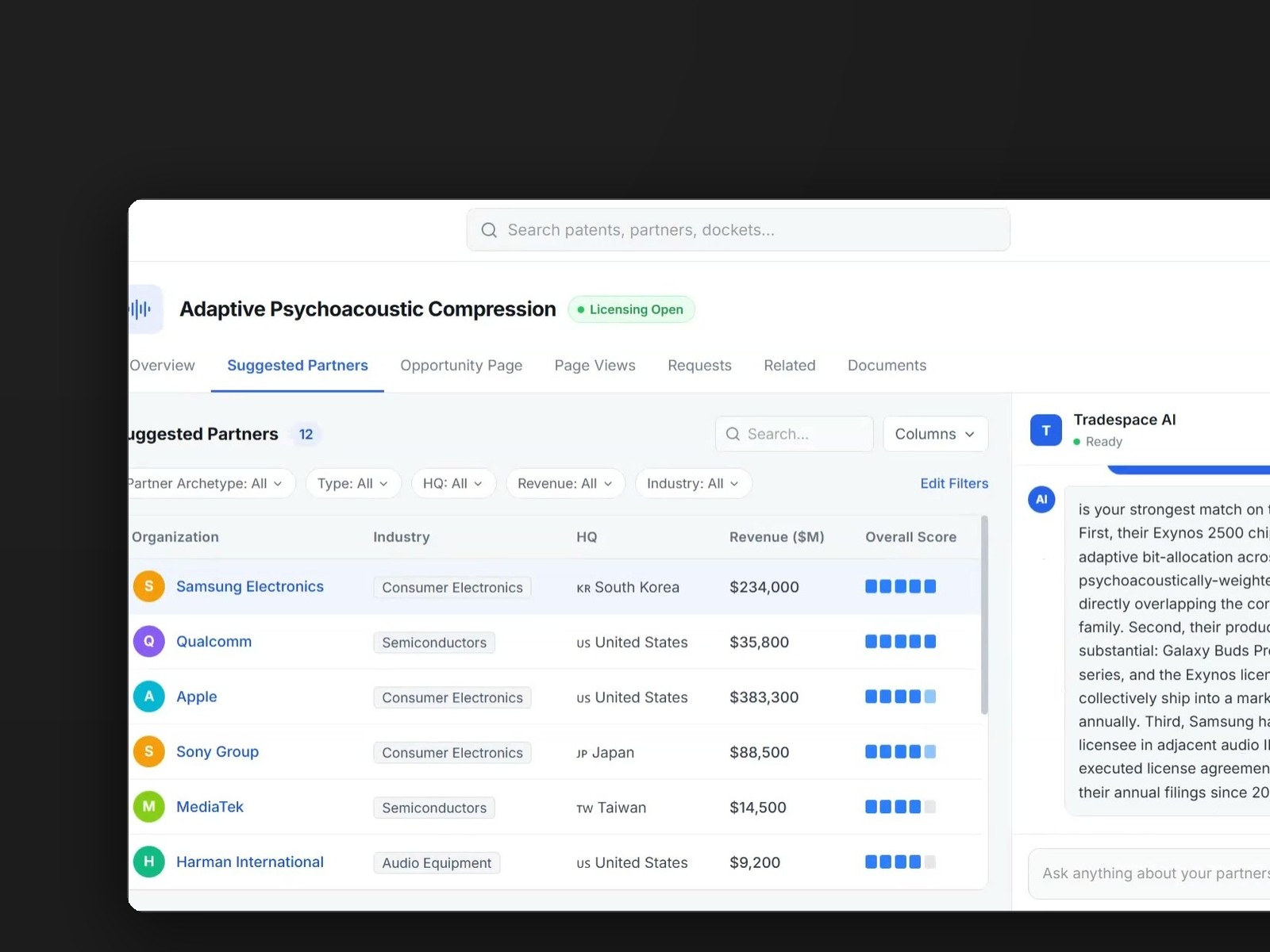
The endpoint of the restructuring is not eliminating outside counsel. It is repositioning the firms as specialized partners for work that genuinely requires their expertise. High-stakes prosecution where the firm’s specialized judgment earns the cost. Complex continuation strategy on high-value families. Litigation. Jurisdiction-specific filings in markets where the firm has deep local expertise. The routine volume work moves to flat-fee, on-demand attorney channels that operate inside the company’s system of record.
The economics shift materially. The firms that remain in the relationship are doing higher-value work at sustainable rates. The volume work runs through faster, cheaper channels. The company’s per-filing cost trends down while the strategic-quality output trends up.
Where IP control commonly falls short
The failure patterns below recur. They cluster — a function with one of these problems usually has at least three.
- Data lives in firm portals. Prosecution history, strategic context, and process data sit in outside counsel’s systems. The IP leader has dashboards from each firm; nobody has a unified view.
- Implicit decision rights. Nobody knows for sure who decides what. Decisions get made by whoever has bandwidth, in whatever way they think the company would want. Consistency suffers.
- No system of record. The company runs on a stack of point tools, internal spreadsheets, and firm portals. Diligence exercises take weeks because the data has to be reassembled every time.
- Cadence driven by deadlines. The IP function operates reactively to whatever docket deadline is closest. Strategic reviews happen ad hoc. The function lives in firefight mode.
- Outside counsel relationships as partnerships. Firms get work because they have been getting work. Performance comparison does not happen. Allocation shifts only when problems become impossible to ignore.
What to look for in IP control and management in 2026
The fundamentals of control do not change much. The operating environment in 2026 has shifted in three ways that matter for how teams should approach the discipline.
Integrated platforms make control operationally affordable
The historical operating economics for a Fortune 500 IP department — enterprise platforms, dedicated administrators, multiple specialist tools — were not available to growth-stage IP functions. Control either cost more than the function could afford or required levels of manual work that consumed the team’s strategic capacity.
The current generation of integrated platforms changes the economics. A growth-stage IP function with 200-500 assets can operate on infrastructure that delivers Fortune 500 grade control at fractional cost. The barrier to control is no longer financial; it is operational discipline.
AI-assisted analysis at portfolio scale
Historically, the analyses that supported IP control decisions — portfolio segmentation, claim mapping, competitive overlap analysis, jurisdiction strategy refresh — were analyst-grade work that ran annually if at all. AI-assisted tooling has compressed this work to a quarterly internal exercise. The IP leader has the strategic context to make control decisions more frequently and with better data than was practical even three years ago.
On-demand legal capacity replaces routine outside counsel work
The historical assumption was that all prosecution work runs through outside firms. The current pattern is that routine volume work increasingly runs through on-demand attorney channels — flat-fee, fast-turnaround, senior judgment, work happening inside the company’s system. The firms keep the specialized work where their expertise earns the cost.
The strategic implication is that control no longer requires building a Fortune 500-grade in-house IP function. The on-demand model provides senior attorney capacity at scale, on the company’s infrastructure, without the headcount investment.
How Tradespace approaches IP control and management
Tradespace was built around the operating model that produces IP control at growth-stage scale — integrated system of record, on-demand patent attorneys for routine work, AI-assisted analysis at portfolio scale, and reporting that flows from the company rather than from the firms. The integration matters because the alternative — assembling control from a stack of point tools and outside firm relationships — produces the operational fragmentation that defeats the control intent.
What this enables operationally:
- Single system of record owned by the company. Every asset, decision, and prosecution event lives in the platform. Outside counsel works inside it or feeds structured data into it. The IP leader has one view.
- On-demand attorneys for routine work. A senior patent attorney drafts and files a utility application in under five days at flat fee. The work happens inside the platform. The strategic context stays with the company.
- Documented decision rights and audit trails. Every decision surfaces with rationale and ownership captured in the system. Institutional knowledge stays with the company across personnel changes.
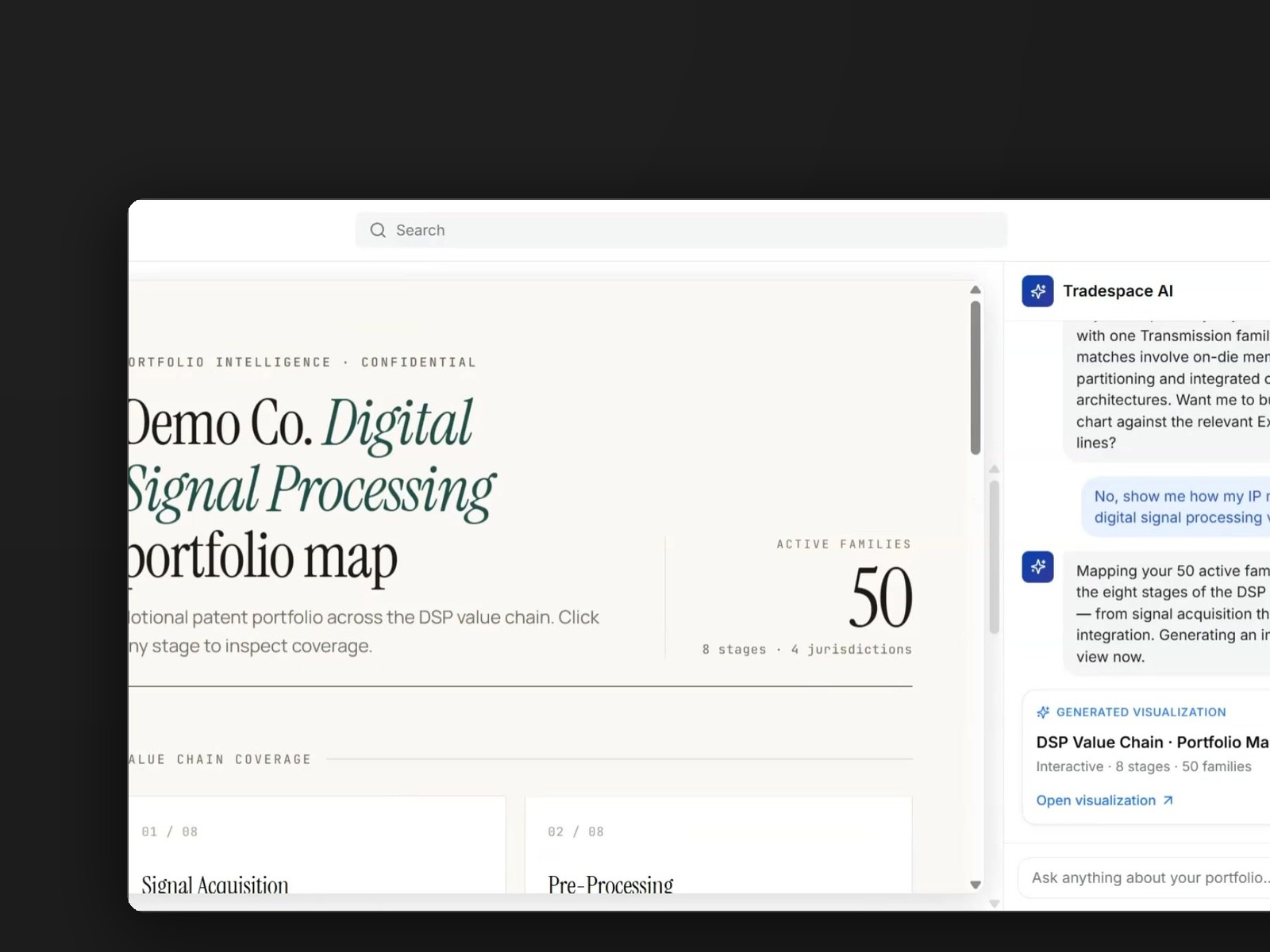
- AI-assisted portfolio analytics. The analyses that inform control decisions — segmentation, claim mapping, competitive overlap, jurisdiction strategy — run as built-in capabilities rather than as outside consulting engagements.
- Outside counsel performance benchmarking. Spend, allowance rates, claim scope at grant, and continuation hygiene tracked across firms. Performance comparison built into the operating cadence.
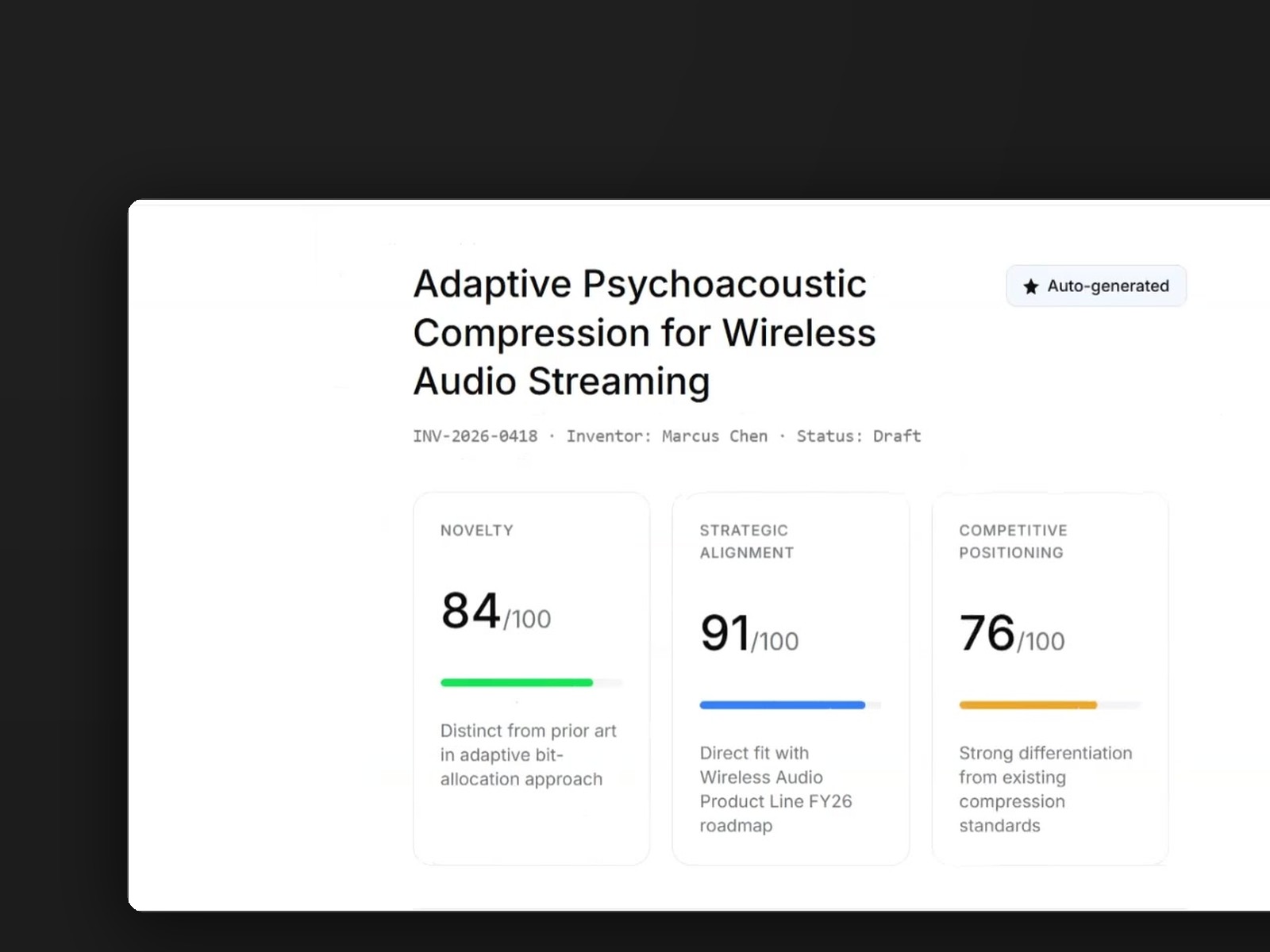
- Reporting infrastructure that flows from the company. Board briefings, CFO dashboards, product team coverage views, diligence exports — each produced from one source, on the company’s schedule, in the format the audience needs.
The shorthand: control as a structural feature of the operating system, not as a goal that has to be defended against the gravitational pull of outside counsel arrangements.
How to implement IP control in practice
For a team running an outside-counsel-centric operating model, the implementation arc below has been the fastest path to a company-controlled function. Compressing it shorter usually means foundation work gets skipped. Stretching it longer means another year of operating on someone else’s infrastructure.
Phase 1: Assessment (months 1-3)
The first three months are diagnostic.
- A complete asset inventory across all outside firms and internal systems
- A data ownership audit identifying where prosecution history, strategic context, and process data live
- A decision rights mapping — who actually decides what, on what cadence, with what input
- A firm-by-firm engagement review covering scope, rates, performance, and contract terms
- A list of the strategic decisions the function is not currently making — abandonments not surfacing, continuations not filed, families not amended
Phase 2: Foundational investment (months 4-9)
Months four through nine convert the diagnostic into a controlled operating model.
- System of record consolidation with data migration from outside firms and internal systems
- Decision rights documented and communicated to all participating firms
- Governance cadence established with documented meeting structure and outputs
- Outside counsel rationalization — which firms stay, which work moves to on-demand channels, which engagements convert to flat-fee
- Reporting infrastructure built with stakeholder-specific views
Phase 3: Continuous operation (month 10 and beyond)
By month ten the function operates under company control.
- Daily docket and decision review inside the system of record
- Weekly multi-firm prosecution coordination
- Monthly outside counsel performance review
- Quarterly portfolio strategy review with product and finance
- Annual firm allocation review based on performance scorecards
- Continuous AI-assisted portfolio analytics feeding strategic decisions
Common implementation pitfalls
The pitfalls below show up at most teams attempting the shift.
- Underestimating the data migration cost. Years of prosecution history living in multiple firm portals does not migrate cleanly. The migration is part of the work, not a one-time event.
- Avoiding the decision rights conversation. The implicit model is comfortable. Making decision rights explicit surfaces disagreements that have been latent. Address them explicitly; do not paper over them.
- Treating the system of record as IT. It is an operating-model decision. The IT work is downstream of the decisions about what data, in what structure, owned by whom, with what decision rights.
- Sequencing the firm rationalization before the system consolidation. Rationalizing firms before the system of record is in place produces inconsistent results. Build the foundation first.
- Reverting to firm-driven cadence under pressure. Quarterly portfolio reviews get rescheduled because the IP team is firefighting deadlines. The function drifts back to reactive. Defending the cadence is the IP leader’s job.
Measuring IP control effectiveness
The metrics below tell the executive team whether the function is operating under company control or under firm-driven dynamics.
- Diligence response time. From a board or investor ask for portfolio context, how long to a complete export package. A controlled function produces it in hours. A firm-dependent one produces it in weeks.
- Per-firm allocation as a percentage of work. Trending toward distribution based on performance rather than concentration based on relationship.
- Cost per filed patent. Outside counsel spend normalized to filing volume, tracked over time. Trending down as flat-fee channels absorb routine work and performance-based allocation shifts work to efficient firms.
- Institutional knowledge survival rate. Hypothetical test: if the IP leader left next month, what percentage of strategic context survives the transition. A controlled function preserves substantially all of it.
- Time from question to answer on any portfolio dimension. Coverage status, prosecution history, spend trend, competitive landscape — each answerable in minutes from the system of record.
Building your IP control strategy
For a team running an outside-counsel-centric operating model, the sequence below has been the fastest path to company control.
- Run the data ownership audit first. Until the location and structure of the data is visible, the control gap is invisible too.
- Document the decision rights explicitly. The conversation is uncomfortable but unavoidable.
- Choose the system of record before choosing tooling. The decision is about data ownership and operating model, not about software features.
- Sequence the firm rationalization carefully. Build the foundation, then move work, then rationalize the relationships.
- Defend the governance cadence as a non-negotiable. The cadence is what makes control operational rather than theoretical.
A pressure-test for your current control posture
The questions below are diagnostic. The honest answers tell an IP leader where the function is controlled and where it has been ceded.
- For any given family in the portfolio, who holds the prosecution history — the firm or the company?
- If you needed to switch outside firms next quarter, how many weeks of data migration would the transition require?
- Can you produce a diligence-ready export with portfolio coverage, spend history, and strategic rationale from the company’s system in hours, or does it require pulling from firm portals?
- For every prosecution decision made last quarter, can you point to documented rationale that does not live in someone’s inbox?
- If the head of IP left next month, what percentage of strategic context survives the transition without forensic reconstruction?
The takeaway
IP control is not a philosophy. It is an operating model decision with three components — data, decisions, and system of record — that either get explicit ownership or get ceded by default. The default mode for growth-stage IP functions is firm-controlled operating, with the company paying for the work and receiving the output while the strategic infrastructure lives with someone else.
The shift to company control is operational, not adversarial. The firms that remain in the relationship after restructuring are doing higher-value work at sustainable economics. The routine volume work moves to channels that are faster and cheaper. The company’s system of record absorbs the institutional knowledge that previously dispersed across firm portals. The IP function becomes more capable, less expensive, and more defensible in front of the executive team — all from the same set of structural decisions.
What does IP control actually mean?
IP control is the operating discipline of owning the data, the decisions, and the operating system that runs the IP function. Data ownership means prosecution history, strategic context, and process data live in the company’s system. Decision ownership means decision rights are documented and the company makes the strategic calls. System ownership means the IP function operates on the company’s platform, with outside counsel working inside it or feeding structured data into it. The integration of all three is what produces a company-controlled function.
How is IP control different from IP management?
IP management is the operational work — docketing, prosecution coordination, annuity payments, reporting. IP control is the structural framework that determines who owns the data, the decisions, and the operating system that the management work runs on. Management without control produces operational competence on someone else’s infrastructure. Control without management produces a structural framework that does not execute. Both matter.
What does "outside counsel as partner versus service provider" mean?
The partnership model treats outside counsel as long-term relationships with soft accountability, relationship-based work allocation, and hourly billing. The service provider model treats outside counsel as procurement with performance-based work allocation, structured rate cards, defined deliverables, and regular performance comparison. The procurement model produces better outcomes at growth-stage scale because it ties firm allocation to observable output rather than to relationship history.
How do you take control back from outside counsel?
The restructuring runs over roughly nine months. First, audit data ownership across all current relationships. Second, document decision rights explicitly and communicate them to participating firms. Third, build the company’s system of record and migrate data from firm portals. Fourth, establish the governance cadence on the company’s calendar. Fifth, rationalize outside counsel relationships — move routine work to flat-fee channels, keep specialist work where firm expertise earns the cost. The work is operational, not adversarial.
What's the role of in-house IP versus outside counsel?
In-house IP holds the strategic decisions, the system of record, the governance cadence, and the procurement relationship with outside firms. Outside counsel handles specialized work where the firm’s expertise legitimately earns the cost — high-stakes prosecution, complex continuation strategy, litigation, jurisdiction-specific filings. The volume work increasingly runs through on-demand attorney channels that operate inside the company’s system. The boundary shifts over time as the function matures.
How does AI change IP control?
AI compresses the analytical work that previously required outside engagements — portfolio segmentation, claim mapping, competitive overlap, prior art research, contract review. This shifts the cost-benefit calculation on what work belongs in-house versus outside. With AI-assisted tooling, more work is operationally tractable in-house, which expands the surface of IP control the company can practically achieve.
What's a system of record in IP?
A system of record is the single platform where the IP function operates — where every asset, decision, prosecution event, and strategic rationale lives. The system is owned by the company, not by outside counsel. Outside firms either work inside the system or feed structured data into it on a regular cadence. The historical alternative — federated data across firm portals and internal spreadsheets — is increasingly being replaced by integrated platforms designed for company ownership at growth-stage scale.
What's IP governance?
IP governance is the documented operating model that defines who decides what, on what cadence, with what reporting. The components include decision rights documentation, meeting cadences with defined attendees and outputs, escalation paths for non-standard decisions, and stakeholder reporting that flows from the company. Without governance, even strong operating systems produce inconsistent outcomes. With it, the function operates predictably and defensibly.
How does IP control connect to fundraising and M&A?
The clearest test of IP control is fundraising or M&A diligence. A controlled function produces a complete diligence package — portfolio status, prosecution history, strategic rationale, coverage maps, spend history — in hours from the company’s system. A function that has ceded control produces the same package in weeks, through manual assembly across firm portals and internal documents. The diligence experience reveals the underlying operating model. Companies whose IP is structurally controlled show well; companies whose IP is firm-controlled struggle.
When should a growth-stage company invest in IP control?
The trigger is usually around Series B or early Series C, when the portfolio reaches 50+ assets, when outside counsel spend hits $500K+ annually, or when an upcoming funding round or M&A event makes IP diligence material. Before that, the operational footprint is small enough that the firm-controlled model produces acceptable outcomes. After that, the cost of operating on someone else’s infrastructure compounds. The piece on how companies can improve their IP management strategy covers the broader improvement framework that the control restructuring fits inside.