Intellectual Property Management: A Strategic Overview
June 18, 2026Key Takeaways
Intellectual property management is the operating discipline that turns the company’s innovations into a defensible, compounding asset class. The work spans patents, trademarks, trade secrets, copyrights, contracts, and the operating system that ties them together.
At growth-stage companies, IP management has moved from a back-office function to a strategic discipline that materially affects valuation, fundraising, M&A outcomes, and competitive positioning.
The strongest IP functions in 2026 run on integrated operating systems, not on stitched stacks of point tools and outside counsel relationships. The shift is operational, not philosophical.
The four jobs of an IP function — capture innovation, protect it, scale into a portfolio, and report it strategically — are interdependent. Underinvestment in any one cascades into the others.
AI-assisted infrastructure has materially changed what is operationally tractable for growth-stage IP teams. Capacity that previously required Fortune 500-scale headcount is now accessible to teams of one to ten.
The best-run IP functions look quiet from the outside. The work runs on systems and cadences. The drama is replaced by compounding strategic value.
Why IP management deserves more strategic attention than it gets
For most of the last twenty years, IP management at growth-stage companies has been treated as a back-office discipline. The function existed to file patents, manage trademarks, and keep the renewal calendar running. The strategic conversations happened elsewhere — in product, engineering, business development, and the C-suite. IP showed up in the strategic conversations during diligence preparation and disappeared back into the docket afterward.
That treatment is increasingly mismatched to operating reality. At IP-intensive growth-stage companies — AI, deep tech, robotics, semiconductors, climate, biotech, advanced hardware — the patent portfolio is not a back-office output. It is a meaningful component of enterprise value, a critical input to fundraising and M&A outcomes, and a strategic asset that determines competitive positioning. Investors and acquirers look at the IP portfolio with the same scrutiny they apply to financials and product traction. A clean, strategically aligned IP profile materially affects valuation. A messy one is a discount.
The function has not always evolved at the same pace. Many growth-stage IP functions are running on operating models built for a 2010s reality — outside-counsel-centric, federated data, manual reporting, no integrated tooling. The strategic conversations happen, but the underlying function does not produce the strategic outputs the company actually needs.
This guide covers the strategic framework that working IP management runs on. It is aimed at IP, legal, and operating leaders at growth-stage IP-intensive companies — Series B to pre-IPO — who need to position the function as a strategic discipline rather than as administrative overhead.
What strategic IP management actually is
Strategic IP management is the operating discipline that captures the company’s innovations, protects them efficiently, scales them into a compounding portfolio, and reports them in the language stakeholders use to make decisions. The work spans multiple legal frameworks, operating cadences, and stakeholder groups, but reduces to four core jobs:
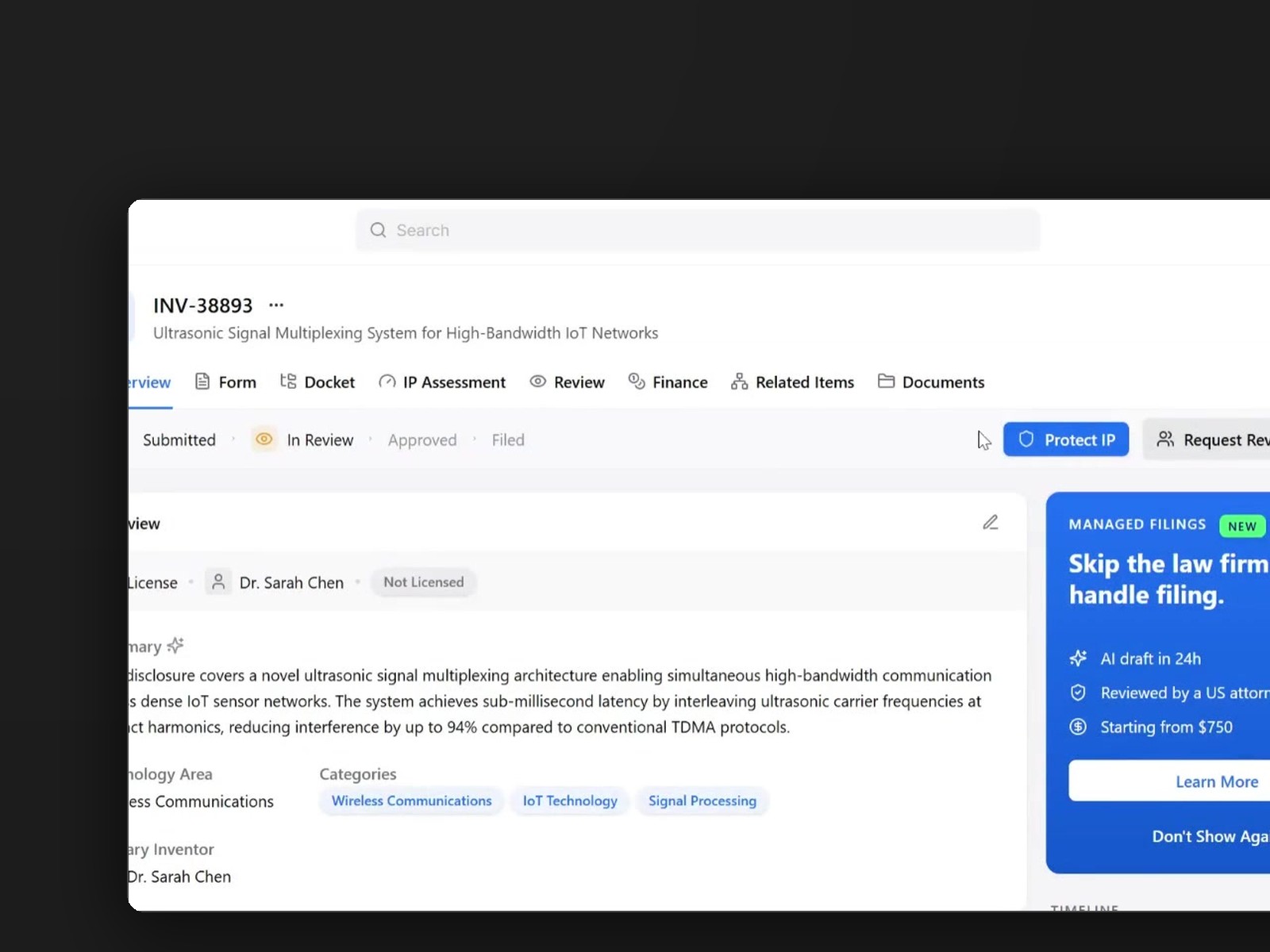
- Getting the company’s innovations into the IP function in a form that can be evaluated and protected. The work covers inventor disclosure processes, AI-structured capture from existing engineering and research artifacts, and the operating discipline that ensures inventions do not slip through the cracks.
- Translating innovations into legal protections — patents, trademarks, trade secrets, copyrights, contract terms — that survive enforcement scrutiny. The work covers prosecution strategy, claim drafting, jurisdiction discipline, and the system of record that supports enforcement when needed.
- Building a portfolio that compounds in value rather than just growing in size. The work covers segmentation, claim mapping, continuation strategy, pruning discipline, and the operating cadence that maintains all of the above.
- Translating the IP function’s output into strategic input for the executive team, the board, fundraising, and M&A. The work covers stakeholder-specific dashboards, diligence-ready exports, and the connection between IP activity and business outcomes.
Each job has its own operating disciplines, tools, and stakeholder groups. The integration of all four is what produces an IP function that operates as a strategic asset.
The seven disciplines that define strategic IP management
The disciplines below are the ones we see consistently in IP functions that operate strategically rather than administratively. They are interdependent — weakening any one weakens the others.
Capture as an operating discipline, not a paperwork exercise
The historical capture model relies on inventors filling out invention disclosure forms. The model has known failure modes: forms take an hour or more to complete, inventors skip them, inventions get disclosed late or not at all, and the IP function only knows about a fraction of the patentable work the company produces.
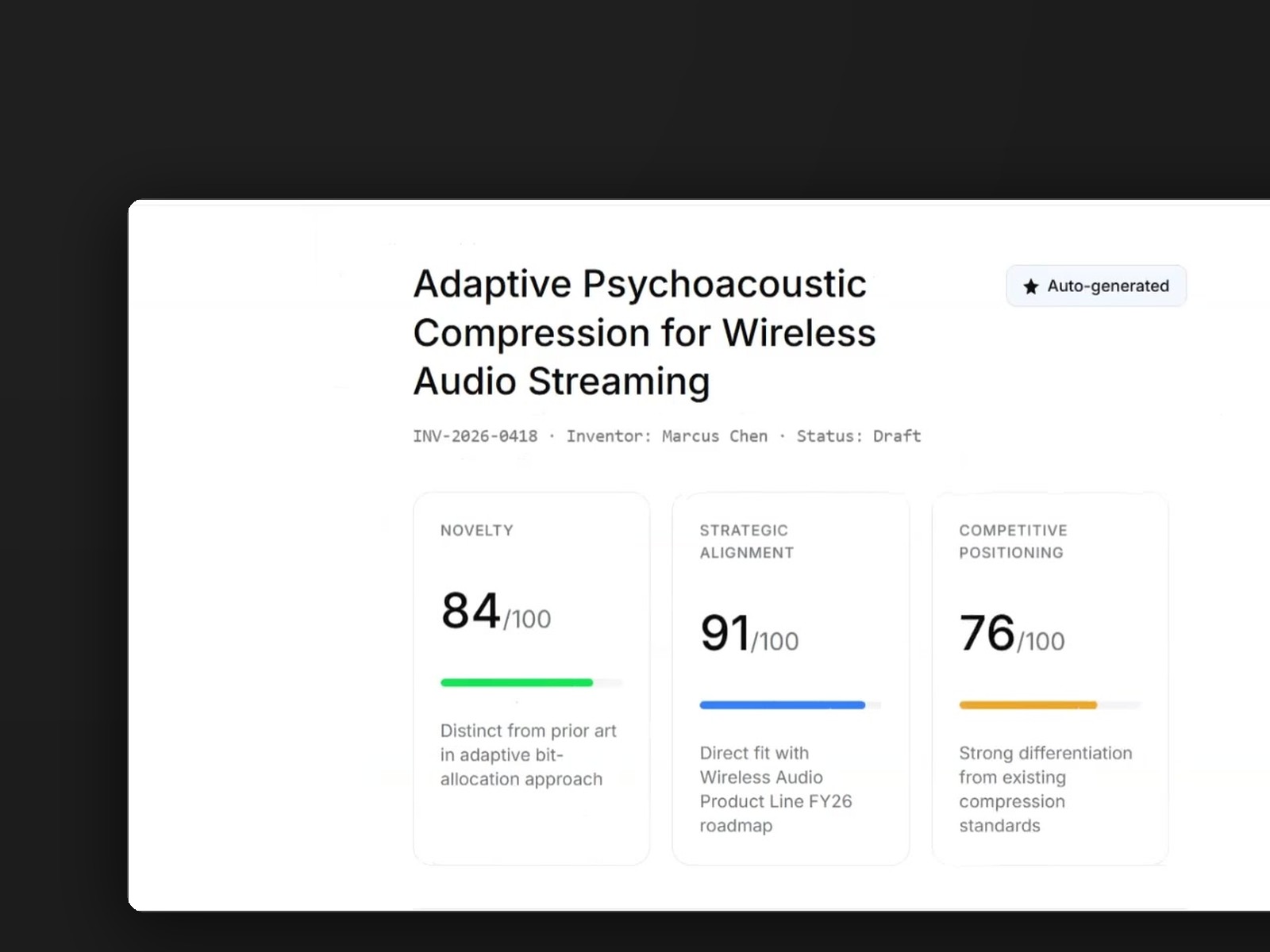
The discipline that scales is treating capture as an operating system that lives inside the inventor’s existing workflow. AI structures the materials engineers and scientists already produce — slides, design documents, voice memos, Jira tickets, lab notebooks — into structured invention disclosures. The capture step takes minutes for the inventor and produces complete attorney-ready disclosures for the IP function. The conversion rate from invention to disclosure rises materially. The IP function stops chasing inventors and starts evaluating disclosures.
Protect with senior judgment, at flat-fee economics
The historical protect model funnels all prosecution work through outside firms under hourly billing. The model produces variable quality (depending on which associate handles the work), unpredictable cost, and timelines that run weeks to months from disclosure to filed application.
The discipline that scales pairs on-demand senior patent attorneys with AI-assisted drafting infrastructure operating inside the company’s system of record. A senior attorney drafts and files a utility application in under five days at flat fee. The strategic judgment is applied at the senior level. The work happens inside the company’s platform with full visibility. The volume work runs through this channel; specialized firm engagements stay in place for work that legitimately requires them.
Scale by compounding, not by accumulating
The historical scale model measures the IP function on filing volume — patents per year, portfolio size, growth rate. The metrics are easy to track and tell a poor story about strategic value.
The discipline that produces compounding value treats the portfolio as a system. Every filing makes the next one faster, cheaper, and better informed. Prosecution history accumulates in the company’s system of record. Claim mapping refreshes as the product roadmap evolves. Pruning runs on a quarterly cadence. Continuation strategy operates at the portfolio level rather than the per-filing level. The portfolio grows in size; more importantly, it grows in strategic value per dollar invested.
Report in the language stakeholders use
The historical report model produces filing summaries, grant counts, and spend reports. The reports are competent and tell stakeholders almost nothing about what the IP function is actually producing for the business.
The discipline that scales produces stakeholder-specific reporting. Board members see coverage maps tied to lead products and strategic positioning. The CFO sees per-filing cost trends, spend benchmarked against output, and pruning impact on annuity exposure. Product teams see coverage against the roadmap with gap analysis. Business development sees licensing-relevant claim positions and competitive overlap. Each stakeholder gets the view their decisions need. The IP function becomes legible to the people deciding the function’s resources.
Run integrated operations across IP asset classes
The historical model treats patents, trademarks, trade secrets, copyrights, and contract IP terms as separate practices, often handled by different firms with different systems and reporting. The fragmentation produces gaps between asset classes and stakeholder reporting that does not consolidate.
The discipline that scales runs IP operations as an integrated practice across asset classes. Patents are the most data-intensive component and often the strategic anchor; the surrounding components — trademarks, trade secrets, copyrights, contracts — operate on the same cadence, in the same system of record, with consolidated stakeholder reporting. The function presents one coordinated practice to the executive team rather than several disconnected ones.
Treat the system of record as the operating foundation
The historical model has data dispersed across outside counsel portals, internal spreadsheets, and email archives. The IP leader has dashboards from each firm. Nobody has a unified view. Diligence exercises take weeks because the data has to be reassembled every time.
The discipline that scales consolidates the function onto a single system of record owned by the company. Outside counsel either works inside the system or feeds structured data into it. The IP leader has one operating view. Diligence produces in hours. Institutional knowledge accumulates in the platform rather than dispersing across firms and personal inboxes.
Govern the function explicitly
The historical model relies on implicit governance — decision rights live in the IP leader’s head, the cadence runs ad hoc, the reporting flows from whoever has bandwidth. The model produces inconsistent outcomes and bottlenecks every decision on the IP leader.
The discipline that scales documents governance explicitly. Decision rights are written down. The operating cadence runs on the calendar. Stakeholder reporting follows a schedule. Outside counsel relationships are managed as procurement rather than as partnership. The function operates predictably whether the IP leader is in the office or not.
Where IP management commonly falls short
The failure patterns below recur across growth-stage IP-intensive companies. They cluster.
- Function treated as administrative overhead. The IP function operates in service of compliance — file the patents, renew the trademarks, manage the docket. Strategic conversations happen elsewhere. The function defends its budget on activity counts rather than on strategic outcomes.
- Capture by chase rather than by system. The IP function chases inventors for disclosures. Some inventions get captured; many do not. The function only knows about the work that survives the chase.
- Protect by inertia. Outside counsel relationships continue because they have been continuing. Performance comparison does not happen. The same firms get the same work whether or not the work is strategic-quality.
- Scale by accumulation. The portfolio grows. Segmentation has not been done in years. Claim mapping has not been done. Pruning happens when annuity bills spike, not on a quarterly cadence.
- Report by activity, not by strategy. Quarterly reports show filings and spend. They do not show coverage status, strategic alignment, or trend on per-filing cost. The function is invisible to stakeholders’ decision-making.
What to look for in IP management in 2026
The strategic fundamentals do not change much. The operating environment in 2026 has shifted in five ways that matter.
Integrated operating platforms replacing stitched stacks
The historical IP function ran on a stack of point tools — docketing software, annuity provider portals, analytics platforms, search tools, internal spreadsheets bridging gaps. Each tool was excellent at its narrow function. The integration was manual.
The pattern that scales in 2026 is integrated platforms handling portfolio management, prosecution execution, competitive intelligence, and reporting in one operating system. The IP function operates in one view. The team’s time goes to strategic work rather than integration work.
AI as operating substrate, not as feature
The first wave of AI in IP management was features added to existing platforms — an AI summarization button, an AI search box. The current wave is AI-native architecture where AI is the operating substrate. Natural language queries, AI-assisted workflows, and tight verification paths between AI output and underlying data are first-class operations. The implication for IP leaders is that the analytical capacity of the function has expanded materially compared to even three years ago.
On-demand legal capacity restructuring make-or-buy economics
The historical assumption was that all prosecution work runs through outside firms. The current pattern is on-demand attorney channels providing senior judgment at flat-fee economics, operating inside the company’s system. The make-or-buy decision shifts. More work becomes operationally tractable inside the company’s infrastructure.
Portfolio data as strategic asset, not docketing input
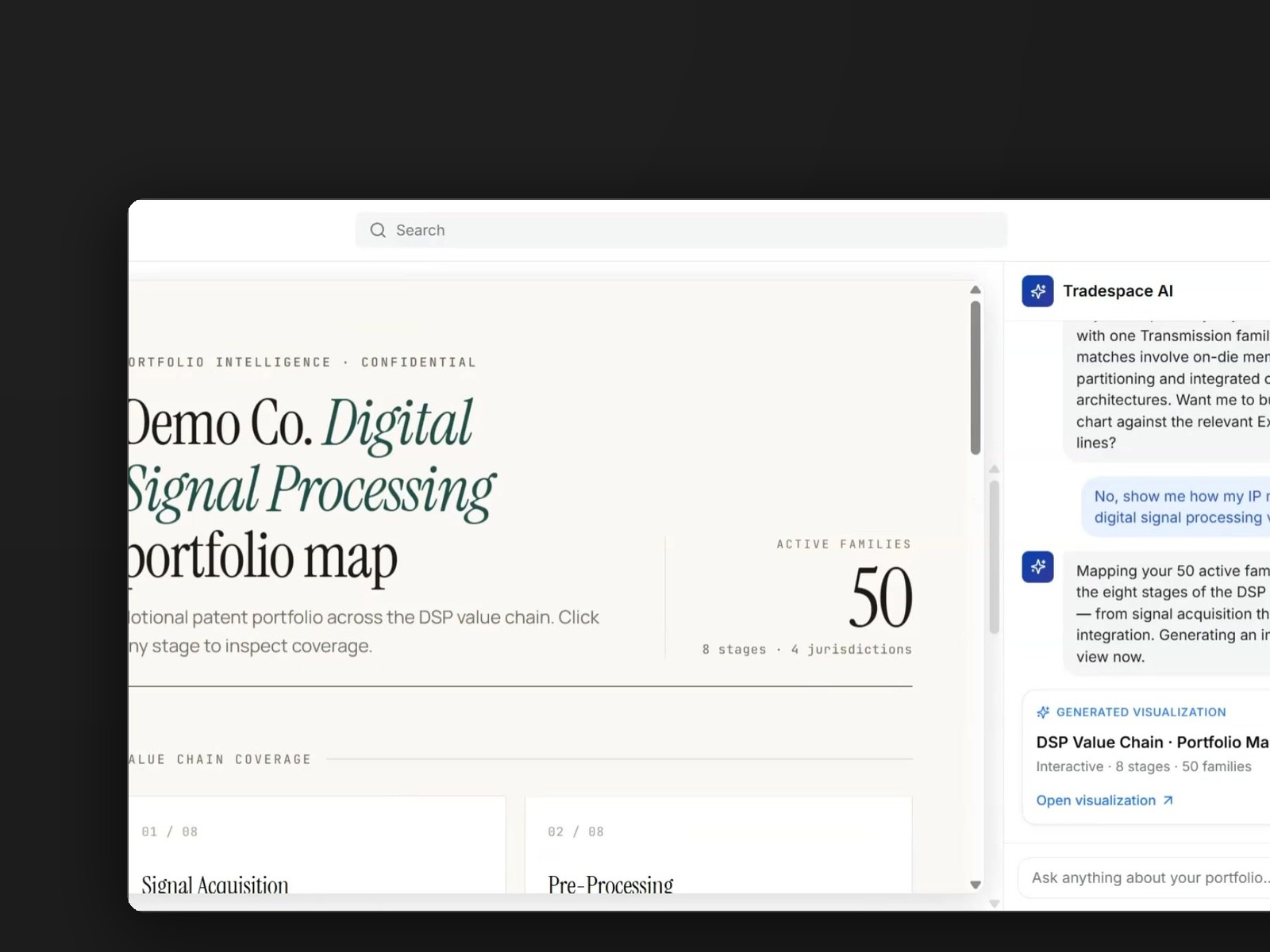
IP management software was historically a docketing tool with reporting bolted on. The shift is treating portfolio data as a queryable strategic asset that informs R&D direction, M&A targeting, competitive positioning, and licensing decisions. The portfolio becomes a source of intelligence rather than just a list of granted patents.
IP function as strategic conversation participant
The historical role for the IP function was producing IP outputs that other parts of the company consumed. The pattern that scales puts the IP function in the strategic conversations — product roadmap reviews, competitive landscape discussions, M&A target evaluation, fundraising preparation. The function contributes intelligence and analysis, not just docketed output.
How Tradespace approaches strategic IP management
Tradespace was built around the operating model that produces strategic IP management at growth-stage scale — integrated system of record, on-demand patent attorneys, AI-assisted analytics, and reporting that flows from the company. The integration matters because the strategic IP function requires the components to operate as one practice rather than as several disconnected ones.
What this enables operationally:
- Capture at the inventor’s workflow, not in IP forms. AI structures what engineers and scientists already produce into invention disclosures in minutes. The IP function evaluates attorney-ready disclosures rather than chasing inventors.
- Protect with senior attorneys at flat-fee economics. A senior patent attorney drafts and files a utility application in under five days for flat fee. The strategic judgment applies on every filing. The work happens inside the platform.
- Scale through portfolio compounding. Prosecution history, strategic context, and analytical output accumulate in the company’s system. Every filing makes the next one faster and better informed.
- Report in stakeholder-specific views. Board IP briefings, CFO dashboards, product team coverage views, diligence-ready exports — each produced from one source, on the company’s schedule, in stakeholder-relevant formats.
- Integrated operations across IP asset classes. Patents, trademarks, trade secrets, and contract IP terms tracked in the same operating system. The function presents one coordinated practice.
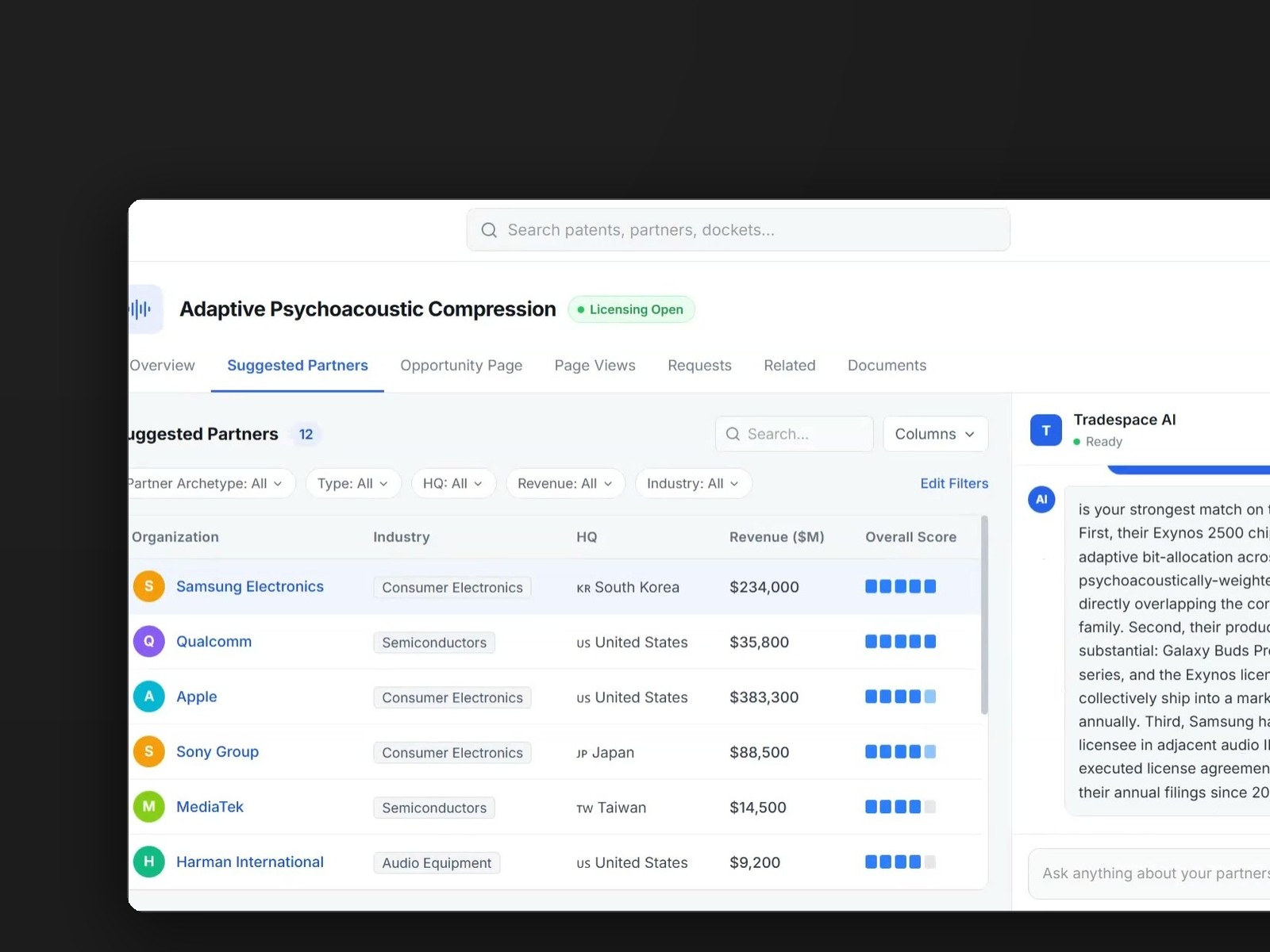
- AI-assisted analytics at portfolio scale. Segmentation, claim mapping, competitive overlap, jurisdiction strategy refresh — each runs as a built-in capability inside the workflow.
- Operating economics designed for growth-stage scale. Deployment in weeks. Pricing tuned for teams of one to ten. The leverage of an enterprise IP function with the operating profile a growth-stage company can actually absorb.
The shorthand: the operating infrastructure of a Fortune 500 IP function, designed for the team size and economics of a growth-stage company.
How to implement strategic IP management in practice
For a team running an administrative IP function and aiming to operate strategically, the implementation arc below has been the fastest path to durable change.
Phase 1: Assessment (months 1-2)
The first two months establish honest baseline.
- A complete asset inventory across all IP asset classes and outside firms
- An operating model audit identifying where the function operates on heroics versus on systems
- A stakeholder reporting review covering what gets produced, what gets read, and what decisions get informed
- A documented gap between current operating reality and strategic potential
Phase 2: Foundational investment (months 3-9)
Months three through nine build the foundation for strategic operations.
- System of record consolidation across IP asset classes
- Capture process restructured around AI-assisted inventor workflow
- Outside counsel rationalization with on-demand channels absorbing routine volume work
- Portfolio segmentation, claim mapping, and continuation strategy refreshed
- Governance cadence established with documented meeting structure and outputs
- Reporting infrastructure built with stakeholder-specific views
Phase 3: Strategic operations (month 10 and beyond)
By month ten the function operates strategically rather than administratively.
- IP function participates in product roadmap reviews and competitive landscape discussions
- Quarterly portfolio strategy reviews with product, finance, and the executive team
- Continuous capture from the inventor workflow
- Continuous AI-assisted analytics feeding strategic decisions
- Diligence-ready outputs available on demand
- Annual strategic review with the executive team
Common implementation pitfalls
The pitfalls below recur across implementations.
- Treating the shift as a strategy exercise rather than an operating model exercise. Strategy documents do not produce operational change. The operating model is the deliverable.
- Compressing the timeline. Strategic operating models take six to twelve months to build. Compressing produces partial implementations that revert under pressure.
- Sequencing failures. Trying to rationalize outside counsel before consolidating the system of record. Trying to build reporting before defining the data model. Sequence the foundational work first.
- Underinvesting in stakeholder communication. The improvements stay invisible to product, finance, and the executive team. The function’s strategic positioning does not change because the stakeholders do not see the change.
- Allowing the function to revert under pressure. The new operating cadence holds in normal weeks. Firefights surface and the cadence slips. Within two quarters, the function is back to the operating model the work was supposed to replace. Defending the cadence is the IP leader’s job.
Measuring strategic IP management effectiveness
The metrics below tell the executive team whether the IP function is operating strategically or just executing activity.
- Coverage ratio against active product line. Percentage of currently shipping or planned products covered by at least one Core Defensive claim. Trending up.
- Time from invention disclosure to filed application. A strategic function moves in days to weeks. An administrative one moves in months.
- Per-filed-patent outside counsel cost. Direction matters more than absolute number. Trending down as flat-fee channels absorb routine work.
- Diligence response time. From a board ask to a complete export package. Trending shorter over time.
- Stakeholder satisfaction. Are product, finance, and the executive team asking for IP function output. Pull is the indicator of strategic operations.
- IP function defensibility in budget cycles. Subjective but consequential. Does the function defend its budget on strategic outcomes or on activity counts.
Building your strategic IP management framework
For a team running an administrative function, the sequence below has been the fastest path to strategic operations.
- Run the honest assessment first. Until the operating gap is documented, the work runs against the wrong target.
- Build the system of record before optimizing anything else. The foundation enables everything else.
- Restructure the capture process to live in the inventor’s workflow. This is the single highest-leverage process improvement.
- Shift routine prosecution work to flat-fee channels. The economic and strategic case is overwhelming.
- Build reporting infrastructure that produces stakeholder-specific views. The reporting is what makes the function legible to the people deciding its resources.
A pressure-test for your current IP management posture
The questions below are diagnostic. The honest answers tell an IP, legal, or operating leader where the function is operating strategically and where it is operating administratively.
- For every product currently shipping, can you point to the IP protection — patents, trademarks, trade secrets, contract terms — that secures the position?
- If a key inventor left next month, would the company retain ownership of every patentable invention they produced during their tenure?
- For every prosecution decision made last quarter, can you point to documented strategic rationale?
- When did you last contribute to a product roadmap review with IP coverage and competitive landscape input?
- If a fundraise or M&A diligence sprint started tomorrow, how many weeks separate the current state of the IP function from a clean export package?
The takeaway
Intellectual property management at growth-stage IP-intensive companies has moved from a back-office function to a strategic discipline. The IP profile materially affects valuation, fundraising, M&A outcomes, and competitive positioning. The function that operates strategically produces compounding value; the function that operates administratively produces overhead.
The shift is operational, not philosophical. The IP teams that operate strategically run on integrated systems of record. They capture innovations at the inventor’s workflow. They protect with senior judgment at flat-fee economics. They scale through portfolio compounding rather than through accumulation. They report in stakeholder-specific views. They govern explicitly. The work is real. The strategic positioning that follows is real too.