Emerging Patent Intelligence Software for Strategic IP Teams
June 4, 2026Key Takeaways
The patent intelligence software category has fragmented further over the past two years. AI-native platforms, integrated portfolio management systems, and traditional analytics tools all market themselves as patent intelligence and solve different problems.
The legacy enterprise systems — Anaqua, Clarivate, CPA Global — are still operationally useful for Fortune 500 IP departments. They are increasingly mismatched to the operating economics of growth-stage IP teams.
The new generation of platforms emphasizes integration over feature breadth. The differentiating capability is not what the platform can do — it is what the platform does inside the team’s actual workflow.
AI-native capabilities have shifted from differentiator to baseline expectation. The question for IP leaders is no longer whether to use AI in patent intelligence, but whose AI, with what verification paths, integrated into which workflow.
The strongest operating models in 2026 combine portfolio management, prosecution execution, and competitive intelligence in a single platform — replacing the historical stack of point tools with one unified operating system.
Evaluation should ground in outcome metrics, not feature counts. The platforms that produce different filing decisions, faster diligence response, and continuation strategy that adapts to landscape shifts are the ones earning their cost.
Why the category looks different than it did three years ago
Patent intelligence software has been a category for thirty years. The fundamentals — search and retrieval, landscape analysis, competitive monitoring — have not changed. What has changed materially in the last two to three years is the operating context the software has to fit into.
Three shifts drove the change. First, AI-assisted analysis compressed work that used to require analyst-hours into operations that run in minutes. Second, the operating economics of IP-intensive growth-stage companies stopped supporting the stitched stack of point tools that worked at Fortune 500 scale. Third, the integration of competitive intelligence with portfolio management and prosecution execution moved from a “nice to have” architectural pattern to an operating necessity.
The result is a category in transition. Legacy enterprise platforms remain capable but increasingly expensive relative to the operating leverage they produce at growth-stage scale. New entrants emphasize AI-native architecture, integrated workflows, and operating economics that fit growth-stage IP teams. Traditional analytics tools have added AI features but mostly retained the standalone-tool operating pattern.
This guide covers how strategic IP teams should think about the category in its current state. It is aimed at IP leaders at IP-intensive growth-stage companies — Series B to pre-IPO — evaluating platforms as part of a broader operating model investment.
What strategic IP teams actually need from intelligence software
The strongest IP teams treat intelligence software as a component of the broader operating system, not as a standalone capability. The needs that scale across most strategic IP functions:
- Portfolio intelligence, not just landscape intelligence. The team needs to understand its own portfolio — coverage, gaps, claim breadth, continuation status — at least as well as it understands the broader landscape. Tools that produce excellent landscape analytics but ignore the team’s own portfolio leave half the strategic surface uncovered.
- Competitive intelligence connected to filing decisions. Monitoring competitors is useful when the monitoring changes filing strategy, continuation decisions, or product roadmap conversations. Monitoring that produces reports nobody acts on is operational theater.
- Workflow integration with prosecution execution. Intelligence that surfaces inside the platform where prosecution happens produces decisions. Intelligence that lives in a separate platform produces translation work.
- AI-assisted analysis with verification paths. AI is now baseline. The differentiator is whether the AI output comes with the underlying patents, claims, and reasoning attached, so the team can validate before acting.
- Reporting in the language stakeholders use. Board members do not want technology classification heat maps. Product teams do not want competitor filing trend lines. Finance does not want claim landscape visualizations. The intelligence has to produce stakeholder-specific output, not generic dashboards.
- Diligence-ready exports. When fundraise, M&A, or partnership diligence hits, the platform should produce clean export packages combining portfolio data, competitive context, and prosecution history in hours rather than weeks.
Each of these is an operating-model need. The platform either supports the operating model or adds friction to it. The evaluation question is which.
The shifts that have reshaped the category
The category has changed in five specific ways that matter for evaluation in 2026. Each is observable; none is hypothetical.
AI-native architecture replacing AI-bolted-on
The first wave of AI in patent intelligence was features added to existing platforms — an AI summarization button, an AI search box, an AI-generated landscape overview. The capabilities worked but operated as adjuncts to the underlying architecture, with limited integration into the platform’s core workflow.
The current wave is AI-native architecture: platforms designed from the ground up around language model capabilities. AI is not a feature; it is the operating substrate. The implications are substantial — queries that previously required navigating multiple search interfaces now run as natural language requests, analyses that previously required dedicated reports now generate inside the workflow, and the verification paths between AI output and underlying data are tighter because the architecture was designed to support them.
For evaluation purposes, the distinction matters operationally. AI-bolted-on platforms produce AI features. AI-native platforms produce AI workflows. The difference shows up in how the team actually uses the tool day-to-day.
Integration over feature breadth
The historical operating pattern for an IP function at growth-stage scale was a stack of point tools: docketing system, annuity provider portal, analytics platform, search tool, internal spreadsheets bridging the gaps. Each tool was excellent at its narrow function. The integration was a manual effort that consumed substantial team capacity.
The shift in 2026 is toward integrated platforms that handle multiple operating functions inside one system. The competitive question for emerging platforms is increasingly not “what features does this tool have” but “what other tools does this tool replace.” A platform that handles portfolio management, competitive intelligence, and prosecution execution in one workflow replaces three or four point tools and the manual integration between them.
The economic implication is meaningful. A team running on five point tools pays five platform licenses, maintains five vendor relationships, and absorbs the operating cost of the integration gaps. A team running on one integrated platform pays one license and reclaims the integration time for strategic work.
Operating economics tuned for growth-stage scale
The legacy enterprise platforms were built for Fortune 500 IP departments. Their pricing, implementation timelines, and operating models reflect that customer base. $50,000+ implementations, multi-month deployments, dedicated administrators, and feature footprints designed for IP teams of 20+.
The growth-stage operating economics are different. A Series C company with 200 patents, a three-person IP team, and an outside counsel spend of $700,000 does not have the budget, the implementation bandwidth, or the team headcount to absorb a Fortune 500-grade platform deployment. The emerging platforms target this operating profile explicitly — faster deployment, modular pricing, designed for teams of one to ten rather than teams of twenty plus.
This is not a quality argument. The enterprise platforms remain capable at what they do. The match between the platform’s operating economics and the customer’s operating reality is what determines whether the platform produces leverage or overhead.
Bundled legal services
The historical assumption was that software and legal services are separate purchases. The team buys software for portfolio management; the team contracts with outside counsel for filings, office actions, and continuation work. The two streams operate independently.
The emerging pattern is platforms that bundle on-demand legal services with software in a single operating system. The same platform that handles portfolio management also provides senior patent attorney capacity for filings, drafting, and office action responses at flat-fee economics. The boundary between “software” and “legal services” dissolves because both are part of the same operating function.
For IP leaders evaluating platforms, the bundle changes the value calculation. Comparing a software-only platform against a software-plus-legal-services platform on software features misses the point. The right comparison is total cost of running the IP function under each operating model.
Outcome metrics replacing feature metrics
The evaluation pattern has historically been feature-based. Demo, feature checklist, capability comparison. Pick the platform that demonstrates the most capabilities.
The pattern that produces better outcomes is outcome-based. What filing decisions did the team make differently because of the platform. How fast did the diligence response produce. Did continuation strategy actually shift in response to insights. Outcome-based evaluation often produces different platform choices than feature-based evaluation. The platforms with the longest feature lists are not always the ones that produce the most operational change.
Where emerging platforms commonly fall short
The new generation of platforms is not uniformly better than the legacy ones. The failure patterns cluster.
- Strong AI features, weak operational integration. The platform’s AI capabilities are genuinely impressive. The operational workflow around them is thin. Output produces reports, not decisions.
- AI without verification paths. The platform’s AI generates summaries and recommendations. The path to the underlying patents, claims, and reasoning is buried. Teams that act on AI output without verification eventually act on a hallucination.
- Integration claims without integration substance. The platform markets itself as integrated but the operational reality is several distinct modules with limited data flow between them. The integration is described, not built.
- Lack of customization to company-specific operating models. The platform works well for a generic IP function. The specific company has decision rights, reporting requirements, or workflow patterns the platform does not support. The team adapts to the platform rather than the platform adapting to the team.
- Aggressive AI claims that erode trust on first contact. The platform demonstrates AI capabilities that look impressive in demo and produce questionable output in actual use. Once trust erodes, the team stops using the AI features regardless of underlying capability.
What to evaluate in patent intelligence platforms in 2026
The evaluation framework below produces consistent signal across the platforms most growth-stage IP teams will consider. It is outcome-oriented; feature comparisons are an input, not the conclusion.
Operating workflow fit
The first evaluation pass is workflow fit. Map the team’s current operating workflow — how disclosures move, how filings get drafted, how prosecution decisions get made, how reporting reaches stakeholders. Then ask, for each major workflow step, whether the platform fits in cleanly or adds friction. Platforms that require the team to leave the platform for adjacent work fail the workflow test.
AI verification paths
For every AI-generated output the platform produces, the team should be able to drill into the underlying patents, claims, and reasoning in two clicks or fewer. Platforms that hide the chain of reasoning behind the AI output are not safe for high-stakes decisions. Platforms that surface the verification paths produce AI output the team can act on with confidence.
Portfolio data ownership
Where does the company’s portfolio data live, and who has ownership over it. Platforms where the data lives in the vendor’s system and the company has limited export capability create lock-in risk. Platforms where the company owns the data, with structured export available on demand, preserve operational flexibility.
Total cost of operating model
Compare not platform pricing in isolation but total cost of the operating model the platform produces. Software-plus-legal-services bundles often have higher software pricing and lower total operating cost when the legal services replace expensive hourly outside counsel work. The right metric is total IP function cost, not platform line item.
Outcome metrics in customer references
Ask customer references about outcomes, not features. How many filing decisions per quarter are different because of the platform. How fast does the diligence response produce. Did continuation strategy actually shift. The customers that produce outcome answers are running operating models that produce outcomes. The customers that produce feature answers are running operating models that produce reports.
Vendor stability and roadmap
The category is in transition. Some emerging platforms will scale; others will not. Evaluate vendor financial position, customer concentration, roadmap clarity, and product velocity. The cost of platform churn is operational, not just financial.
How Tradespace approaches patent intelligence
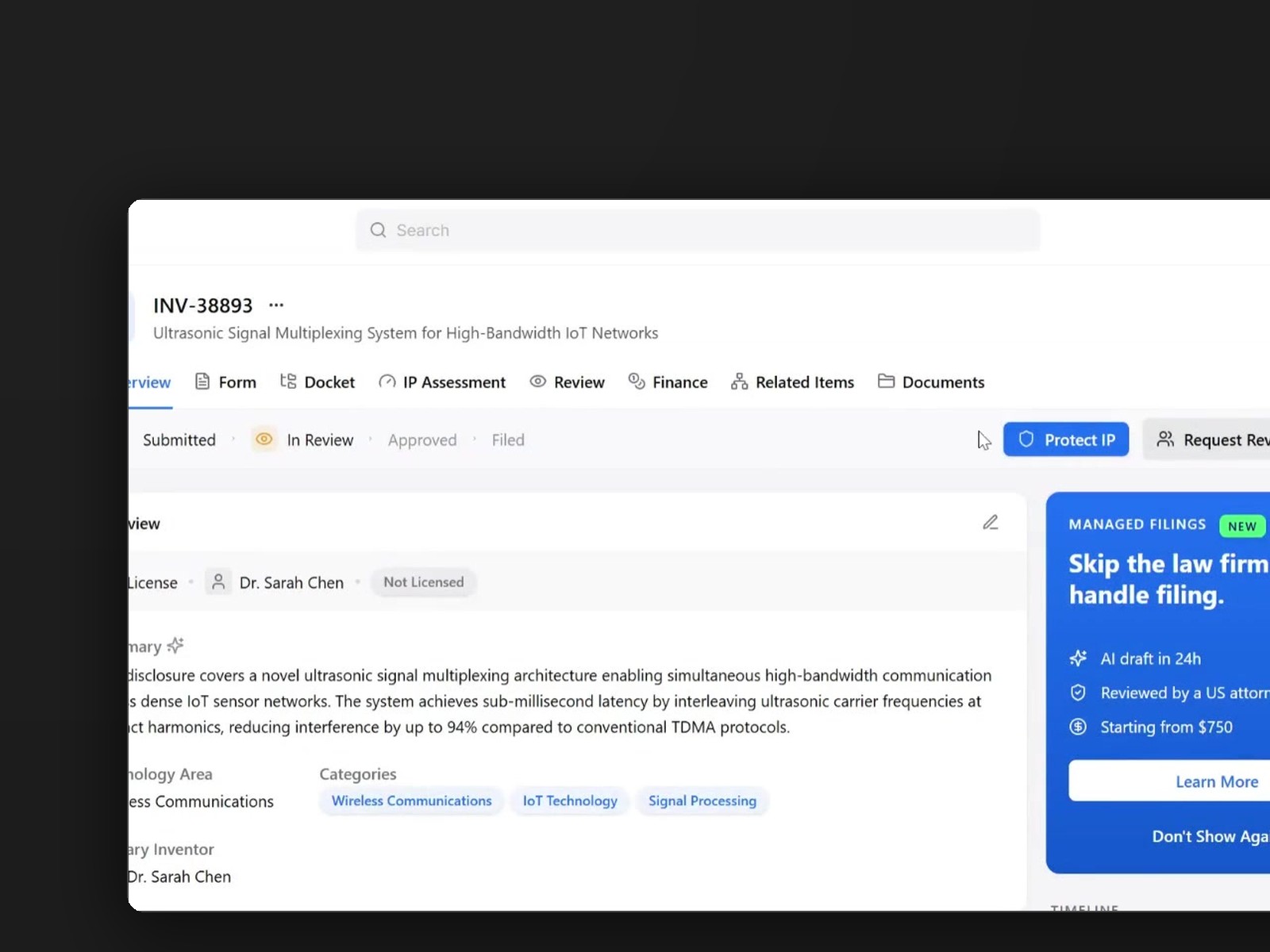
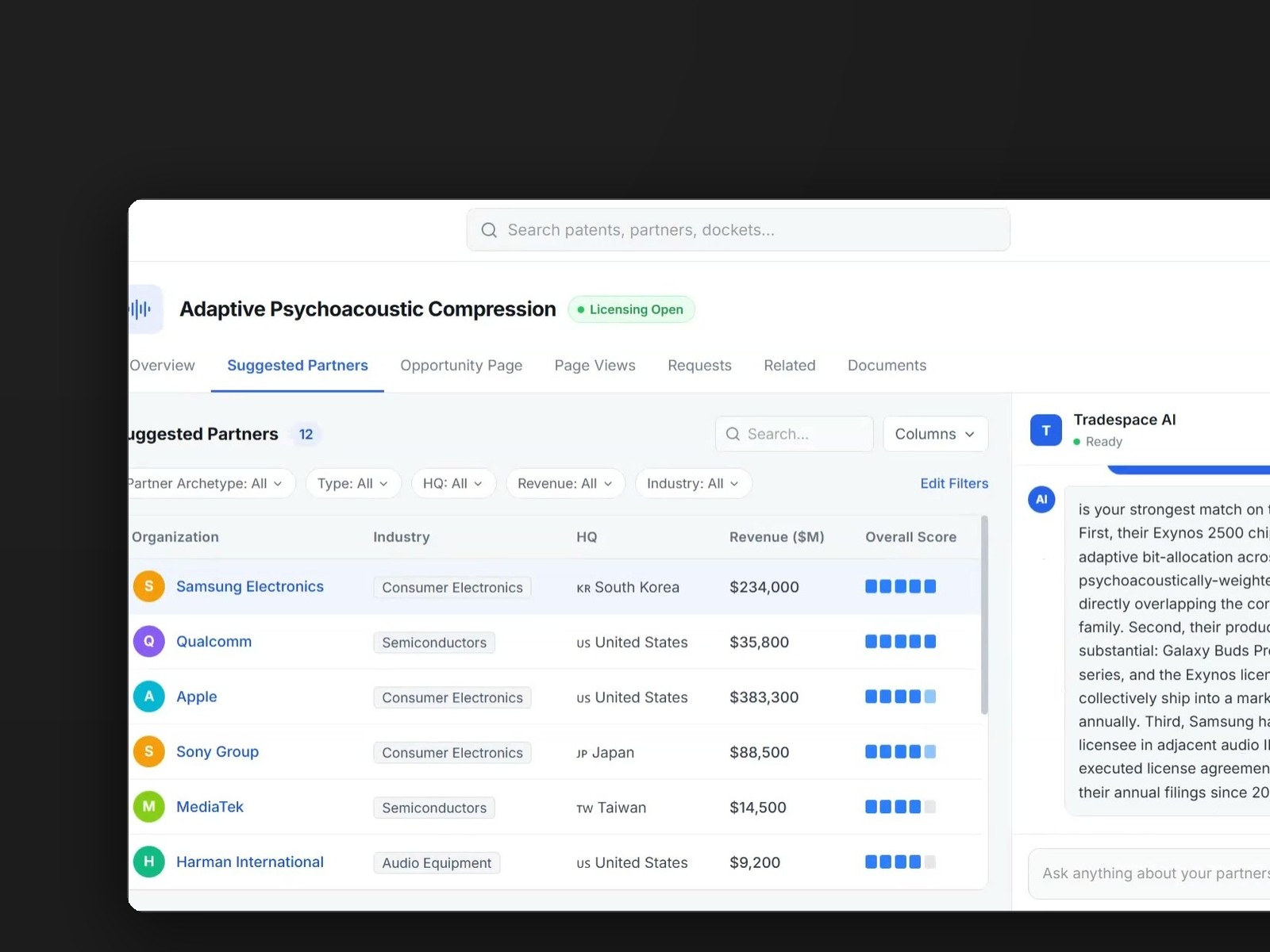
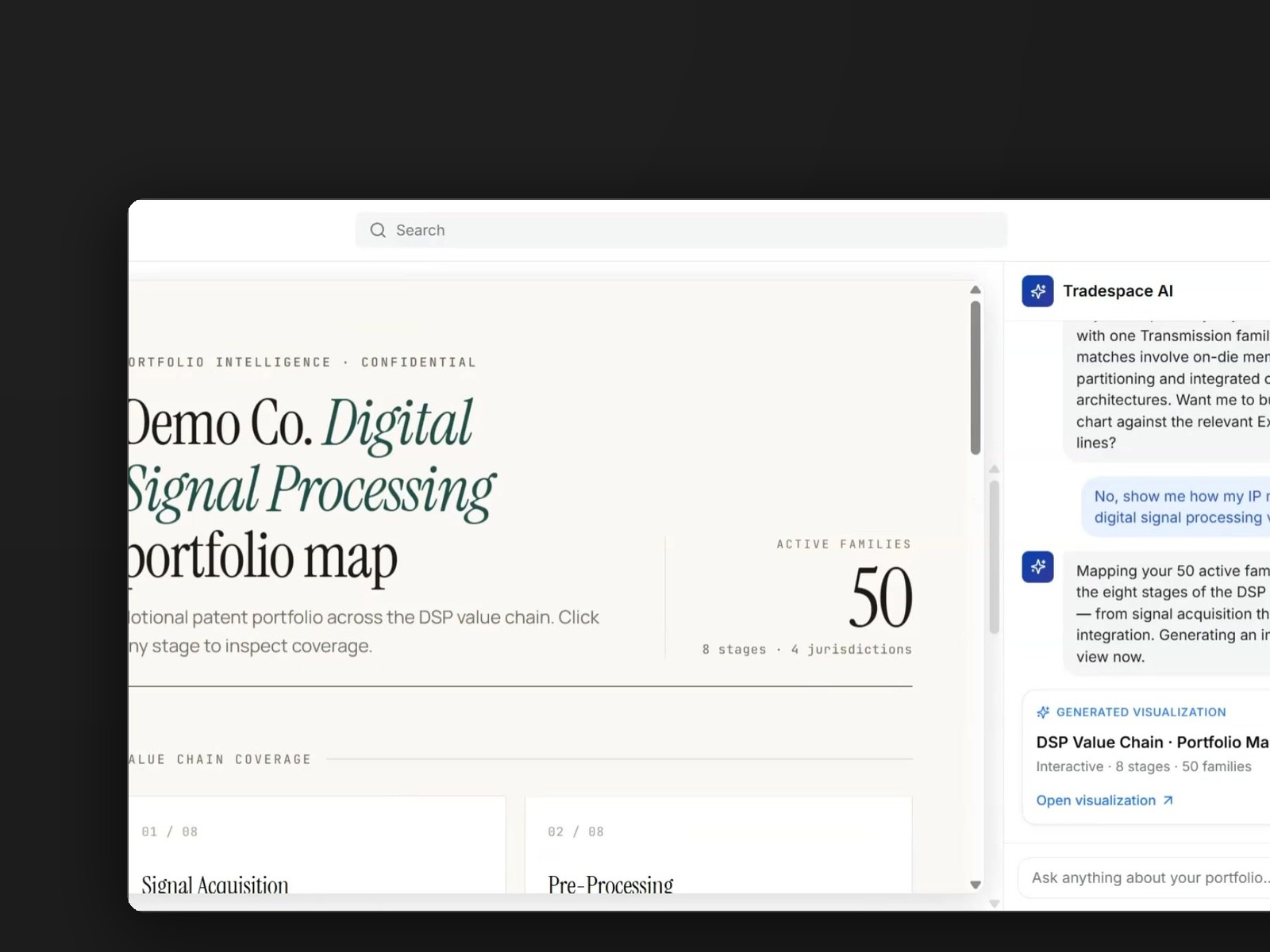
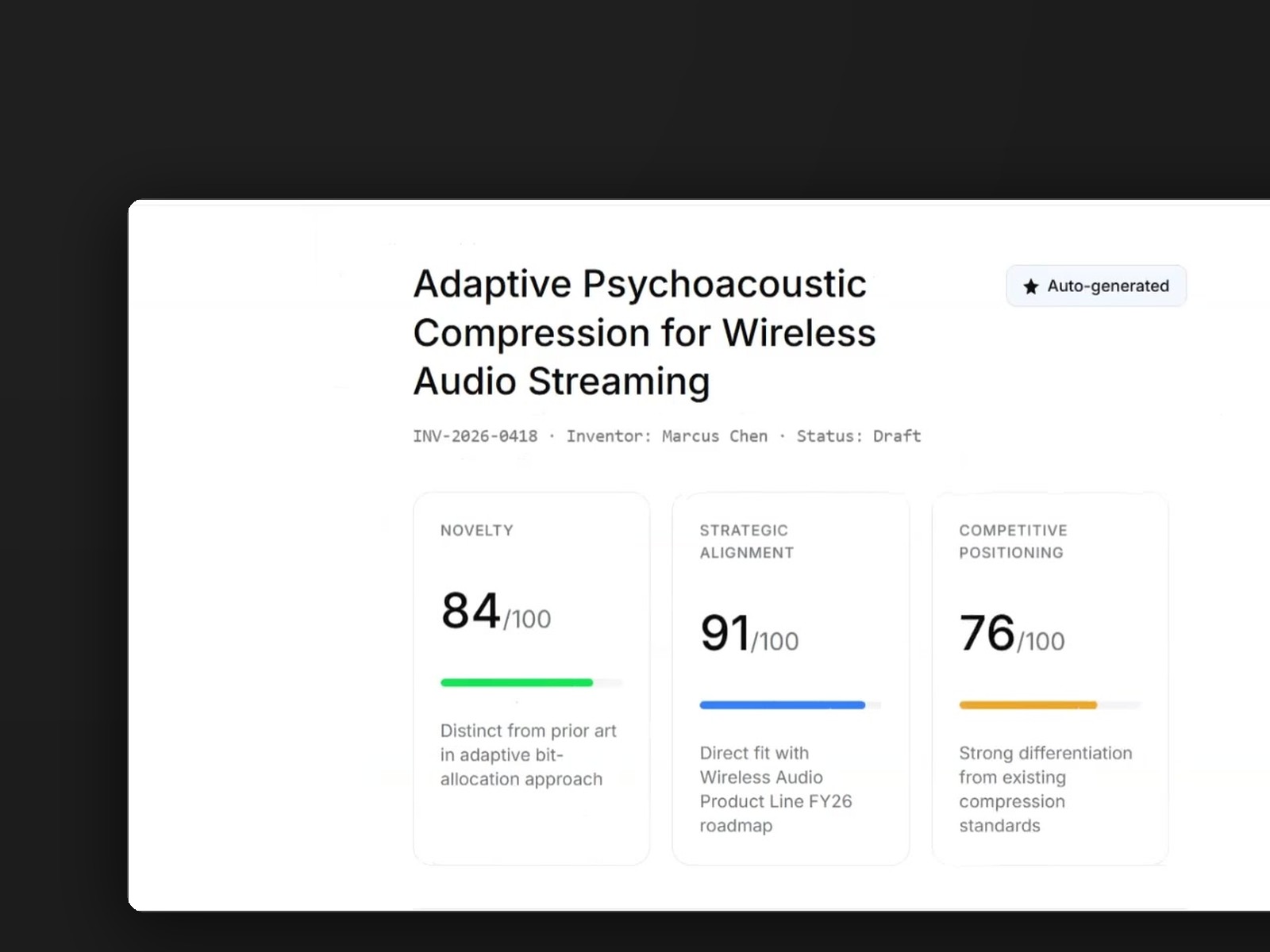
Tradespace is built around the operating model the new generation of platforms is converging toward — integrated portfolio management, on-demand patent attorneys, and AI-assisted analytics in a single operating system. The integration matters because the alternative — separate portfolio software, separate firm relationships, separate analytics tools — produces the operating friction that the integrated model is supposed to eliminate.
What this enables operationally:
- Portfolio management, prosecution execution, and competitive intelligence in one workflow. The IP leader works in one platform rather than five. The team’s time goes to strategic work rather than integration work.
- AI-native architecture, not AI features bolted on. AI is the operating substrate of the platform, not a sidebar feature. Natural language queries against the portfolio and the broader landscape are first-class operations.
- On-demand senior patent attorneys at flat-fee economics. A senior patent attorney drafts and files a utility application in under five days for flat fee. The work happens inside the platform with full visibility to the IP team.
- AI-assisted analysis with verification paths. Every AI output surfaces with the underlying patents, claims, and reasoning attached. The team can validate before acting.
- Designed for growth-stage operating economics. Implementation in days, not months. Pricing tuned to teams of one to ten rather than teams of twenty plus. The leverage of an enterprise platform with the operating profile a growth-stage team can actually absorb.
- Reporting at every stakeholder cadence. Board coverage maps, CFO spend dashboards, product team coverage views, diligence-ready exports. Each stakeholder gets the view that fits their decision context.
The shorthand: the operating infrastructure of a Fortune 500 IP function, designed for the team size and economics of a growth-stage company.
How to evaluate and implement a patent intelligence platform
For a team selecting a platform as part of a broader operating model investment, the implementation arc below produces consistent results.
Phase 1: Operating model definition (months 1-2)
Before platform evaluation begins, the operating model has to be documented.
- Current workflow mapping across portfolio management, prosecution execution, and competitive intelligence
- Stakeholder reporting requirements and current production cost
- Decision rights documentation — who decides on filings, continuations, abandonments, outside counsel allocation
- Total cost of current operating model — software, outside counsel, internal headcount, integration time
- Strategic outcomes the platform should produce, beyond features
Phase 2: Platform evaluation (months 2-4)
Months two through four run structured platform evaluation against the documented operating model.
- Shortlist of three to five platforms based on operating profile match
- Workflow fit assessment for each platform
- AI verification path review
- Customer reference calls focused on outcome metrics
- Total cost modeling for the operating model each platform produces
Phase 3: Implementation and operating shift (months 4-9)
Months four through nine implement the selected platform and complete the operating model transition.
- Platform configuration and data migration
- Outside counsel rationalization where the platform’s legal services capacity changes the make-or-buy calculation
- Workflow transition with phased adoption
- Reporting infrastructure rebuild
- Stakeholder onboarding and cadence establishment
Phase 4: Continuous operation (month 10 and beyond)
By month ten the platform should be producing measurable operating leverage.
- Quarterly outcome review against the strategic outcomes defined in phase one
- Continuous refinement of workflow and reporting
- Annual platform performance review including total cost trajectory
Common implementation pitfalls
The pitfalls below recur across platform implementations.
- Selecting based on features rather than on operating model fit. The platform with the most features is not the platform that produces the most operating change. The fit between platform and existing workflow is the predictor of value.
- Skipping the operating model documentation in phase one. Without explicit documentation of current workflow, decision rights, and stakeholder requirements, the platform evaluation reduces to feature comparison. The result is a platform purchase rather than an operating model decision.
- Underestimating the change management cost. Platforms produce operating change. Operating change produces resistance. Teams that have run on the legacy operating model for years do not automatically adopt the new workflow. The change management work is real.
- Ignoring the legal services bundle in the cost comparison. Comparing platforms on software pricing alone misses the operating cost in adjacent areas — outside counsel spend, integration time, reporting cost. Total operating model cost is the right comparison.
- Accepting AI output without verification. Teams that adopt new AI capabilities without building verification discipline eventually act on AI output that is wrong. The verification habit has to be built into the workflow from day one.
Measuring platform effectiveness
The metrics below tell the executive team whether the platform is producing strategic compounding or just executing operational activity.
- Time from operating question to operating answer. Diligence-ready export in hours. Board coverage report in a day. Ad hoc executive question in minutes. Trending shorter over time.
- Number of filing decisions per quarter informed by the platform’s intelligence. A working platform produces measurable input into filing decisions. A theater platform produces reports that do not change outcomes.
- Outside counsel spend trajectory. A platform that includes on-demand legal services should produce a downward trend on per-filing outside counsel cost while filing volume holds steady or increases.
- Stakeholder satisfaction. Are product, finance, and the executive team asking for the platform’s output, or is the IP team pushing it. Pull is the indicator of value.
- Integration time saved. Hours per week the team previously spent on translation between point tools that the integrated platform now eliminates. Trending up as the new operating model takes hold.
Building your platform evaluation
For a team starting a platform evaluation cycle, the sequence below has been the fastest path to a defensible decision.
- Document the current operating model before looking at any platform. Without a documented baseline, the evaluation reduces to feature comparison.
- Define the strategic outcomes the platform should produce, in measurable terms. Faster diligence response. More filing decisions informed by intelligence. Lower per-filing outside counsel cost. The outcomes anchor the evaluation.
- Shortlist platforms based on operating profile match, not on feature breadth. Three to five platforms is the right size.
- Run workflow fit assessments for each shortlist platform. Map the team’s actual workflow onto the platform’s actual capability. Where does it fit cleanly. Where does it add friction.
- Make the decision on total operating model cost, not on platform line item.
A pressure-test for your current platform selection
The questions below are diagnostic. The honest answers tell an IP leader whether the current platform is producing leverage or absorbing operating capacity.
- For every report your team produces, can you point to the decision it informed in the last quarter?
- How much time per week does the team spend translating data between point tools?
- When was the last time the platform’s AI output produced a decision the team would not have made without it?
- If a new IP leader joined next month, could they become operationally productive on the current platform within sixty days?
- If you replaced the current platform stack with one integrated system, what would the total operating model cost difference be?
The takeaway
The patent intelligence software category has changed materially in the last three years. AI-native architecture, integrated platforms, growth-stage operating economics, and bundled legal services have shifted the evaluation framework from feature comparison to operating model match. The platforms that produce strategic compounding are the ones that fit the team’s actual workflow, surface AI output with verification paths, and integrate the operating components that previously required separate point tools.
The shift is not about picking the best platform. It is about picking the right operating model and selecting the platform that supports it. The IP teams that get this right reclaim operating capacity, produce faster diligence response, and make filing decisions informed by intelligence that previously lived in reports nobody read. The teams that pick platforms on feature counts end up with stacks of capable tools and operating models that look the same as before the purchase.
What is emerging patent intelligence software?
Emerging patent intelligence software refers to the new generation of platforms that combine AI-native analytics, integrated workflow, and operating economics tuned for growth-stage IP teams. The category sits between legacy enterprise platforms (built for Fortune 500 IP departments) and standalone analytics tools (focused narrowly on landscape analysis). The defining characteristics are AI-native architecture, integration across portfolio management and prosecution execution, and accessibility for IP teams of one to ten rather than twenty plus.
How is this different from legacy IP management software?
Legacy IP management software was built for Fortune 500 IP departments with dedicated teams of 10+ to operate the software. The software is capable but requires $50,000+ implementations, months of deployment, and ongoing administration. Emerging platforms are designed for the operating economics of growth-stage IP teams — fast deployment, modular pricing, and workflow patterns that fit lean teams rather than enterprise functions.
Should I switch from my current platform?
The right answer depends on the platform’s fit with the team’s operating model. If the current platform produces friction that consumes meaningful team capacity, if the integration gaps require manual work that does not scale, or if the platform’s operating economics no longer fit the team’s stage, switching makes sense. If the current platform fits the workflow and the operating model is producing the strategic outcomes the team needs, switching is operational disruption without clear payoff.
How long does platform implementation actually take?
Emerging platforms target implementation in days to weeks rather than the months typical of legacy enterprise systems. Real implementation timelines depend on data migration complexity, outside counsel rationalization, and stakeholder onboarding. For a growth-stage IP team with 200-500 active assets, a well-run implementation produces the platform’s core operating value within 60-90 days and full operating model transition within 6-9 months.
What's the role of AI in emerging patent intelligence platforms?
AI is the operating substrate of the new generation of platforms, not a sidebar feature. Capabilities include AI-structured inventor disclosures, AI-assisted prior art research, AI-generated competitive analysis, natural language querying of portfolios, and AI-summarized stakeholder reports. The verification paths between AI output and underlying data are the critical evaluation point — platforms that surface the underlying patents, claims, and reasoning produce AI output the team can act on with confidence.
How do I evaluate vendor stability in an emerging category?
The category is in transition. Some emerging platforms will scale; others will not. Evaluation should consider vendor financial position, customer concentration, roadmap clarity, product velocity, and customer reference patterns. The cost of platform churn is operational — data migrations, workflow transitions, stakeholder onboarding all repeat if the vendor exits. Selecting a platform from a vendor with strong fundamentals reduces this risk.
What's the difference between AI-native platforms and AI-bolted-on platforms?
AI-bolted-on platforms added AI features to existing architecture — an AI summarization button, an AI search box. The capabilities work but operate as adjuncts to the underlying workflow. AI-native platforms were designed from the ground up around language model capabilities. AI is not a feature; it is the operating substrate. Natural language queries, AI-assisted workflows, and tight verification paths between AI output and underlying data are first-class operations in AI-native platforms.
Can emerging platforms replace traditional IP management software?
For most growth-stage IP teams, yes. The integrated platforms handle portfolio management, prosecution coordination, annuity management, and competitive intelligence in a single operating system. The legacy enterprise platforms remain operationally appropriate for Fortune 500 IP departments where the team size, budget, and operating profile match. For Series B to pre-IPO companies with IP teams of one to ten, the operating economics typically favor emerging integrated platforms.
How should an IP team think about platform total cost of ownership?
Total cost of ownership includes platform licensing, implementation cost, internal time required to operate the platform, integration cost between this platform and adjacent tools, and the impact on adjacent operating costs like outside counsel spend. Platforms that bundle legal services change the total cost calculation by replacing expensive hourly outside counsel work with platform-included or flat-fee services. The right comparison is total IP function operating cost under each platform option, not platform line item.
What does "strategic IP team" mean in this context?
A strategic IP team is one that operates IP as a value driver rather than as administrative overhead. The team treats the portfolio as a queryable strategic asset, runs competitive intelligence continuously, makes filing decisions informed by both portfolio context and landscape context, and produces stakeholder-specific reporting that connects IP to business outcomes. The distinction from a tactical IP function is in the operating model — strategic IP teams run on systems and cadences; tactical IP functions react to deadlines. The piece on patent intelligence software for competitive analysis covers the competitive intelligence component in more detail.