How to Effectively Manage a Large Patent Portfolio
June 18, 2026Key Takeaways
A large patent portfolio — 500+ active assets across multiple jurisdictions and outside firms — fails for operational reasons more often than for strategic ones. The strategy can be sound and the function still drowns.
The biggest scaling problem is not portfolio size. It is the explosion of decisions that have to be made on a cadence: prosecution direction across families, continuation choices, jurisdiction calls, annuity decisions, claim mapping refreshes.
Multi-firm prosecution coordination is the single highest-leverage operational discipline. Without it, the portfolio becomes a federation of inconsistent prosecution philosophies, each owned by a different firm.
Reporting at scale requires automation. Manual board reports, manual diligence packages, and manual coverage maps are not sustainable past 200-300 assets.
The institutional knowledge problem compounds with portfolio size. A 50-asset portfolio survives the IP leader leaving. A 500-asset portfolio without a real system of record does not.
The teams that operate large portfolios well treat the function as a system, not a heroic effort. The system absorbs personnel changes, product pivots, and competitive shifts. The heroic-effort model does not.
The operational threshold where IP functions break
Patent portfolios scale unevenly. A 50-asset portfolio is operationally trivial. A 100-asset portfolio is manageable with discipline. A 200-asset portfolio requires real structure. By 500 active assets, an IP function that has not invested in operating infrastructure is no longer managing the portfolio — it is reacting to whichever deadline screams loudest this week.
The threshold is not just about volume. It is about combinatorial complexity. A 500-asset portfolio at a growth-stage company typically spans 8-15 jurisdictions, 100-200 patent families, 4-6 prosecution firms, multiple technology areas, and a docket of 80-120 deadlines per month. Every operational discipline that works at 100 assets — manual deadline tracking, ad hoc continuation review, relationship-based outside counsel selection — breaks down somewhere between 200 and 500 assets.
This guide covers the operating model that works at scale. It assumes the reader is running an in-house IP function with 500 to 2,000+ active assets, a team of three to ten people, a multi-firm prosecution footprint, and an executive team that expects the portfolio to be a strategic asset rather than an administrative cost center.
What “managing a large portfolio” actually means
Past 500 assets, portfolio management is fundamentally a systems problem rather than a strategy problem. The strategy work — segmentation, claim mapping, jurisdiction discipline — does not change in nature. What changes is the operational machinery required to execute it consistently across hundreds of families.
The components of a working large-portfolio operating model:
- A unified system of record. Every asset, decision, deadline, spend item, and prosecution artifact lives in one place. The historical alternative — different firms with different portals, internal spreadsheets, email archives — is unsustainable at scale.
- Standardized prosecution philosophy across firms. Every firm working on the portfolio operates under the same playbook for claim drafting, continuation strategy, amendment philosophy, and inventor interview practice. Inconsistency between firms creates a federation of mini-portfolios.
- Automated reporting infrastructure. Coverage maps, spend dashboards, deadline forecasts, and diligence-ready exports get generated on demand, not assembled manually under time pressure.
- A documented decision rights framework. Who decides on continuation filings, who decides on jurisdiction changes, who decides on abandonment candidates, who decides on outside counsel work allocation. Without explicit decision rights, decisions either bottleneck on the IP leader or get made inconsistently by whoever has bandwidth.
- A scale-appropriate stakeholder cadence. Product, finance, R&D, business development, and the executive team all need different views of the portfolio at different cadences. The reporting infrastructure has to support this without becoming a full-time job.
Each of these is a systems decision, not a tactic. The IP teams that operate large portfolios well treat the systems as the leverage, with the tactics layered on top.
The seven disciplines that hold a large portfolio together
The disciplines below are the ones we see consistently in well-operated large portfolios. They are interdependent — weakening any one stresses the others.
Single system of record, owned by the company
The historical operating model for large portfolios is a federation: each prosecution firm runs its own docketing system, the IP team maintains internal spreadsheets that approximate a master view, and the master view is always slightly out of date. At 500+ assets this model produces predictable failure modes — missed deadlines, duplicate work, conflicting prosecution direction, and diligence exercises that take weeks because the data lives in too many places.
The shift required at scale is consolidating onto a single system of record owned by the company. Outside firms continue to do prosecution work, but the master data — every asset, decision, deadline, spend item, document — lives in the company’s system. Firms either work directly in the system or feed data into it on a structured cadence. The IP leader has one view of the portfolio. Diligence exercises produce in hours, not weeks. Personnel changes do not erase institutional knowledge.
Multi-firm prosecution coordination
A 500-asset portfolio typically spans 4-6 outside firms — historical relationships, technology specialization, geographic coverage. Each firm has its own prosecution philosophy. Left uncoordinated, the portfolio becomes inconsistent in ways that show up at enforcement: claim breadth varies wildly across families, continuation hygiene differs by firm, amendment strategy is incoherent across the portfolio.
The coordination discipline is straightforward in description. The IP team writes a prosecution playbook that defines the company’s standards for claim breadth, continuation strategy, amendment philosophy, inventor interview practice, and prior art handling. Every firm working on the portfolio operates under the playbook. The IP team reviews a sample of work from each firm quarterly to confirm consistency. Firms that produce work outside the playbook standards get either re-trained or rotated out.
This is also where outside counsel performance benchmarking earns its scale. With 500+ assets across 4-6 firms, comparable metrics — allowance rate, claim scope at grant, response cycle time, cost per office action — produce reliable signal about which firms are doing strategic work and which are issuing patents efficiently but narrowly.
Continuation strategy as a portfolio-level operating program
At 100 assets, continuation decisions can be made one family at a time, reactively, when the parent allows. At 500+ assets this approach guarantees missed opportunities. The right operating model is a portfolio-level continuation program with explicit rules: every Core Defensive and Core Offensive family carries an active continuation until the product line is mature or the family is closed by design.
Implementing this requires the system of record to surface continuation status across the portfolio, the prosecution playbook to specify the company’s continuation philosophy, and the operating cadence to include a quarterly continuation review. Families without active continuations get flagged. The decision is either “file one” or “document the rationale for not.” Either is acceptable. Drift is not.
Jurisdiction discipline across families
The default-jurisdiction reflex compounds at scale. A 500-asset portfolio that files every PCT family into US, EP, JP, CN, and KR by reflex is burning material foreign filing spend on coverage that does not map to commercial reality. At small scale this is annoying. At large scale it is a six-figure annual line item.
The discipline that scales is a jurisdiction rubric tied to commercial footprint, refreshed annually. The rubric distinguishes core markets (always file), opportunistic markets (file if claim has high commercial value), and exit markets (do not file unless there is a specific competitive or licensing rationale). Every PCT national phase decision routes through the rubric. The savings on a 500-asset portfolio typically run between $150,000 and $400,000 annually, with no meaningful reduction in coverage that matters.
Annuity management as a strategic line item
Annuity spend on a large portfolio typically runs $500,000 to $2 million annually. Treating annuity decisions as administrative — default-to-pay, executed by the annuity provider on the docketed schedule — leaks budget in the same way default-jurisdiction filing does, except more expensively because the decisions repeat over the life of every asset.
The discipline is the one covered in detail in the complete guide to patent annuity payments. A quarterly review cycle that runs two quarters ahead of deadlines, structured pruning candidates surfaced by segmentation, stakeholder escalation for close calls, and reporting that frames annuity work as strategic budget defense rather than cash outflow.
Automated reporting infrastructure
Past 200-300 assets, manual reporting becomes structurally unsustainable. The CFO wants quarterly spend breakdowns. The board wants coverage maps. The executive team wants competitive landscape views. R&D wants to know which inventions converted to filings. M&A diligence exercises want clean export packages. Each of these, produced manually, requires days of work.
The infrastructure required is straightforward but rarely built early. Standard report templates pulling from the system of record on the same data structure. Automated dashboards updated continuously. Diligence-ready export packages generated on demand. The work to build this is real but bounded. The work to keep producing the same reports manually, every quarter, forever, is unbounded.
A scale-appropriate operating cadence
The cadence that works for a 100-asset portfolio — monthly internal docket review, quarterly portfolio review with product and finance, annual board report — does not scale. At 500+ assets, the cadence has to layer in additional touchpoints: weekly multi-firm prosecution coordination, monthly outside counsel performance review, monthly annuity review, quarterly continuation review, quarterly stakeholder rotation across product, R&D, business development, and finance, semi-annual jurisdiction strategy refresh, annual board report.
The cadence is not optional. It is the operating system. Skipping cycles produces the failure modes the cadence is designed to prevent. The discipline is committing to the cadence in advance — calendar holds, owners, documented outputs — rather than running it ad hoc.
Where large portfolio management commonly falls short
The failure patterns below are the ones we see most often when reviewing growth-stage portfolios that have outgrown their operating model. They cluster — a team with one of these problems usually has at least three.
- Federated data, no system of record. Different firms own different slices of the master data. The IP team’s internal spreadsheet is always behind. Diligence exercises take weeks because the data has to be reassembled every time.
- Inconsistent prosecution philosophy across firms. Each firm prosecutes to its own house style. Claim breadth varies wildly across families. Continuation hygiene is excellent at some firms, nonexistent at others. The portfolio looks coherent at the asset level and incoherent at the family level.
- Continuation decisions made one at a time. No portfolio-level continuation program. Families without continuations drift static. By the time the gap is noticed, the parent has issued and the priority window has closed.
- Reactive annuity management. Decisions get made when the annuity provider’s reminder hits. The default outcome is “just pay it.” Pruning happens during budget pressure, not on a quarterly rhythm.
- Reporting that captures activity, not strategy. Quarterly reports show filings, grants, and spend. They do not show coverage ratio against the product line, percentage of portfolio in strategic roles, or spend trend per maintained asset. The function is harder to defend in budget cycles because the metrics do not tell a strategic story.
What to look for in large portfolio management in 2026
The fundamentals of operating discipline at scale do not change much. The operational environment in 2026 reshapes how the work gets executed.
AI-assisted portfolio analytics
The historical objection to running claim mapping, coverage analysis, and competitive intelligence at portfolio scale was cost. With 500+ assets, the analyst-hours required were prohibitive. AI-assisted portfolio tooling reduces the analyst-hour requirement by an order of magnitude. Claim mapping runs against new filings automatically. Coverage gaps surface as the product roadmap updates. Competitive landscape refreshes happen on a schedule rather than as a project.
The IP leader’s role shifts from producing the analysis to validating it and acting on it. The leverage is meaningful — work that used to require a dedicated analyst or an outside consultant now runs in-house on a monthly cadence.
Outside counsel rationalization toward flat-fee models
The volume of routine prosecution work in a 500-asset portfolio — straightforward utility filings, common-rejection office action responses, continuation filings — is substantial. Increasingly, this volume work is moving from traditional hourly engagements to flat-fee, on-demand attorney arrangements. The firms keep the specialized work where their expertise legitimately earns the cost. The volume work runs through faster, cheaper channels.
The economic impact at scale is material. A 500-asset portfolio with 80-120 active prosecution events per year, paying $14,000 average cost per filing under hourly engagement versus $5,000 average cost per filing under flat-fee on-demand, sees seven-figure annual savings without reducing prosecution quality.
Integrated platforms instead of stitched stacks
The historical operating model at scale is a stack of point tools: a docketing system, an annuity provider portal, a separate analytics tool, separate firm portals, internal spreadsheets bridging the gaps. Each tool was excellent at its narrow function. The integration was a manual effort that consumed significant team capacity.
The shift in 2026 is toward integrated platforms that handle docketing, portfolio management, prosecution coordination, analytics, and execution in a single system. The IP leader has one operational view rather than ten. The team’s time goes to strategic work rather than integration work. The institutional knowledge accumulates in the platform rather than dispersing across tools.
How Tradespace approaches large portfolio management
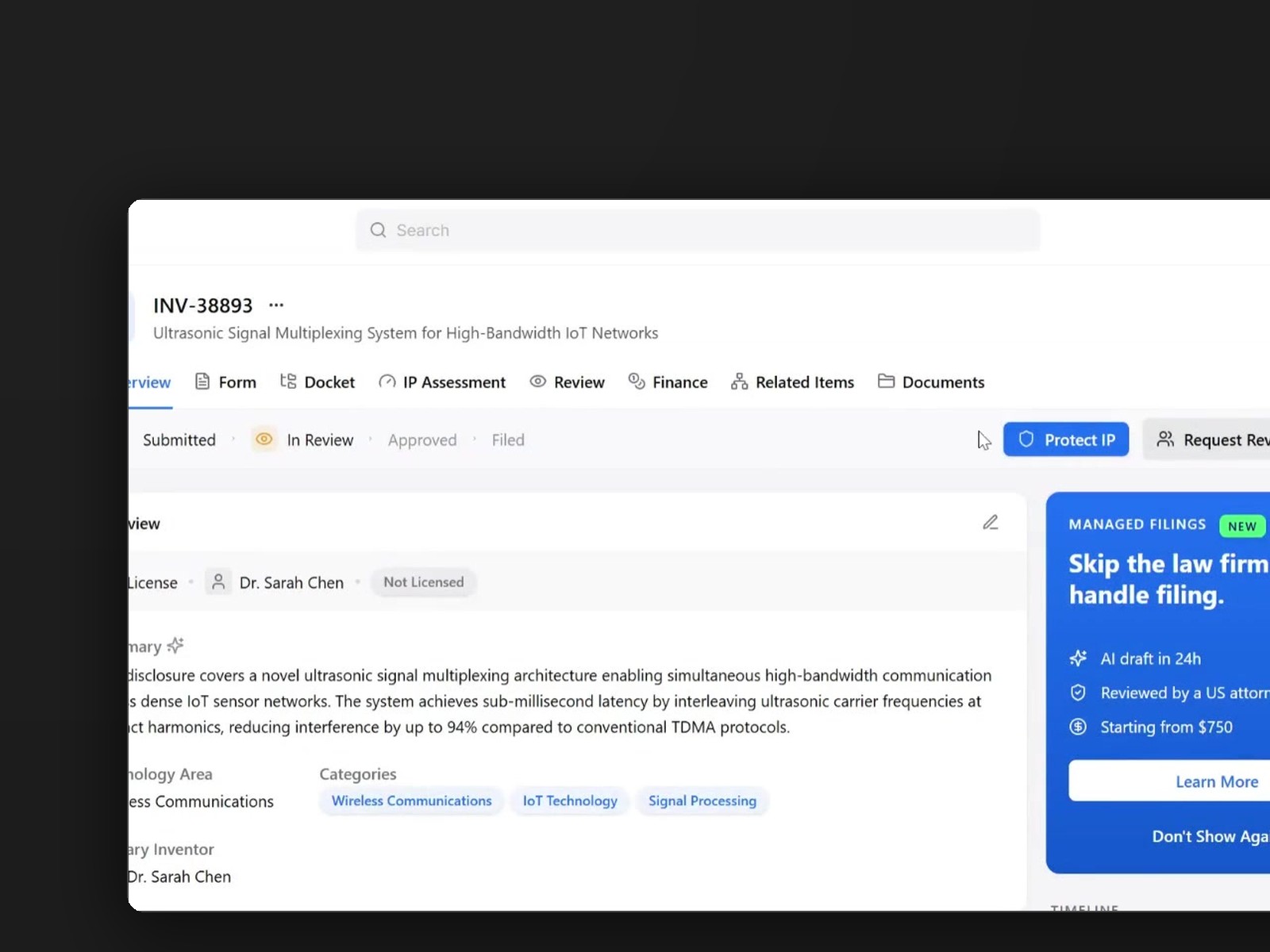
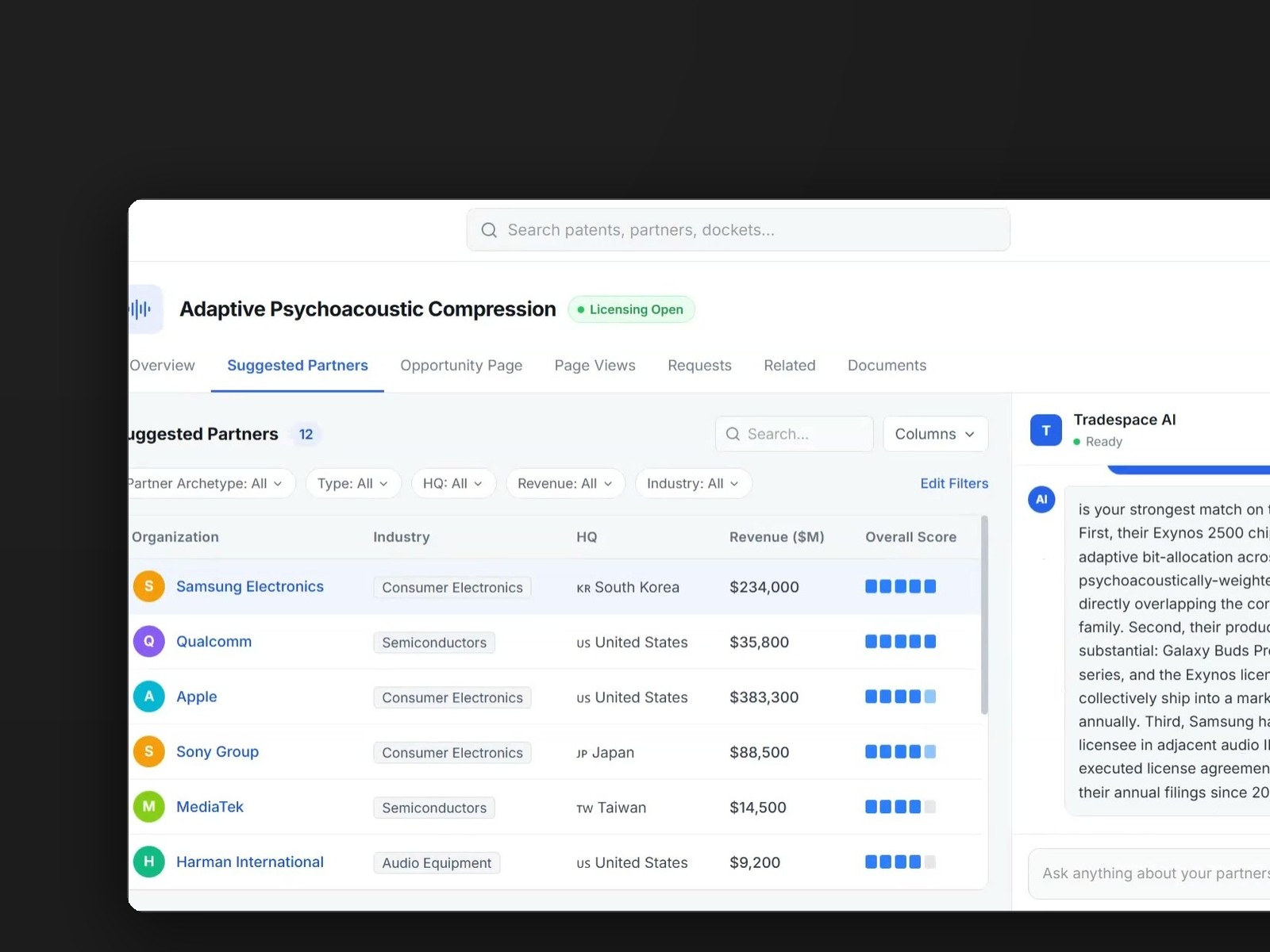
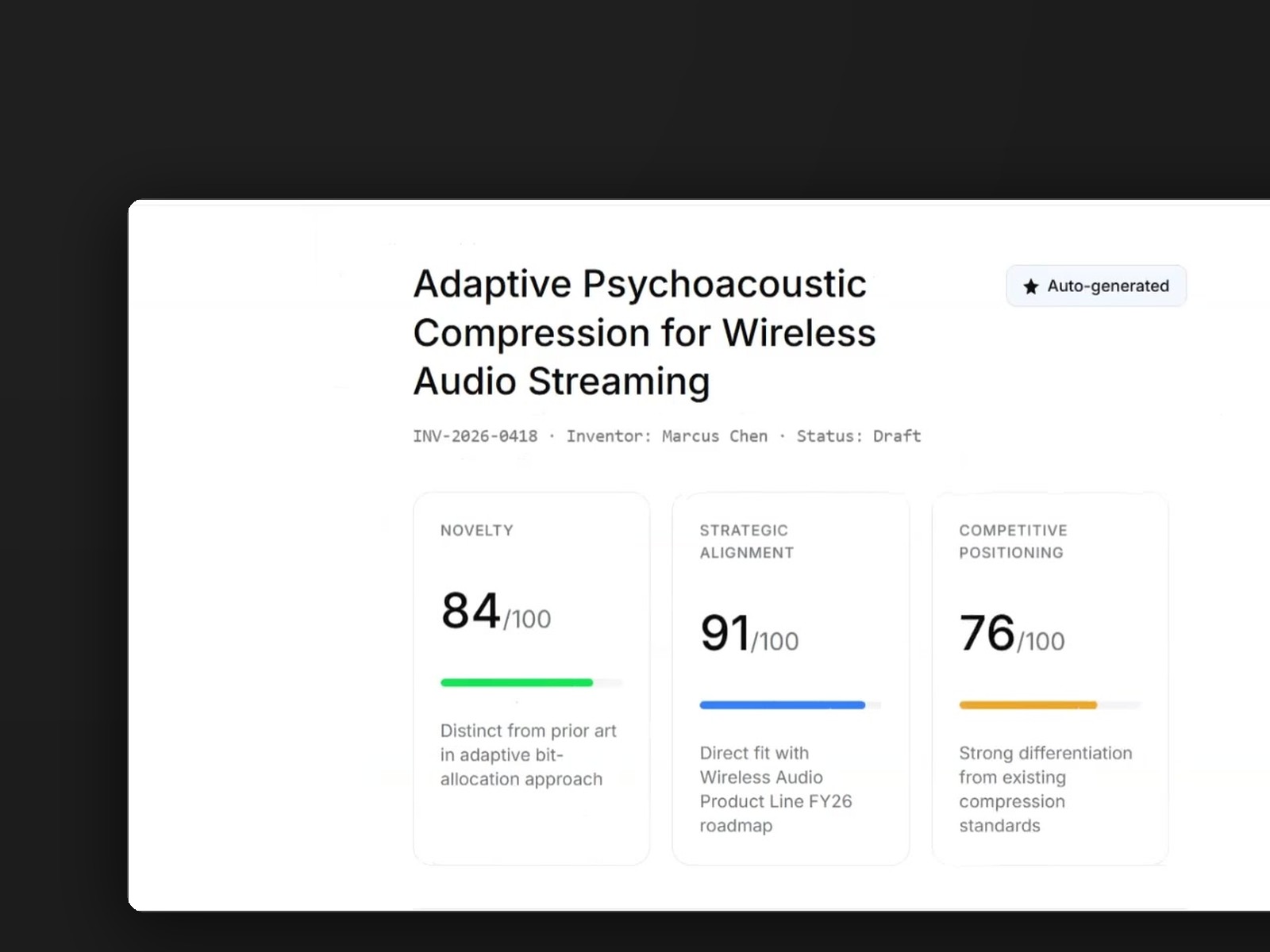
Tradespace was built with the operational realities of multi-firm, multi-jurisdiction portfolios in mind. The platform combines a unified system of record, on-demand patent attorneys for volume work, and AI-assisted portfolio analytics in one product. The combination matters because the alternative — a separate docketing system, a separate firm relationship for volume work, a separate analytics tool — produces the integration problem the operating model is supposed to solve.
What this enables at scale:
- A single source of truth for the full portfolio. Every asset, family, deadline, spend item, and prosecution artifact lives in one system. Outside firms either work in the platform or feed structured data into it. The IP leader has one view, not ten.
- Multi-firm coordination built into the workflow. The prosecution playbook lives in the platform. Firms working in the system follow it by default. Outside firms operating in their own systems get the playbook as part of the engagement.
- On-demand attorney capacity for volume work. A senior patent attorney drafts and files a utility patent in under five days at flat fee. Office action responses on common rejections run through the same channel. Specialized firm engagements stay in place for high-stakes work.
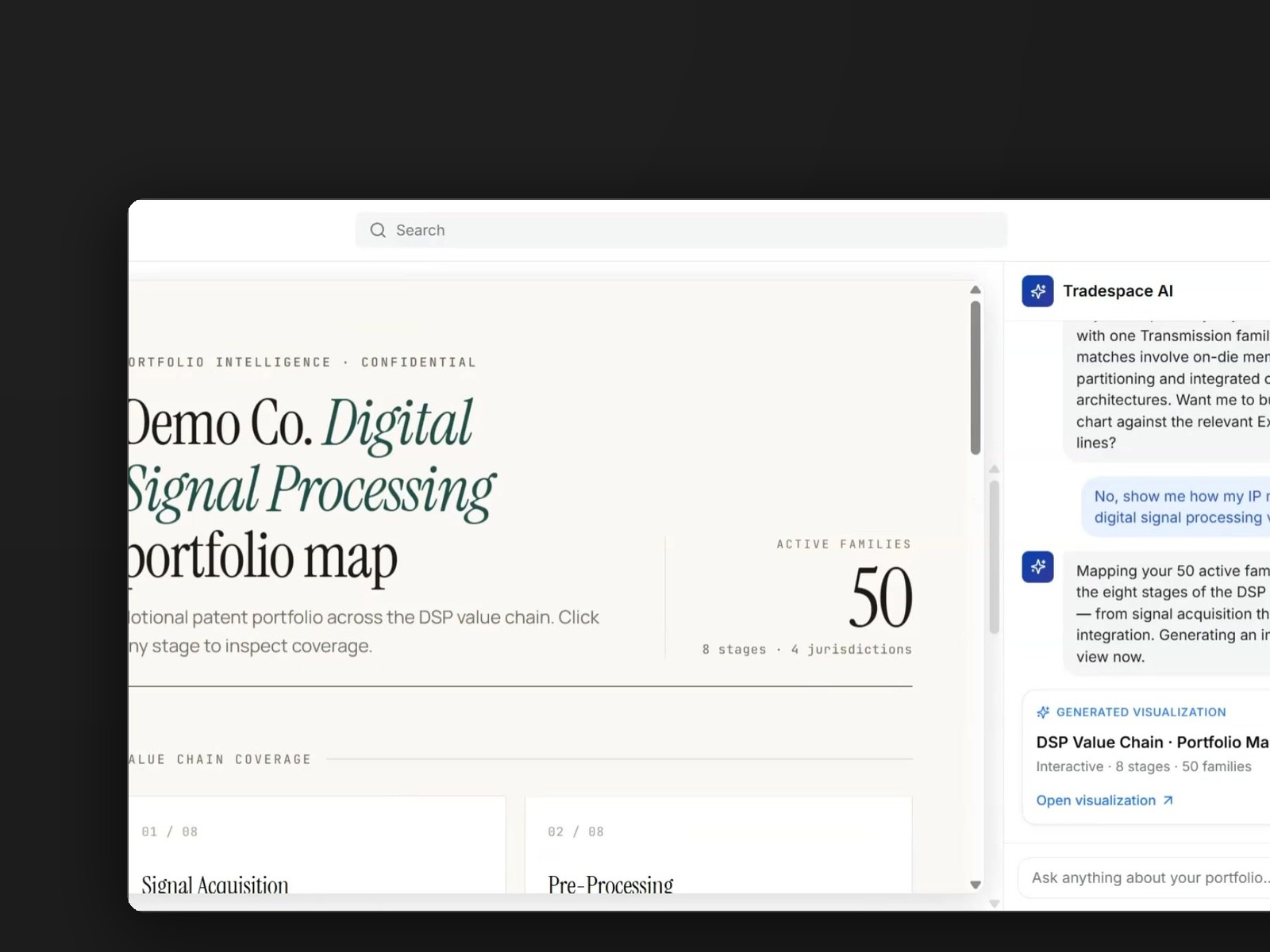
- AI-assisted portfolio analytics. Claim mapping refreshes automatically as new filings issue. Coverage gaps surface as the product roadmap updates. Competitive landscape analysis runs on a schedule rather than as a project.
- Automated reporting at every cadence. Quarterly spend breakdowns, coverage maps, deadline forecasts, and diligence-ready exports generated on demand from the same data structure.
- Documented decision rights and audit trails. Every prosecution decision, continuation call, annuity choice, and abandonment surfaces with rationale captured in the system. Institutional knowledge stays with the company across personnel changes.
The shorthand: the operating infrastructure of a Fortune 500 IP department, designed for the team size and economics of a growth-stage company.
How to implement large portfolio management in practice
For a team running a 500+ asset portfolio on a federated operating model, the implementation arc below is the fastest path to a unified operating system. Compressing it shorter usually means foundation work gets skipped. Stretching it longer means another year of integration heroics.
Phase 1: Assessment (months 1-3)
The first three months are exclusively diagnostic. Nothing structural changes yet.
- A complete asset inventory across all outside firms, jurisdictions, and internal systems
- A prosecution-firm map: who handles which families, what philosophy each follows, how decisions get made and tracked
- A docket reconciliation: where are deadlines tracked, how are conflicts surfaced, what is the gap between any single source and the master view
- A spend audit across the trailing twelve months by firm, family, and activity type
- A list of the operational pain points the function actually experiences — missed deadlines, delayed continuations, inconsistent prosecution, slow diligence response
Phase 2: Foundational investment (months 4-9)
Months four through nine convert the diagnostic into a unified operating model.
- System of record consolidation, with data migration plan and firm-by-firm integration approach
- Prosecution playbook documented and distributed to all participating firms
- Outside counsel rationalization: which firms stay, which work moves, which engagements convert to flat-fee
- Continuation program implementation across Core Defensive and Core Offensive families
- Jurisdiction rubric refresh tied to current commercial footprint
- Reporting infrastructure built, with templates for each stakeholder audience
Phase 3: Continuous operation (month 10 and beyond)
By month ten the cadence should run without heroics.
- Weekly multi-firm prosecution coordination
- Monthly outside counsel performance review
- Monthly annuity review
- Quarterly continuation review
- Quarterly stakeholder rotation across product, R&D, finance, business development
- Semi-annual jurisdiction strategy refresh
- Annual board report and strategic review
Common implementation pitfalls
The pitfalls below show up at most teams attempting the consolidation. None are fatal individually. Together, they stall the program.
- Trying to migrate everything before pruning. Moving 700 assets into a new system before deciding which 150 are abandonment candidates burns migration effort on dead weight. Prune first, migrate the survivors.
- Underestimating the change management with outside firms. Firms that have run their own docketing for the company’s portfolio for years do not enjoy the conversation about consolidating into the company’s system. Plan it, do not improvise it.
- Skipping the prosecution playbook. Without an explicit playbook, firm consistency cannot be enforced. The playbook does not need to be elaborate — a five-page document covering claim breadth, continuation strategy, amendment philosophy, and inventor interview practice is enough.
- Treating system consolidation as an IT project. It is an operating model decision. The IT work is downstream of the decisions about what data, in what structure, owned by whom, with what decision rights.
- Building reporting after consolidation rather than during. Reporting requirements should shape the data model from day one. Building reports against a data model that was not designed for them produces reports that take longer to produce than the reports they were supposed to replace.
Measuring large portfolio management effectiveness
The metrics below tell the executive team whether the operating model is producing strategic compounding or just executing activity.
- Time from portfolio question to portfolio answer. Diligence-ready export in hours, board coverage report in a day, ad hoc executive question in minutes. Direction matters: trending shorter over time.
- Cross-firm prosecution consistency. Sampled review of claim breadth, continuation hygiene, and amendment philosophy across firms, tracked against the playbook. Trending toward consistency.
- Cost per filed patent across the portfolio. Outside counsel spend normalized to filing volume. Trending down as flat-fee channels absorb the volume work.
- Continuation coverage on active families. Percentage of Core Defensive and Core Offensive families with active continuations. Trending toward 90%+.
- Per-maintained-asset annual cost. Annuity spend normalized to active maintained assets. Trending down as pruning discipline runs.
Building your large portfolio strategy
For a team running a 500+ asset portfolio on a federated operating model, the sequence below has been the fastest path back to a unified system.
- Run the asset inventory across all firms, jurisdictions, and internal systems before any structural decisions. Until the full portfolio is visible, system consolidation is guesswork.
- Document the prosecution playbook explicitly, even if the current state is implicit. Putting it on paper exposes which firms are operating outside it.
- Choose the system of record before choosing tooling. The decision is about data ownership and operating model, not about software features.
- Sequence the outside counsel rationalization carefully. Move the highest-volume routine work first; let the specialist work stay where it is for the first cycle.
- Build the reporting infrastructure during consolidation, not after. The reports that get produced define the operating model that will hold.
A pressure-test for your current operating model
The questions below are diagnostic. The honest answers tell an IP leader where the function is mature, where it is fragile, and where the next quarter’s work should focus.
- If you needed to produce a diligence-ready portfolio export today, how many systems and people would the work touch?
- For any given family in the portfolio, can you state the prosecution philosophy the handling firm is operating under and how it matches the company’s playbook?
- How many Core Defensive families have an active continuation pending right now?
- If your highest-volume prosecution firm raised rates 15% next quarter, would you have the data to challenge it on a per-filing basis?
- If the head of IP left next quarter, how much institutional knowledge about the portfolio would survive the transition?
The takeaway
Large patent portfolios fail at the operating model layer, not the strategy layer. A 500-asset portfolio with sound strategy and a federated operating model produces missed deadlines, inconsistent prosecution, expensive diligence exercises, and an IP leader who spends every quarter firefighting the operations instead of running the strategy. The same portfolio with a unified system of record, documented prosecution playbook, multi-firm coordination, and automated reporting compounds in strategic value while the team spends its time on the work that requires senior judgment.
The shift is operational, not philosophical. The IP teams that operate large portfolios well are not smarter than the ones that do not. They are running a different operating system. They built it deliberately, on a sequenced implementation, with the reporting infrastructure designed in from the start. The work is real. The compounding is too.
What counts as a "large" patent portfolio?
There is no formal threshold, but operationally the transition from “manageable” to “large” usually happens between 200 and 500 active assets. By 500 assets, manual deadline tracking, ad hoc continuation review, and relationship-based outside counsel selection have all broken down. By 1,000 assets, the operating model differences between well-run and poorly-run portfolios become severe — diligence exercises that take a day at one company can take a month at another with the same portfolio size.
How many outside counsel firms should a large portfolio use?
Most well-run large portfolios use 3-6 firms. Fewer than 3 creates concentration risk and limits specialization. More than 6 creates coordination overhead that exceeds the specialization benefits. The right number depends on technology coverage, jurisdiction footprint, and the balance between volume work and specialized work. The volume work increasingly moves to flat-fee, on-demand attorney channels rather than traditional firm engagements.
How often should a large portfolio be audited?
A full audit makes sense annually. Continuous incremental maintenance of the audit data — new filings logged, status changes captured, segmentation updates applied — runs on a weekly operating rhythm. The mistake to avoid at scale is treating the audit as a periodic project rather than a continuous discipline. A portfolio that was clean in January is no longer clean in October without continuous maintenance.
What's the right team size for managing a large portfolio?
A 500-asset portfolio typically requires 3-5 in-house IP professionals, depending on filing velocity and complexity. A 1,000-asset portfolio runs 5-8. A 2,000+ asset portfolio runs 8-15+. The right composition mixes senior strategic roles (IP leader, family-level prosecution oversight), operational roles (docketing, portfolio management), and patent agent or paralegal roles. The leverage from operating infrastructure can substantially reduce the headcount required at any given portfolio size.
How do you handle institutional knowledge in a large portfolio?
Institutional knowledge has to live in the system of record, not in people. Every prosecution decision, continuation call, annuity choice, and strategic rationale captured in the platform with timestamp and owner. Quarterly review summaries documented. Outside counsel communication logged. The test is whether a new IP leader joining the company can be operationally productive within two months by reading the system, rather than within twelve months by absorbing tribal knowledge.
What software does a large patent portfolio need?
The historical answer is enterprise IP management software (Anaqua, Clarivate, CPA Global, Patrix). These remain capable systems but typically require $50K+ implementations, months of deployment, and dedicated administrators. The newer alternative is integrated platforms that combine portfolio management, on-demand legal services, and AI-assisted analytics in one product, designed for growth-stage companies rather than Fortune 500 IP departments.
How does AI change large portfolio management?
AI compresses three things materially at scale: prior art and patentability research across hundreds of active prosecution events, claim mapping refreshes against current products and competitors, and competitive landscape analysis. AI does not replace senior attorney judgment on claim drafting, filing strategy, or continuation decisions. It removes the manual work that previously limited how often those strategic exercises could run.
When should a large portfolio be pruned aggressively?
The portfolio should always be on a quarterly pruning rhythm. Aggressive pruning campaigns — moving from a default-to-pay posture to a structured segmentation-driven model — make sense when the per-maintained-asset cost has drifted high, when an upcoming budget cycle is putting pressure on the IP function, or when an M&A or fundraising event will trigger diligence scrutiny on the portfolio. The savings from a one-time aggressive prune typically run 20-40% of annual annuity spend. The recurring discipline produces the same savings every year.
How do you align a large portfolio with a fast-moving product roadmap?
The alignment runs through claim mapping and segmentation, refreshed on a quarterly cadence that matches the product team’s planning cycle. The IP leader joins the product roadmap reviews. The portfolio’s coverage map gets updated as the roadmap shifts. New features that lack coverage get prioritized for filing. Coverage on deprecated features moves to the pruning candidate pool. The discipline is connecting the IP function’s operating cadence to the product team’s, not running them in parallel.
What's the role of the in-house IP leader at scale?
At 500+ assets, the IP leader’s role is primarily strategic and procurement-focused. The day-to-day prosecution work runs through outside firms and on-demand attorney channels under a documented playbook. The leader’s time goes to portfolio strategy, executive and board reporting, outside counsel performance management, stakeholder coordination, and the high-stakes decisions where senior judgment legitimately earns the time. A leader who spends most of their time on operational firefighting at scale has an operating model problem, not a workload problem.