IP Due Diligence Checklist for Fundraising and M&A (2026)
August 11, 2026Key Takeaways
IP due diligence during a fundraise or M&A event is the moment when years of IP function operations get evaluated in weeks. Companies that have been operating on structured IP practices produce clean diligence packages in hours. Companies that have not spend weeks assembling documentation and often surface issues that delay or reprice the transaction.
The diligence checklist covers six categories: patent portfolio composition, prosecution history and pending matters, freedom to operate posture, trade secret and confidentiality practices, contract IP terms, and licensing and encumbrances.
The most common diligence issues at growth-stage companies are gaps between claimed IP protection and documented IP protection. Trade secrets without documented reasonable measures. Contractor agreements without IP assignment clauses. Portfolios with maintenance fees paid on patents that no longer cover the current product line.
The best IP diligence preparation is not a scramble in the weeks before the transaction. It is a continuous operating discipline that produces diligence-ready documentation as a byproduct of normal operations.
Modern IP management platforms produce diligence-ready exports in hours from live portfolio data. Legacy operations relying on outside counsel portals and internal spreadsheets typically require weeks of manual assembly.
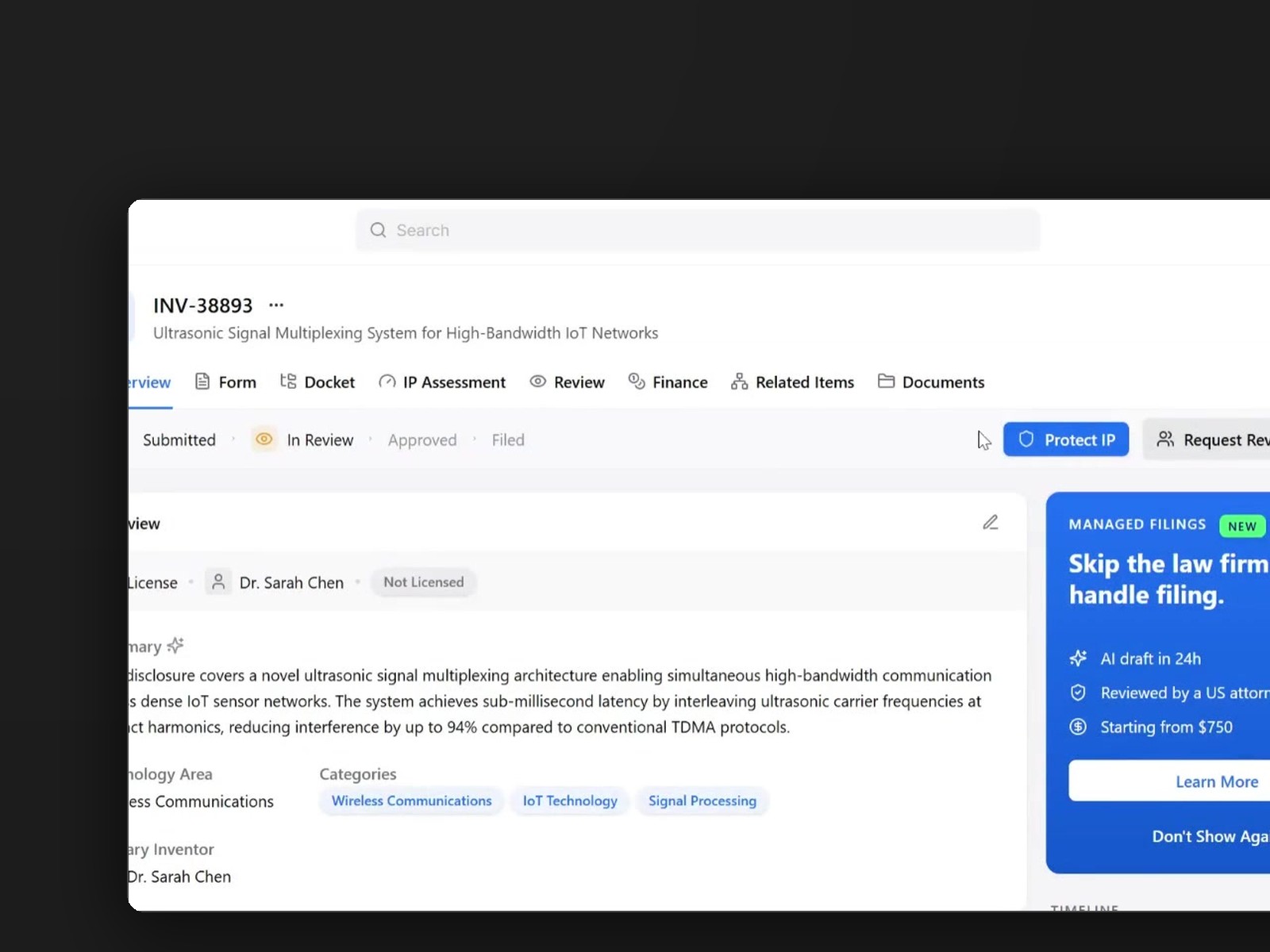
Tradespace’s platform captures every IP decision, prosecution event, and strategic rationale in a system of record the company owns, with diligence-ready exports available on demand.
Why IP diligence is the moment of truth for the IP function
Every IP function operates for years without external scrutiny. Filings get made, portfolios grow, outside counsel does its work, reports go to the CFO. The rigor of the operating model is largely invisible from outside the function.
Then a fundraising round starts, or an acquisition offer arrives, or a partnership diligence process begins. Suddenly the entire IP function is under external review. The investor’s counsel or the acquirer’s diligence team wants to see the portfolio, the prosecution history, the contract terms, the trade secret documentation, the FTO analysis, and the licensing arrangements. They want it in structured form, they want it fast, and they will surface any gaps as risks to price into the transaction.
This is the moment when years of operating discipline pay off, or years of operational shortcuts get exposed. IP functions that have been running structured operations produce complete diligence packages in hours. IP functions that have been running on tribal knowledge, outside counsel portals, and internal spreadsheets spend weeks assembling documentation and often surface issues that delay closing or reprice the deal.
This guide covers the IP due diligence checklist growth-stage companies should have ready. It is organized by category, with the specific items diligence teams look for and the operating practices that produce clean diligence packages.
What IP due diligence actually looks for
The diligence checklist has six categories. Each has its own documentation requirements, common failure modes, and preparation timeline.
Category 1: Patent portfolio composition
The diligence team wants a complete picture of the patent portfolio. What is owned, what is pending, what is in prosecution, what has expired or been abandoned. Specifically:
- Complete list of granted patents with jurisdiction, filing date, grant date, expiration date, and current status
- Complete list of pending patent applications with jurisdiction, filing date, current examination status, and next-action deadline
- Complete list of provisional patent applications with filing date and 12-month conversion deadline
- Patent family relationships (which patents are continuations, divisionals, or related applications of others)
- Assignee chain of title for every patent, confirming clear ownership from inventor through to current owner
The most common gap in this category is chain of title. Patents filed early in a company’s history often have gaps in the assignment chain from inventors to the company, or from predecessor entities to the current company. These gaps can be resolved but take time to fix under diligence pressure.
Category 2: Prosecution history and pending matters
The diligence team wants visibility into active prosecution. Not just what patents exist, but what is happening with the applications currently under examination. Specifically:
- Current status of every pending application (which office actions have been issued, which responses have been filed, next action deadline)
- Prosecution history for each granted patent, showing the examination path from filing to grant
- Any outstanding office actions with response deadlines
- Any pending appeals or continuations
- Any recent adverse decisions or narrowing amendments that limit claim scope
The most common gap here is fragmented data. Prosecution history typically lives in outside counsel portals across multiple firms. Assembling a consolidated view takes weeks in a manual operating model.
Category 3: Freedom to operate posture
The diligence team wants to understand the company’s exposure to third-party patent infringement. Specifically:
- Documented FTO analysis for major product lines, with jurisdiction coverage and date of last refresh
- Any known concerning third-party patents and the mitigation approach for each
- Any received cease-and-desist letters or infringement notices, with the response and current status
- Any active patent litigation or threatened litigation
- Any patent licenses received or granted, covering products or technology in scope
The most common gap in this category is that FTO analysis has not been done for meaningful product lines, or was done long enough ago that it is stale. Both create diligence risk because the acquirer or investor cannot verify the company’s stated IP position. The freedom to operate analysis guide covers FTO in detail.
Category 4: Trade secret and confidentiality practices
The diligence team wants documentation that trade secret protection is real and defensible. Specifically:
- Documented inventory of information classified as trade secret
- Classification scheme showing levels of sensitivity and access controls
- Employment agreements with confidentiality terms and IP assignment clauses
- Contractor agreements with confidentiality and IP assignment terms
- Exit procedures for departing employees, including return-of-property protocols
- Physical and digital security measures protecting trade secret information
The most common gap here is that trade secret protection is de facto rather than documented. The company treats certain information as confidential in practice but has no documented inventory, classification scheme, or reasonable-measures record. This creates diligence risk because the trade secret status may not survive enforcement scrutiny if challenged.
Category 5: Contract IP terms
The diligence team wants to see that IP flowing through the company’s contracts is properly handled. Specifically:
- IP assignment clauses in every employment agreement
- IP assignment and confidentiality clauses in every contractor and consultant agreement
- IP terms in customer agreements (license grants, indemnification, ownership of derivative works)
- IP terms in vendor and supplier agreements
- IP terms in any partnership, joint venture, or collaboration agreement
- Any grants of security interests in IP (as loan collateral, for example)
The most common gap here is contractors without IP assignment clauses. Early-stage companies frequently hire contractors under informal agreements that do not explicitly transfer IP ownership. Work product created under these agreements may not be owned by the company, creating a serious diligence issue.
Category 6: Licensing and encumbrances
The diligence team wants to know what licenses are granted out, what licenses are received, and whether any encumbrances exist on the IP. Specifically:
- Complete list of outbound licenses (licenses granted to other parties on company IP)
- Complete list of inbound licenses (licenses received from other parties)
- Any exclusivity arrangements, field-of-use restrictions, or geographic limitations on licenses
- Any change-of-control provisions in licenses that would be triggered by the pending transaction
- Any liens, security interests, or other encumbrances on IP assets
- Any pending or threatened claims of IP infringement by third parties
The most common issue here is change-of-control provisions that terminate licenses upon acquisition. If a valuable license terminates when the acquisition closes, the acquirer’s valuation may need adjustment.
Where IP due diligence commonly finds problems
The five patterns below account for most of the issues surfaced during IP diligence at growth-stage companies.
- Broken assignment chains. Patents filed early in company history have gaps in the chain of title from inventor to company, or from predecessor entities to the current entity. These are usually fixable but take time under diligence pressure.
- Contractor IP assignment gaps. Contractors hired without IP assignment clauses may own the work product they created. Retroactive assignment agreements are sometimes possible but not always.
- Undocumented trade secret protection. Trade secrets treated as confidential in practice but without documented reasonable measures. Trade secret status may not survive enforcement scrutiny.
- Stale or nonexistent FTO analysis. Major products lack documented FTO analysis, or the analysis is more than 12 months old. The acquirer cannot verify the company’s stated IP exposure.
- Portfolio maintenance on non-strategic assets. Substantial maintenance fees paid on patents that no longer cover current products. Suggests weak portfolio management discipline.
What to look for in IP diligence readiness in 2026
Three shifts have changed how growth-stage companies should approach IP diligence readiness.
Diligence-ready operating models replace pre-transaction scrambles
The traditional model prepared for IP diligence in the weeks before a transaction, assembling documentation under time pressure. The modern model runs IP operations continuously in a form that produces diligence-ready output on demand. When the transaction starts, the documentation is already there.
The operational shift is real. Continuous diligence readiness requires structured system-of-record discipline, documented decision rationale on every IP action, and reporting infrastructure that produces stakeholder-appropriate exports on demand.
Integrated platforms replace federated data
The traditional model held IP data across multiple systems: outside counsel portals, internal spreadsheets, email archives, annuity provider portals. Diligence assembly required manual reconciliation across these systems, taking weeks.
Modern integrated IP management platforms hold all this data in a single system of record. Diligence exports run against the live data and produce complete packages in hours rather than weeks.
AI-assisted diligence support has matured
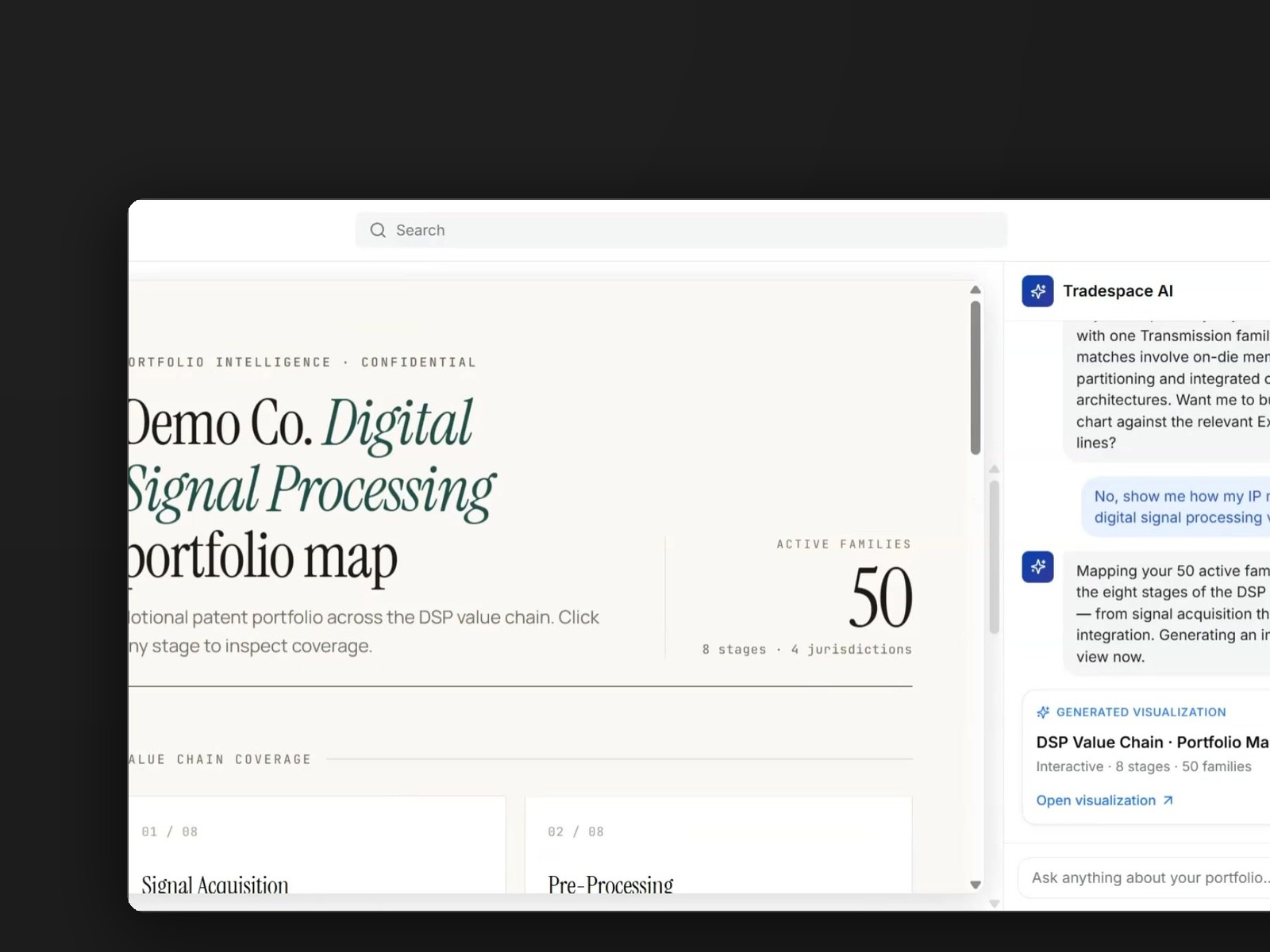
AI tools now support several aspects of diligence readiness: automated portfolio analysis producing coverage maps and gap identification, contract IP term analysis flagging deviations from standard templates, and automated compilation of prosecution history and status across firms. These compress the manual work substantially.
How Tradespace supports IP due diligence readiness
Tradespace’s operating platform is designed for continuous diligence readiness. Specifically:
- Live docketing across every matter including filings from prior outside counsel that get migrated into the platform. The diligence team sees a complete portfolio view without cross-referencing multiple firm portals.
- Patent-to-product mapping documents which patents cover which products, one of the most requested diligence exhibits.
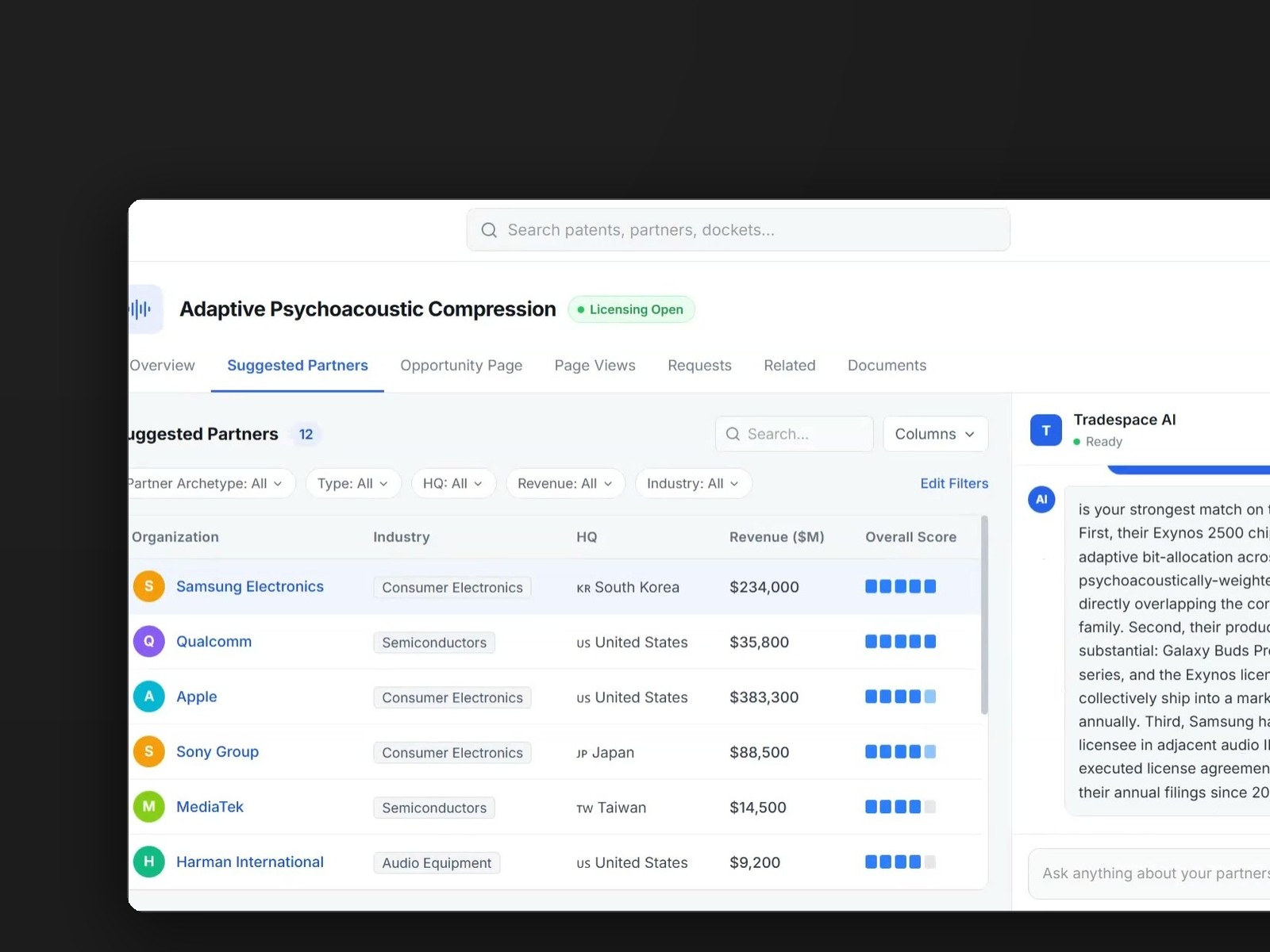
- Chat with your portfolio capabilities let the IP team answer diligence questions on demand, extracting the specific information the acquirer or investor is asking for.
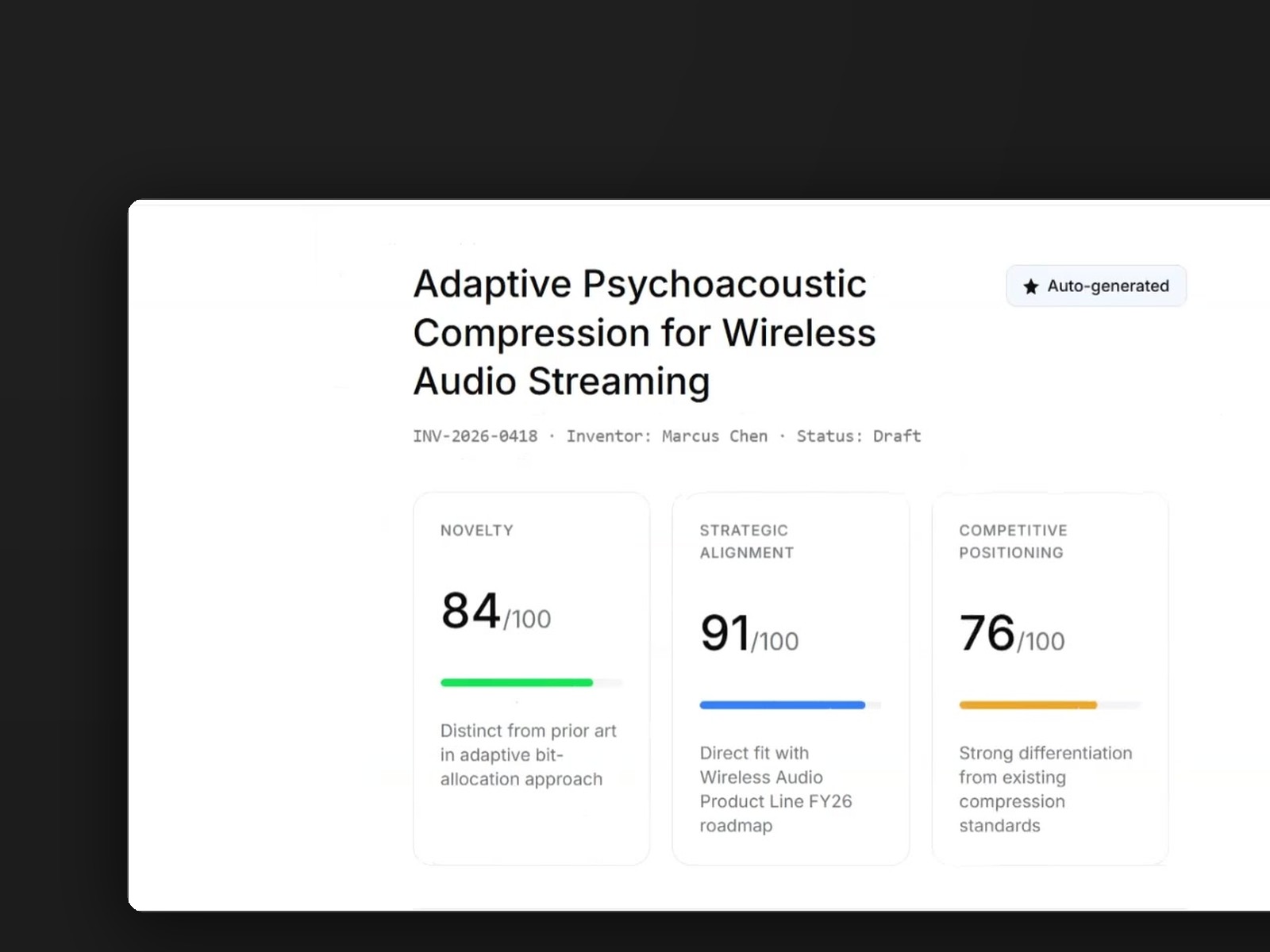
- AI-assisted invention harvesting with the AI mining Slack, Gmail, Notion, PRs, design docs, and call recordings for invention capture, ensuring nothing meaningful gets missed and stays undocumented in the run-up to a transaction.
- 250+ vetted USPTO-registered patent attorneys with dedicated 1:1 attorney match means every filing has clear ownership of prosecution decisions and rationale, captured in the platform.
- Work happens inside Tradespace with real-time visibility so every decision is documented at the moment it is made, not reconstructed under diligence pressure.
For growth-stage IP teams preparing for future fundraising or M&A events, the operational reality is that diligence readiness is a byproduct of running the IP function on Tradespace, rather than a separate preparation exercise. The complete guide to patent portfolio management covers the broader operating discipline that produces this state.
How to build a diligence-ready IP function in practice
For teams starting from a scrambled operating model with diligence approaching, the framework below produces the fastest path to a defensible package.
Phase 1: Assessment (weeks 1 to 3)
The first three weeks establish the current state.
- Complete portfolio inventory across all outside firms and internal systems
- Assignment chain audit for every patent, identifying gaps that need to be fixed
- Contract IP term audit covering employment agreements, contractor agreements, customer contracts, and partnership agreements
- Trade secret protection audit assessing documented reasonable measures
- FTO coverage inventory identifying products without current analysis
- Licensing inventory of both inbound and outbound licenses
Phase 2: Gap remediation (weeks 4 to 12)
The next two months close the most critical gaps.
- Execute retroactive IP assignment agreements for any inventor or contractor with unclear ownership
- Document trade secret protection measures if not already documented
- Run FTO analysis on any product lines without current coverage
- Update contract templates to include proper IP terms going forward
- Consolidate portfolio data into a single operating system if currently fragmented
Phase 3: Documentation package assembly (weeks 12 to 16)
Assemble the diligence-ready documentation package.
- Complete patent portfolio schedule with all required data fields
- Prosecution history summaries for pending applications
- FTO documentation for major products
- Trade secret inventory and protection documentation
- Contract IP term compliance report
- Licensing schedule and encumbrance summary
Phase 4: Continuous operation (month 5 and beyond)
By month 5, IP diligence readiness becomes a continuous discipline.
- Monthly portfolio data update and quality check
- Quarterly contract review for IP term compliance
- Semi-annual FTO refresh on shipping products
- Annual full diligence-package dry run
Common IP diligence preparation mistakes
The mistakes below recur across growth-stage companies preparing for diligence.
- Starting preparation too late. IP diligence issues often take months to remediate. Starting the assessment in the same quarter as the transaction leaves no time to fix problems.
- Assuming outside counsel has the data. Outside counsel holds fragments of the picture (prosecution status at their firm, filings they handled). The complete diligence picture requires data from multiple firms plus internal sources.
- Skipping the contract review. IP terms in employment, contractor, customer, and partnership agreements are one of the most commonly-cited diligence issues. A pre-transaction contract review is worth the effort.
- Underdocumenting trade secrets. Trade secret protection depends on documented reasonable measures. If the measures are not documented, they effectively do not exist for diligence purposes.
- Not doing FTO on major products. Products without current FTO analysis produce diligence uncertainty that can reprice or delay the transaction.
Measuring IP diligence readiness
The metrics below tell an IP leader whether the function is continuously diligence-ready.
- Time from diligence request to complete package. A continuously-ready operating model produces this in hours. A scrambled operating model produces this in weeks.
- Portfolio completeness. Percentage of granted patents with complete records (assignment chain, prosecution history, product mapping, current status).
- Contract IP compliance rate. Percentage of signed contracts with IP terms matching approved templates.
- FTO coverage. Percentage of shipping products with current (within 12 months) FTO analysis.
- Trade secret documentation completeness. Percentage of information classified as trade secret with documented reasonable measures.
Building your IP diligence readiness strategy
For a team preparing for a future fundraise or M&A event, the sequence below produces the fastest path to a defensible position.
- Run the assessment before doing anything else. Until the current state is documented, the remediation work has no target.
- Prioritize the gaps by severity. Assignment chain gaps and contractor IP gaps are typically the highest severity.
- Consolidate portfolio data into a single system of record. This alone dramatically compresses future diligence preparation time.
- Build continuous operating cadences (monthly, quarterly, annual) that maintain diligence readiness as a byproduct of normal operations.
- Run an annual diligence-package dry run so the actual transaction is not the first time the package is assembled.
A pressure-test for your current IP diligence readiness
The questions below are diagnostic.
- If a diligence request arrived tomorrow, how many weeks of work would separate you from a complete package?
- For every patent in your portfolio, can you produce a complete chain of title from inventor to current owner?
- Are all your contractors under agreements with IP assignment clauses?
- Do you have documented trade secret protection measures that would survive enforcement scrutiny?
- For your top three shipping products, when was the last FTO analysis?
The takeaway
IP due diligence is the moment when the IP function’s operating discipline gets externally validated. Companies with structured operating models produce complete diligence packages in hours from live portfolio data. Companies with scrambled operating models spend weeks assembling documentation and often surface issues that delay or reprice the transaction.
The disciplined move is to run the IP function continuously in a form that produces diligence-ready output as a byproduct. This requires a single system of record for portfolio data, documented decision rationale on every IP action, continuous FTO on shipping products, structured contract IP review, and documented trade secret protection.
The teams that build this operating discipline sail through diligence. The teams that do not scramble through diligence, often at the cost of transaction terms or timing. The upfront operating investment is real. The downside avoided is substantially larger.
What is IP due diligence?
IP due diligence is the structured review of a company’s intellectual property assets, protections, and risks conducted during fundraising, M&A, or partnership transactions. The diligence team assesses the composition of the patent portfolio, prosecution history and pending matters, freedom to operate posture, trade secret protection, contract IP terms, and licensing arrangements. The output is a diligence report that informs valuation, deal structure, and risk allocation.
What is included in an IP due diligence checklist?
An IP due diligence checklist typically covers six categories: complete patent portfolio inventory with status and expiration data, prosecution history and pending matters, freedom to operate analysis and any received infringement notices, trade secret inventory and protection measures, IP terms in employment and contractor agreements plus customer and partnership contracts, and licensing arrangements including any encumbrances or change-of-control provisions.
How long does IP due diligence take?
IP due diligence typically takes 2 to 6 weeks in an active transaction, depending on portfolio size and complexity. Preparation on the seller side can range from a few days (if the operating model is continuously diligence-ready) to several months (if starting from a scrambled operating model with material remediation needed).
What are common IP diligence issues at growth-stage companies?
The most common issues are broken assignment chains from inventor to company on early filings, contractor agreements without IP assignment clauses, undocumented trade secret protection measures, stale or missing FTO analysis on major products, and portfolio maintenance fees paid on patents that no longer cover current products.
How do I prepare for IP due diligence?
Start with a complete assessment of the current state across all six diligence categories. Prioritize gap remediation by severity, with assignment chain and contractor IP issues typically highest priority. Consolidate portfolio data into a single system of record. Build continuous operating cadences that maintain diligence readiness. Run an annual dry run of the diligence package assembly process so the actual transaction is not the first time the package gets produced.
What is an IP audit?
An IP audit is a comprehensive internal review of a company’s IP assets, protections, and risks. It differs from IP due diligence in being an internal exercise rather than a transaction-driven external review. An IP audit typically produces the same documentation that IP due diligence would examine, positioned as a proactive management practice rather than a reactive diligence response. Companies that run regular IP audits are typically well-prepared for external diligence when it comes.
Who conducts IP due diligence?
IP due diligence is typically conducted by IP counsel representing the acquiring party or the investor. For M&A transactions, this is often outside counsel with specific IP diligence experience. For fundraising, this may be the investor’s counsel or a specialized IP diligence firm. On the seller side, the internal IP team or outside counsel typically prepares the documentation package.
What is a patent audit?
A patent audit is a subset of IP audit focused specifically on the patent portfolio. It covers portfolio composition, prosecution history, chain of title, maintenance fee status, and strategic role of each asset. Patent audits are typically run annually as part of ongoing portfolio management discipline, and produce documentation that also supports IP due diligence readiness.
How much does IP due diligence cost?
Costs vary substantially by portfolio size and complexity. Outside counsel IP diligence engagements typically range from $25,000 to $250,000+ for the acquiring side, depending on portfolio depth and jurisdictional coverage. Seller-side preparation costs vary based on how much remediation is needed. Companies that have been operating on structured IP models incur minimal seller-side preparation costs. Companies starting from scrambled operations often incur $50,000 to $200,000+ in remediation costs before diligence readiness is achieved.
How does modern IP management software support IP due diligence?
Modern IP management platforms produce diligence-ready exports on demand from live portfolio data. Instead of manually assembling documentation across multiple outside counsel portals, spreadsheets, and email archives, the diligence package generates in hours from the platform’s single system of record. Continuous operating models running on integrated platforms produce diligence readiness as a byproduct of normal operations rather than a separate preparation exercise. The best strategies for patent portfolio management covers the broader operating discipline.