Outside Counsel Alternatives: How Growth-Stage IP Teams Are Reducing Filing Costs in 2026
August 11, 2026Key Takeaways
Traditional hourly outside counsel is not the only channel for patent work. In 2026, flat-fee managed filing providers deliver senior attorney work on routine matters at 40% to 70% less cost than traditional hourly firms, with faster turnaround and predictable pricing.
The typical growth-stage IP team can reduce outside counsel spend by 40% or more within two quarters by routing routine volume (provisionals, non-provisionals, office action responses) through flat-fee channels while retaining specialist firms for high-stakes work.
The core reason flat-fee providers can price lower is not lower-quality labor. It is AI-assisted drafting infrastructure and structured intake processes that compress the manual work around senior attorney judgment.
The disciplined transition preserves relationships with specialist firms for the work they legitimately handle better (litigation, complex prosecution, cross-border strategy) and moves the volume work to channels priced for efficiency.
The bigger operational win is predictability. Flat-fee pricing lets IP teams forecast patent spend the same way finance forecasts any other line item, replacing “somewhere between $10K and $25K per filing” with a fixed dollar figure.
Tradespace prices US non-provisional and PCT filings at $5,000 flat, provisionals at $1,000 flat, and office action responses at $1,000 flat. Filings happen in 1 week from disclosure at senior attorney-handling economics.
Why the traditional outside counsel model is under pressure
For decades, the default operating model for patent filings at growth-stage companies has been: hire a boutique patent firm or BigLaw for prosecution work, bill hourly, budget an approximate range per matter, and accept that the actual cost will vary with how many hours the firm logs. The model worked when there were no serious alternatives. It works less well now, for three reasons.
First, the cost gap between hourly billing and flat-fee alternatives has widened. Traditional BigLaw partner rates have risen 30% to 50% over the past decade, while flat-fee providers with AI-assisted infrastructure have driven their per-matter costs down. The gap between a BigLaw utility filing and a flat-fee utility filing is now often 4x or more for the same output quality on routine matters.
Second, growth-stage IP functions have gotten more sophisticated about operating economics. IP leaders now report to CFOs who expect predictable, forecastable spend. Hourly billing produces unpredictable spend by design. Flat-fee billing produces predictable spend by design. As the IP function becomes more operationally rigorous, the pressure to move away from hourly increases.
Third, AI-assisted drafting infrastructure has matured to the point where senior attorney work at flat-fee prices is genuinely available. The quality signal has caught up with the pricing model. Providers that made bold claims two years ago now have track records that can be evaluated.
This guide covers the alternatives to traditional outside counsel that growth-stage IP teams should actually be considering in 2026, how they compare, and how to run the transition without disrupting active prosecution work.
What “outside counsel alternatives” actually means
Outside counsel alternatives are not a single category. They span multiple operating models, each suited to different types of patent work. The three main categories:
- Flat-fee managed filing providers. Service providers that deliver senior attorney work on a per-matter flat-fee basis. AI-assisted drafting infrastructure and structured intake compress the manual work around attorney judgment. Best-suited for routine utility filings, provisionals, and office action responses.
- AI-first patent drafting platforms. Software platforms that use AI to draft patent applications, typically requiring a patent attorney (whether in-house or contracted) to review and finalize. Best-suited for teams with in-house patent expertise looking to accelerate their own drafting workflow.
- In-house patent departments. Building patent capabilities directly, hiring in-house patent attorneys and agents. Best-suited for large-scale IP operations at Fortune 500 companies. Rarely economically viable for growth-stage companies with fewer than 100 filings per year.
For growth-stage IP teams (Series B to pre-IPO, filing 10 to 50 patents per year), the practical alternative is flat-fee managed filing for routine work, plus retained specialist firms for high-stakes matters. This is the operating model this guide focuses on.
The four ways flat-fee managed filing beats traditional outside counsel
The comparison below covers where flat-fee managed filing meaningfully outperforms traditional hourly outside counsel on routine patent work.
Cost per matter
Traditional hourly outside counsel prices a US utility patent at $10,000 to $25,000+ for initial drafting, with office action responses adding $2,000 to $6,000 each. Flat-fee managed filing typically prices the same work at $3,000 to $8,000 for the utility filing and $500 to $2,000 per office action response. Tradespace specifically prices US non-provisional filings at $5,000 flat and office action responses at $1,000 flat.
Across a portfolio of 20 filings per year with an average of two office action responses each, the annual cost gap between hourly and flat-fee is typically $200,000 to $500,000. Multiply across three years and the compounding is substantial.
Timeline from disclosure to filing
Traditional hourly firms typically deliver a filed non-provisional in 6 to 12 weeks from a completed disclosure. Flat-fee managed filing providers with AI-assisted drafting typically deliver in 1 to 3 weeks. Tradespace commits to 1 week from disclosure to filed patent.
For time-sensitive filings (product launches, competitor threats, imminent public disclosure), the timeline gap can be the difference between preserving priority and losing it.
Predictability of spend
Traditional hourly billing produces unpredictable spend by design. The client cannot forecast total per-matter cost until the work is complete, and estimates from the firm at engagement often understate the actual final bill by 30% to 60%.
Flat-fee pricing produces predictable spend by design. The client knows the cost at engagement, and the provider carries the efficiency risk. For growth-stage IP teams needing to forecast annual patent spend for finance planning, this is a substantial operational advantage.
Incentive alignment
Under hourly billing, the firm’s economic incentive is to log more hours. Efficient firms leave money on the table. Inefficient firms bill higher. The client has no structural way to know which they are getting.
Under flat-fee pricing, the provider’s economic incentive is to complete the work efficiently and consistently. Providers with efficient infrastructure make money. Providers with inefficient infrastructure lose money. The market pressure aligns provider economics with client outcomes.
Where traditional outside counsel still earns its cost
Traditional hourly outside counsel is not universally the wrong answer. The scenarios below cover where specialist firms legitimately earn their premium and should not be displaced by flat-fee alternatives.
- Contested proceedings and litigation. Inter partes reviews, patent litigation, complex opposition proceedings, and appeals warrant senior specialist judgment across many hours. The specialist premium is directly justified.
- Complex prosecution in unusual technology areas. Some technology areas (advanced semiconductor structures, novel biological processes, complex chemical compositions) require deep technical specialization that not every provider can offer.
- Cross-border strategy on multi-jurisdiction portfolios. Coordinating US, European, Asian, and other prosecution with jurisdiction-specific procedural knowledge is genuinely complex work that specialist firms handle better.
- High-stakes freedom-to-operate opinions. Formal FTO opinions on high-value products where the opinion itself carries legal weight benefit from specialist firm brand and expertise.
- M&A and licensing transaction support. Patent due diligence during acquisition or licensing negotiation warrants specialist firms with transaction experience.
The right operating model retains specialist firms for these matters and moves the routine volume (standard utility filings, provisionals, common office action responses, straightforward continuations) to flat-fee channels.
Where outside counsel alternatives commonly fall short
Not every alternative is created equal. The four failure patterns below account for most disappointment with flat-fee provider transitions.
- Underqualified attorneys handling the work. Some flat-fee providers hit their price point by using junior associates or attorneys with limited experience. Quality suffers, and the pricing advantage is not worth the outcome. The better flat-fee providers commit to senior attorney handling and can point to their attorney network credentials.
- AI-generated output without adequate attorney review. Some providers over-index on AI and under-invest in attorney review. Output may look competent but include errors that only a trained attorney would catch. Verify that a senior attorney reviews and finalizes every filing.
- Limited technology-area expertise. Some flat-fee providers work best in specific technology areas and struggle in others. Confirm the provider has expertise in the specific technology areas the client’s portfolio covers.
- Inadequate operational infrastructure. Some providers have good attorneys but poor operational infrastructure (docketing, deadline management, portfolio visibility). This produces surprises later. Evaluate the operational side as well as the legal side.
What to look for in outside counsel alternatives in 2026
Three shifts have reshaped the alternatives landscape in the last two years.
Quality signal has matured for the leading flat-fee providers
Two years ago, evaluating flat-fee provider quality required leaps of faith. Track records were thin. Attorney networks were opaque. In 2026, the leading providers have established track records, published attorney credentials, and case study data. The quality signal has caught up to the pricing model.
AI-assisted drafting infrastructure is now the operating substrate
The flat-fee providers that scale have built AI-assisted drafting infrastructure that compresses the manual work around senior attorney judgment. This is what makes the pricing sustainable. Providers still relying on manual drafting workflows cannot match the pricing at scale.
Bundled operating platforms are replacing point services
The historical model was to buy separate services for each function: outside counsel for prosecution, docketing software for portfolio management, annuity services for maintenance, analytics tools for competitive intelligence. In 2026, integrated platforms bundle these functions into a single operating system, with the outside counsel work embedded in the platform rather than sitting as a separate vendor relationship.
How Tradespace approaches the outside counsel alternative
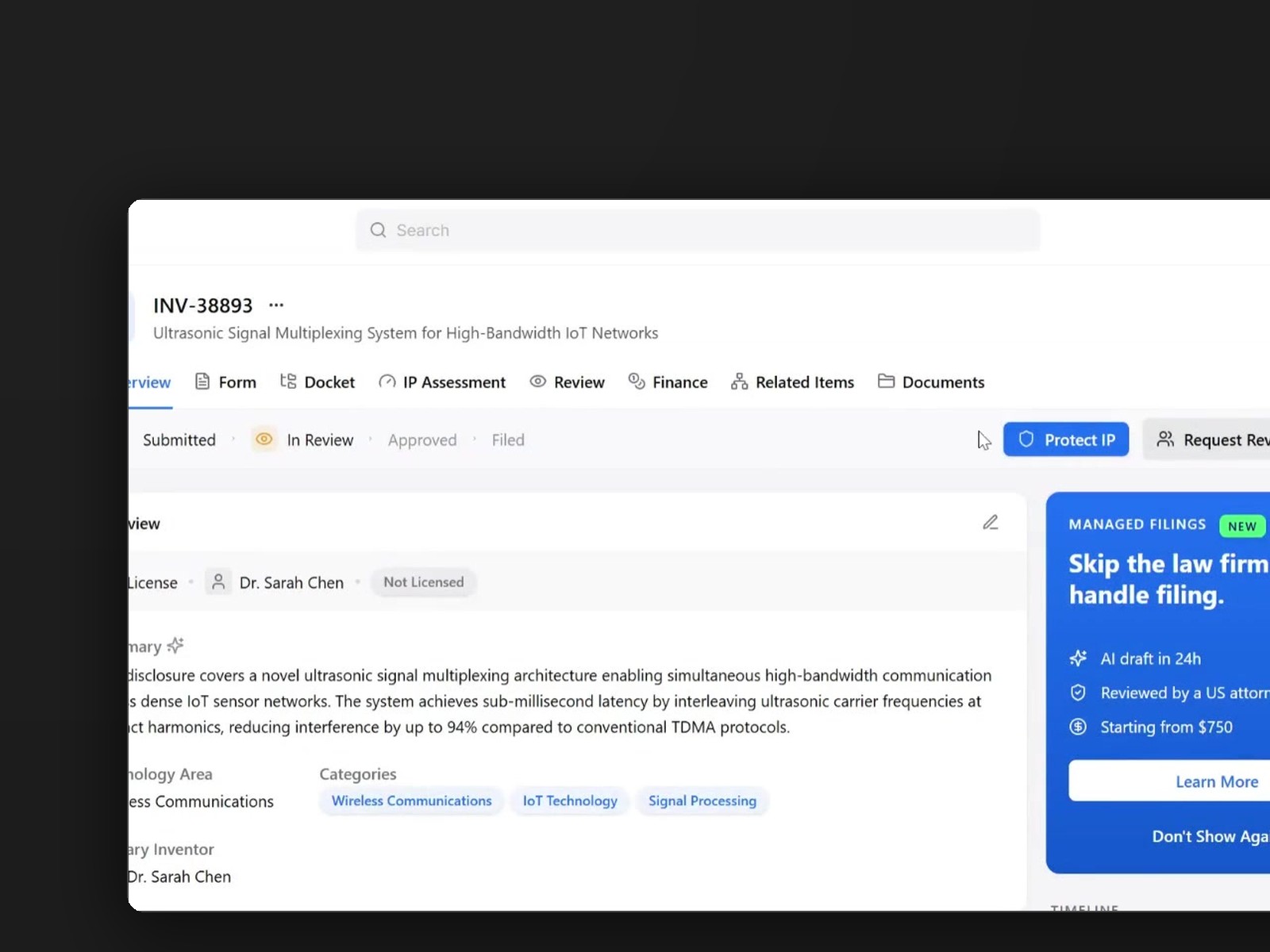
Tradespace is a full-service patent practice powered by a modern AI platform. The service bundles what traditionally required separate vendor relationships: patent attorney work, portfolio management infrastructure, and AI-assisted drafting, delivered as one product.
Specifically, Tradespace prices patent work at flat fees:
- US Non-Provisional or PCT filing: $5,000 flat
- Provisional patent application: $1,000 flat
- Office action response: $1,000 flat
Every matter is handled by a senior USPTO-registered patent attorney from a network of 250 vetted practitioners. Each client is matched 1:1 with a dedicated senior attorney who works across every matter, rather than the work being distributed among junior associates. Tradespace’s tagline positions this explicitly: file patents at the speed of innovation, without the law firm markup.
The operational model:
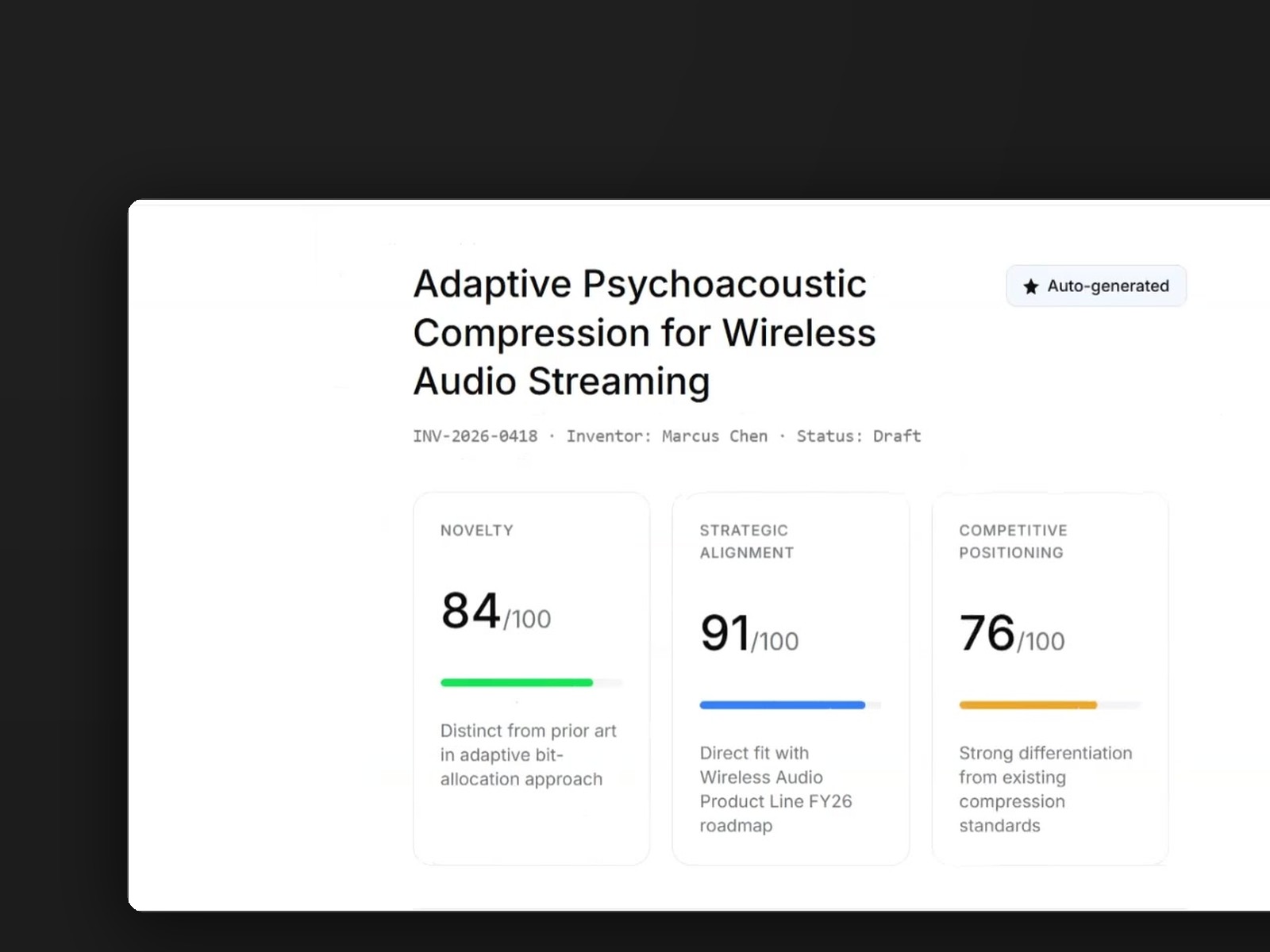
- AI-assisted intake and drafting. The Tradespace platform’s AI capabilities structure inventor materials (Slack, Gmail, Notion, PRs, design docs, call recordings) into attorney-ready invention disclosures.
- 20-minute inventor reviews replace the 2-hour intake interviews traditional firms schedule.
- 1 week from disclosure to filed patent. AI-assisted drafting compresses the applicant-controlled portion of the timeline.
- Work happens inside Tradespace with full real-time visibility to the client at every step.
- Live docketing covers every matter, including filings from prior outside counsel that get migrated into the platform.
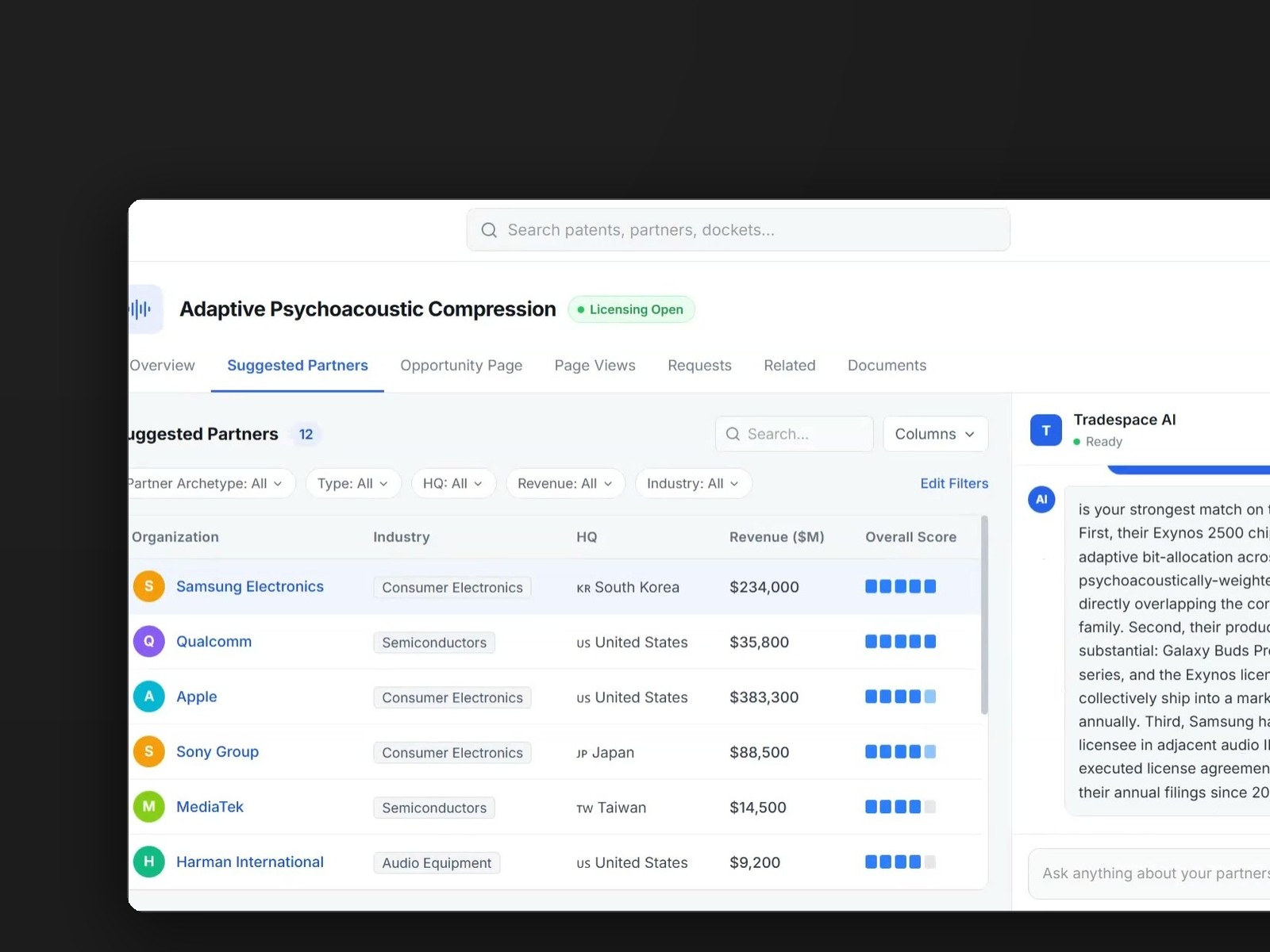
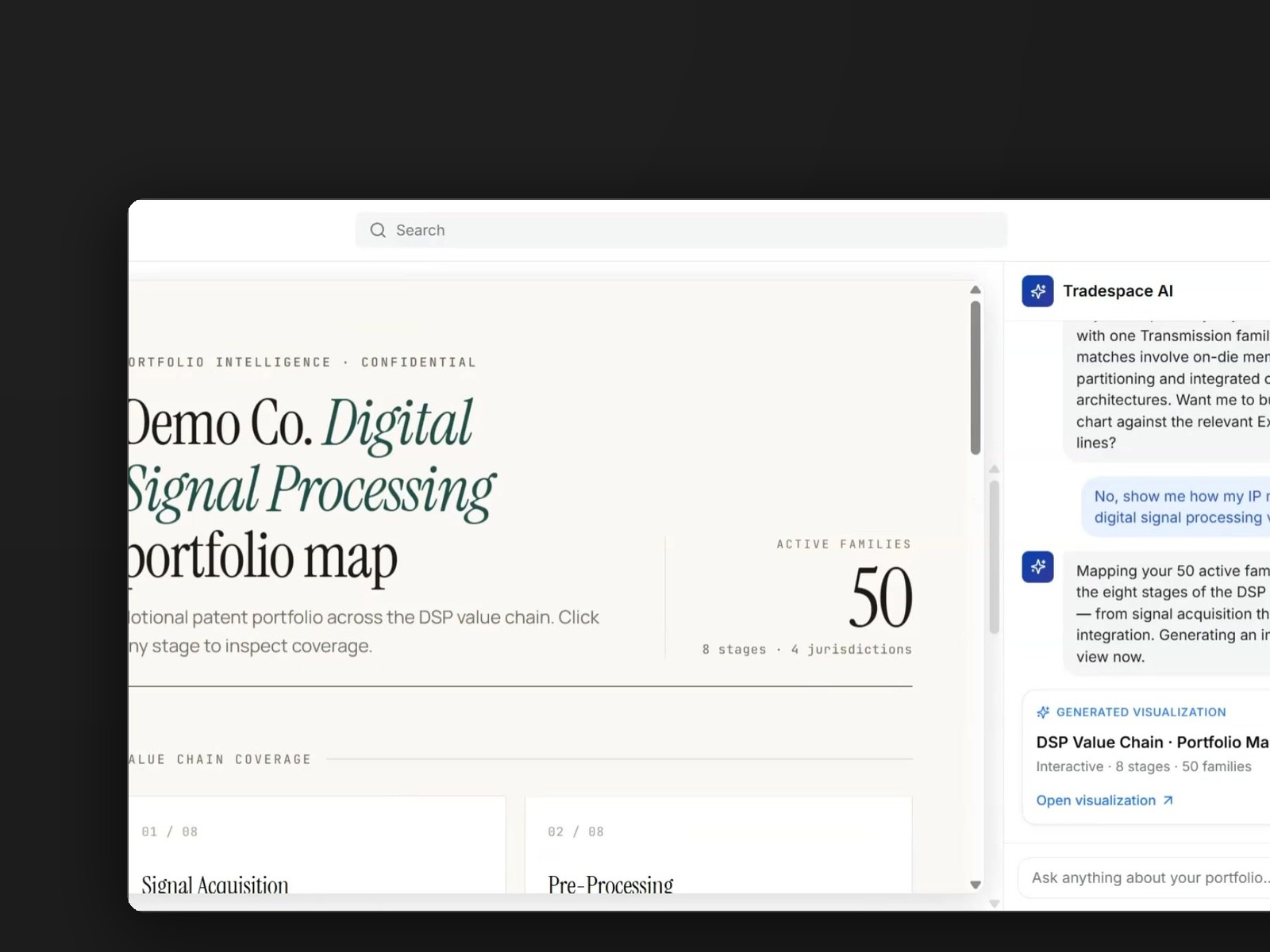
- Patent-to-product mapping and chat with your portfolio capabilities extend the operating model beyond individual filings to portfolio-level strategy.
For growth-stage IP teams evaluating the shift from traditional outside counsel, Tradespace’s model bundles the flat-fee filing economics with the operating infrastructure that would otherwise require separate vendor relationships. The patent attorney fees guide covers detailed pricing comparison across the market.
How to transition from traditional outside counsel in practice
For teams currently on hourly-billed outside counsel, the transition framework below produces the fastest cost reduction without disrupting active prosecution work.
Phase 1: Assessment (weeks 1 to 4)
The first month is a diagnostic pass on current outside counsel spend.
- Pull the trailing 12 months of outside counsel invoices by matter and by activity type
- Calculate per-matter cost by type: cost per non-provisional filing, cost per provisional, cost per office action response
- Segment the active portfolio into routine matters (candidates for flat-fee channels) and specialized matters (retain at hourly firms)
- Model total spend under a flat-fee alternative for the routine matter segment
- Identify the highest-cost firms and the highest-volume matter types
Phase 2: Provider evaluation (weeks 5 to 8)
Evaluate two or three flat-fee providers against the specific matter mix.
- Request pricing schedules from each candidate
- Verify senior attorney handling on every matter
- Check technology-area expertise for the specific portfolio
- Review the operational infrastructure (docketing, portfolio visibility, real-time status)
- Ask for customer references at similar company stage and portfolio size
Phase 3: Channel shift (weeks 9 to 16)
Start moving routine work to the selected flat-fee provider from a defined start date.
- Route new routine filings through the flat-fee provider from a specific cutover date
- Keep existing prosecution work with the current firms through to grant or abandonment (in-flight work is usually not worth reassigning)
- Migrate portfolio data into the new provider’s system of record if the provider offers integrated portfolio management
- Establish reporting cadence on per-matter cost and total spend
Phase 4: Continuous operation (month 5 and beyond)
By month 5 the operating model runs on a portfolio-level cost discipline.
- Monthly spend tracking with per-matter benchmarking
- Quarterly firm-mix review, moving work between channels based on performance
- Annual firm rate negotiation for retained hourly engagements
- Ongoing pruning of the traditional counsel relationship to specialized work only
Common transition mistakes
The mistakes below recur across teams attempting to move work from traditional outside counsel to alternatives.
- Trying to move all work at once. Specialized matters (litigation, complex prosecution, cross-border strategy) legitimately warrant hourly-billed firms. Force-fitting these into flat-fee channels produces quality problems and damages the transition’s credibility.
- Not doing the per-matter cost diagnostic upfront. Without a baseline of what the current firm charges per matter, the savings from the new provider are not visible in reporting, and the change loses executive support.
- Underestimating change management with existing firms. Firms that have been getting the client’s work for years do not enjoy losing volume. The transition conversation has to be planned, not improvised.
- Evaluating providers on price alone. Senior attorney handling, technology-area expertise, and operational infrastructure matter as much as the per-matter price. A cheap provider that produces weak filings costs more than a fair-priced provider that produces strong filings.
- Failing to build reporting infrastructure. Cost savings should be visible monthly in CFO-facing dashboards. Without that visibility, the shift becomes invisible in budget cycles and the executive team does not credit the IP function for the improvement.
Measuring the outside counsel transition
The metrics below tell the executive team whether the transition is producing real savings.
- Total outside counsel spend, monthly. Trending down as flat-fee channels absorb volume.
- Per-filed-patent attorney cost. Trending down while quality metrics hold steady or improve.
- Percentage of total attorney spend at flat-fee providers. A working shift moves 60% to 80% of routine volume within 6 months.
- Time from disclosure to filed application. Trending shorter as AI-assisted providers absorb volume.
- Claim scope at grant relative to as-filed. Quality signal. A working shift maintains or improves this ratio versus the prior operating model.
Building your outside counsel alternatives strategy
For a team overpaying on traditional outside counsel, the sequence below is the fastest path to a working alternative operating model.
- Run the per-matter cost diagnostic against the trailing 12 months of invoices before contacting any alternative providers.
- Segment the active portfolio by matter type. Identify the routine tier that is a candidate for flat-fee channels.
- Evaluate two or three flat-fee providers on both pricing and quality signal.
- Shift new routine work to the selected flat-fee provider from a defined start date, leaving in-flight matters with the existing firm through to grant.
- Report savings monthly in CFO-facing dashboards to build executive support for the operating shift.
A pressure-test for your current outside counsel spend
The questions below are diagnostic.
- Can you produce a per-matter cost breakdown of the last 12 months of outside counsel spend?
- What percentage of your current outside counsel work is specialized (litigation, complex prosecution) versus routine (standard utility filings, provisionals, office action responses)?
- If you moved 70% of your filing volume to a flat-fee alternative, what would total annual outside counsel spend look like?
- For every filing your current outside counsel does, is the work handled by a senior attorney or delegated to a junior associate?
- If your outside counsel raised hourly rates 15% next quarter, would you have the data to challenge it on a per-filing basis, or would you just absorb the increase?
The takeaway
The traditional outside counsel model is no longer the only serious option for growth-stage IP teams. Flat-fee managed filing providers now deliver senior attorney work on routine matters at 40% to 70% less cost, with faster turnaround and predictable pricing. The economics no longer favor the traditional model on routine volume.
The disciplined transition preserves specialist relationships for the work they legitimately do better and moves the routine volume to channels priced for efficiency. IP teams that make this shift see per-filing cost drop meaningfully within two quarters, forecast their annual patent spend with the same rigor as any other operational line item, and reclaim the operating capacity that was previously spent managing hourly billing surprises.
The market has matured. The alternative operating model is available. What remains is the operational decision to use it.
What are outside counsel alternatives for patent work?
The main alternatives to traditional hourly outside counsel are flat-fee managed filing providers, AI-first patent drafting platforms, and in-house patent departments. For growth-stage IP teams filing 10 to 50 patents per year, flat-fee managed filing providers are typically the practical alternative. These providers deliver senior attorney work on a per-matter flat-fee basis, using AI-assisted drafting infrastructure to compress the manual work around attorney judgment.
How much can I save by switching from outside counsel to flat-fee providers?
Typical savings on routine patent work range from 40% to 70% per matter. A US utility filing that costs $15,000 at a boutique hourly firm typically costs $3,000 to $8,000 at a flat-fee provider. An office action response that costs $3,000 hourly typically costs $500 to $2,000 flat-fee. Across a portfolio of 20 filings per year, annual savings typically run $200,000 to $500,000.
What is managed patent filing?
Managed patent filing is a service model where a provider delivers patent drafting and prosecution work at flat-fee prices per matter, with senior attorney handling and integrated operating infrastructure. The service typically includes provisional and non-provisional filings, office action responses, and ongoing portfolio management. Tradespace’s Managed Patent Filing service prices US non-provisional and PCT filings at $5,000 flat, provisionals at $1,000 flat, and office action responses at $1,000 flat.
How is flat-fee patent filing different from hourly billing?
Flat-fee patent filing prices each matter at a fixed dollar figure known at engagement. Hourly billing prices each matter based on the number of hours the attorney logs, with total cost unpredictable until the work is complete. Flat-fee pricing produces predictable spend, aligns provider incentives with client outcomes, and typically comes in at 40% to 70% less cost than hourly billing for comparable work quality on routine matters.
When should I keep traditional outside counsel instead of switching?
Traditional outside counsel is warranted for contested proceedings and litigation, complex prosecution in unusual technology areas, cross-border strategy on multi-jurisdiction portfolios, high-stakes freedom-to-operate opinions, and M&A or licensing transaction support. For routine utility filings, provisionals, and standard office action responses, flat-fee alternatives typically deliver comparable quality at meaningfully lower cost.
How do I choose a flat-fee patent filing provider?
Evaluate providers on four dimensions: senior attorney handling verified per matter, technology-area expertise for the specific portfolio, operational infrastructure (docketing, portfolio visibility, real-time status), and pricing schedule. Ask for customer references at similar company stage and portfolio size. Request a walkthrough of the operating platform and the attorney network credentials.
What is "patent as a service"?
“Patent as a service” is a general market term for subscription or flat-fee patent legal services delivered through a technology platform. The category includes managed filing services that price per matter, subscription services that bundle a fixed number of filings per year, and hybrid models. The common thread is predictable pricing and technology-enabled delivery, in contrast to the traditional hourly outside counsel model.
Can flat-fee providers handle complex patent work?
The leading flat-fee providers can handle most routine patent prosecution work at senior attorney quality. Complex matters (contested proceedings, litigation, cross-border coordination) typically stay with specialized firms. The disciplined operating model routes routine volume to flat-fee providers and retains specialist relationships for the work that legitimately requires them.
How long does the transition from outside counsel to flat-fee providers take?
A structured transition typically runs 3 to 4 months. The first month is a diagnostic pass on current outside counsel spend. The second month is provider evaluation and selection. The third month begins the channel shift for new routine filings. By month 4 the operating model is running under the new provider mix, with monthly reporting on per-matter cost trends.
Does switching to flat-fee providers hurt patent quality?
Not when the transition is structured well. The leading flat-fee providers commit to senior attorney handling on every matter and use AI-assisted infrastructure to compress the manual work rather than the judgment work. Quality metrics (claim scope at grant, allowance rate, continuation hygiene) typically hold steady or improve versus traditional hourly firms on comparable routine matters. Verify the provider’s senior attorney handling and review output quality metrics before committing to a full transition.