Patent Annuity Payments: A Complete Guide - Tradespace

Patent Annuity Payments: A Complete Guide

Key Takeaways

  • Patent annuity payments are the most predictable line item in an IP budget and, at most companies, the line item most likely to be overpaid. Discipline here is worth more than any tooling decision in the function.

  • A 240-asset portfolio at a Series C company will typically carry 18-40% of its annuities on assets that no longer support a current product, a competitor block, or a real licensing thesis. The savings from disciplined pruning are usually six figures annually.

  • “Pay them all” is not a strategy. Neither is “abandon anything we don’t use.” A working annuity strategy is a decision rhythm tied to portfolio segmentation, product roadmap, and competitive landscape.

  • The annuity decision is also a continuation decision. Letting a patent lapse is a permanent choice. Letting a continuation drop is the same choice with less visibility.

  • Annuity providers compete on price. The bigger savings are upstream — in deciding which annuities to pay, not in shaving fees on the ones you’ve decided to pay.

  • The teams that handle annuities best report on them as a strategic line item, not as overhead. Cost per maintained asset, percentage of maintained portfolio mapped to a current product, and trend over time are the metrics that matter.

Why annuity payments deserve more attention than they get

The standard treatment of patent annuity payments in an IP function is a docket entry, a routing email, and a wire transfer. The decision to pay or abandon gets a few minutes of attention per asset, somewhere between the annuity provider’s reminder and the deadline. Multiply that across a portfolio of 200, 400, or 800 patents, and an IP team is making hundreds of high-leverage decisions per year on the lowest-attention bandwidth in the function.

The result is the most common pattern in mid-stage IP portfolios: maintenance fees on assets the company forgot it owned, paid out of inertia rather than strategy. Those fees compound. A US patent maintained through its full term costs roughly $13,000 in maintenance fees alone, before any foreign equivalents. Across a foreign-filed family with EP, JP, CN, KR, and BR coverage, the full-term annuity bill can exceed $50,000 per family. For a portfolio with 200 active assets, the lifetime annuity exposure runs into the millions.

The good news is that annuity discipline is the highest-ROI exercise in portfolio management. The decisions are scoped. The data needed to make them well is finite. The savings show up immediately. And the work, done properly, simultaneously surfaces the portfolio health questions every IP leader is supposed to be asking anyway. This guide covers what “properly” actually looks like.

What patent annuity payments are

Patent annuity payments — also called maintenance fees in the US, renewal fees in Europe and most other jurisdictions, and annuities by IP practitioners — are the periodic government fees required to keep a granted patent in force. They are jurisdiction-specific, escalate over the life of the patent, and vary substantially across countries.

The core elements every IP leader should be operationally fluent in:

  • The jurisdiction-specific cadence. US maintenance fees are due at 3.5, 7.5, and 11.5 years after grant. European national renewals are due annually, typically starting in the second or third year after filing. China, Japan, Korea, and most other jurisdictions follow annual schedules with escalating fees.
  • The escalation pattern. Annuity fees rise sharply over time. A first-year renewal in most jurisdictions is modest. A twentieth-year renewal can be ten to twenty times higher. The economic question of whether to keep an asset alive gets harder, not easier, as the patent ages.
  • The grace period. Most jurisdictions allow a six-month grace period with a surcharge after the deadline. Missing the grace period is permanent. There is no reinstatement once the patent is fully lapsed in most countries.
  • The reduction options. US small-entity and micro-entity status, fee reductions for individual inventors in some jurisdictions, and reduced fees for explicit licenses-of-right in some European countries can reduce maintenance costs materially if the qualifying conditions apply.
  • The annuity provider role. External annuity service providers (CPA Global, Dennemeyer, IPAN, RWS, and others) handle the operational mechanics — receiving instructions, paying fees, confirming payments, and producing reports. They do not, by default, advise on whether to pay.

This last point is where most of the strategic decision-making sits. The annuity provider is a payment utility. The decision of whether to pay any given annuity is, and should remain, an in-house decision tied to portfolio strategy.

The five components of an annuity strategy that works

A real annuity strategy is not a spreadsheet or a calendar reminder. It is a decision system that runs against every annuity decision in the portfolio. The components below are the operating model, not a checklist.

The annuity-aligned portfolio segmentation

Every annuity decision starts with a segmentation that maps each asset to a strategic role. If portfolio segmentation has not been done — or has been done at the family level without rolling down to individual jurisdictions — every annuity decision becomes an ad hoc judgment call made under time pressure.

A useful segmentation distinguishes five roles for annuity purposes: assets covering current revenue products, assets covering pipeline products, assets blocking known competitor products, assets preserving optionality the company has explicitly decided is worth paying for, and assets without any of the above. The last category is the abandonment-candidate bucket. Every annuity decision should reduce to checking which bucket the asset sits in and applying the bucket-level rule.

The annuity decision cadence

Annuity decisions should not be made in the week before the deadline. They should be made on a quarterly review cycle that runs ahead of the next two quarters’ worth of due dates. The cycle is the same exercise regardless of portfolio size: pull the assets coming due, refresh the segmentation against the current product roadmap and known competitor activity, surface the abandonment candidates, escalate the close calls, and ship a clean payment instruction set to the annuity provider.

A quarterly cadence does two things a weekly or monthly cadence cannot. It gives the IP team time to surface stakeholders — product, finance, business development — when an abandonment decision needs their input. And it produces a defensible audit trail: every annuity decision was reviewed in cycle, against current strategy, with explicit ownership.

The product mapping refresh

The single biggest source of wasted annuities is the asset that used to cover a product the company no longer sells. Mapping every Core Defensive annuity-eligible asset to a current SKU, product line, or feature is the exercise that exposes these. The refresh has to happen often enough that product pivots do not turn into orphaned coverage that gets paid for three more years before anyone notices.

For most Series C companies, an annual product mapping refresh is too infrequent. Product roadmaps move faster than annual cycles. A semi-annual product mapping refresh, tied to the broader portfolio review, catches most of the drift. For companies on faster product cycles — consumer hardware, AI products with frequent pivots — quarterly is appropriate.

The competitive map refresh

The Core Offensive bucket is the easiest to under-maintain. An asset that reads on a competitor product is worth maintaining as long as the competitor is actively shipping the covered feature. When the competitor pivots, sunsets the product, or designs around, the asset loses its leverage. Annuity decisions on Core Offensive assets need a current view of competitor activity, not a snapshot from the year the family was filed.

This is also the area where patent intelligence tooling earns its keep. Tracking which competitor products are still shipping in which jurisdictions is operational work that can be done manually for a small set of assets and not at all for a portfolio of 300. The piece on patent intelligence software for competitive analysis covers what to look for in tooling that supports this.

The abandonment-with-licensing-pass step

Before any abandonment becomes final, the candidate should pass through a quick “is there a sale or license here” filter. Patents the originating company no longer wants can still be valuable to a non-practicing entity, an industry buyer, or a specialist licensing firm. The conversion rate is low — most abandonment candidates are abandonment candidates for good reasons — but the work involved in the filter is small, and the upside on the rare hit is meaningful.

A reasonable rule: if the patent has more than three years of remaining term, has at least one independent claim that reads on something a third party is doing, or covers a technology area with active enforcement, send it through a five-minute licensing review before scheduling abandonment. The other 80% of cases skip the review and abandon cleanly.

Where annuity strategy commonly falls short

The failure patterns below are the ones we see most often when an IP team brings us a portfolio for review. They are not exotic. They are the predictable consequence of treating annuities as operational rather than strategic.

  • Default-to-pay inertia. The annuity provider sends the list. The IP team approves it. No one asks, family by family, whether the underlying assets are still doing work. Years of payments accumulate on portfolios that should have been pruned.
  • Family-level decisions on jurisdiction-level data. The decision is “maintain the EP family” rather than “maintain DE, FR, and UK, drop IT, ES, and NL.” Granular jurisdiction-level discipline can cut foreign annuity spend 20-40% on its own.
  • No abandonment escalation path. Abandonment decisions get made by the IP team in isolation. Product, business development, or finance never gets consulted. When a candidate has any commercial implications, the decision either gets stuck or gets made without the relevant input.
  • Reactive timing. Decisions get made when the annuity provider’s reminder hits, two to six weeks from the deadline. The IP team is under time pressure, the product team is unavailable, and the default outcome is “just pay it.”
  • No reporting back to finance. The CFO sees annuity spend as a quarterly cash outflow with no context. The IP team is not building the narrative — that annuity discipline is reducing per-maintained-asset cost while keeping coverage on every strategic asset — that turns annuity work into a budget defense.

What to look for in annuity strategy in 2026

The fundamentals of annuity payments do not change much year to year. The operating environment around them is shifting in three ways that matter for how an IP team should approach the discipline this year.

Annuity provider price compression is mostly over

Annuity service providers competed aggressively on fees through the 2010s. The price compression has largely run its course. The differences between major annuity providers on per-payment fees are now measured in single dollars, not in meaningful percentages of the overall annuity bill. Renegotiating provider contracts is still worth doing every three to five years, but the dollar impact is small compared to the strategic decisions about which annuities to pay.

What this means for the IP team’s attention budget: time spent on provider contract negotiation should be modest. Time spent on annuity strategy — segmentation, pruning, product mapping — has higher leverage and is where the real budget gets recovered.

AI-driven portfolio analysis makes pruning faster and defensible

The historical objection to aggressive annuity pruning has been that the analysis is expensive. Mapping every asset against current products, competitors, and licensing opportunities was an analyst’s job, run annually if at all. AI-driven portfolio tools — the same category being used for competitive intelligence and gap analysis — can run a first-pass annuity pruning review against the portfolio in hours instead of weeks. The output is not a final decision. It is a structured starting list with the strategic context an analyst would have spent days assembling.

This tooling shifts annuity discipline from “annual project we usually skip” to “quarterly operating rhythm we actually run.” The teams that adopt it report material reductions in maintained portfolio size and in per-maintained-asset cost without any reduction in coverage that mattered.

Annuity decisions tied to a system of record, not a service provider

The historical operating model for annuities is that the annuity provider holds the calendar, sends the reminders, and produces the reports. The IP team’s view of annuity activity lives in the provider’s portal. This is structurally similar to the outside counsel model — the third party owns the data layer, the company owns the output.

The shift in 2026 is that the system of record sits inside the IP team’s platform, with the annuity provider acting as a payment utility downstream. Annuity decisions, the reasoning behind them, the segmentation that drives them, and the spend trend over time all live in the company’s own infrastructure. The annuity provider executes payment instructions. The strategic data does not leave the building.

How Tradespace approaches patent annuity payments

Tradespace integrates annuity management into the broader portfolio management operating system rather than treating it as a separate workflow. The reason is that annuity decisions are not really annuity decisions — they are portfolio strategy decisions that happen to surface on the annuity calendar. Handling them in isolation guarantees the strategic context gets lost.

What this looks like operationally:

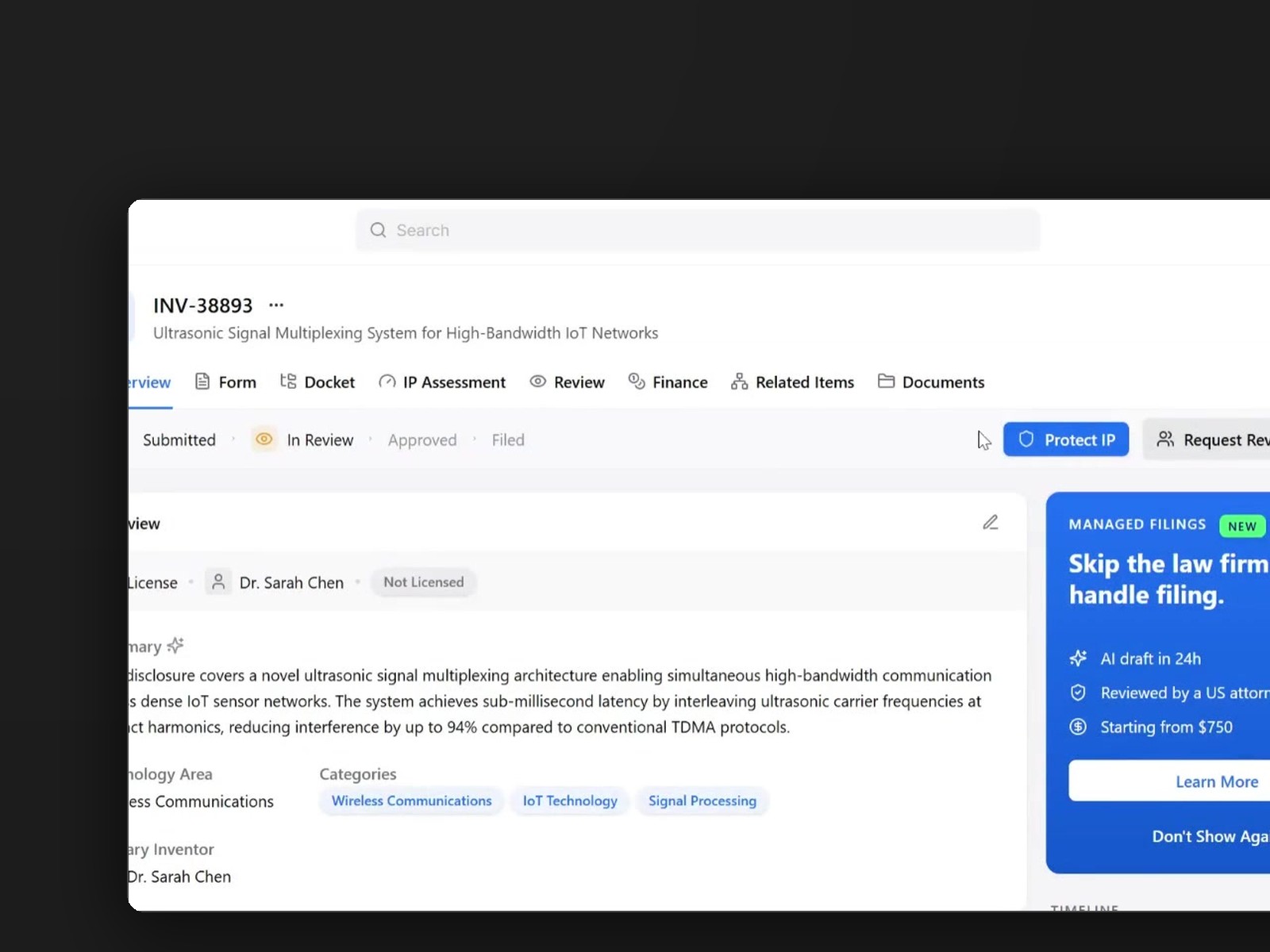
  • Annuity calendar inside the portfolio view. Every upcoming annuity, by jurisdiction, family, and asset, sits in the same view as the underlying segmentation, claim mapping, product mapping, and prosecution history. No portal switching, no cross-referencing.
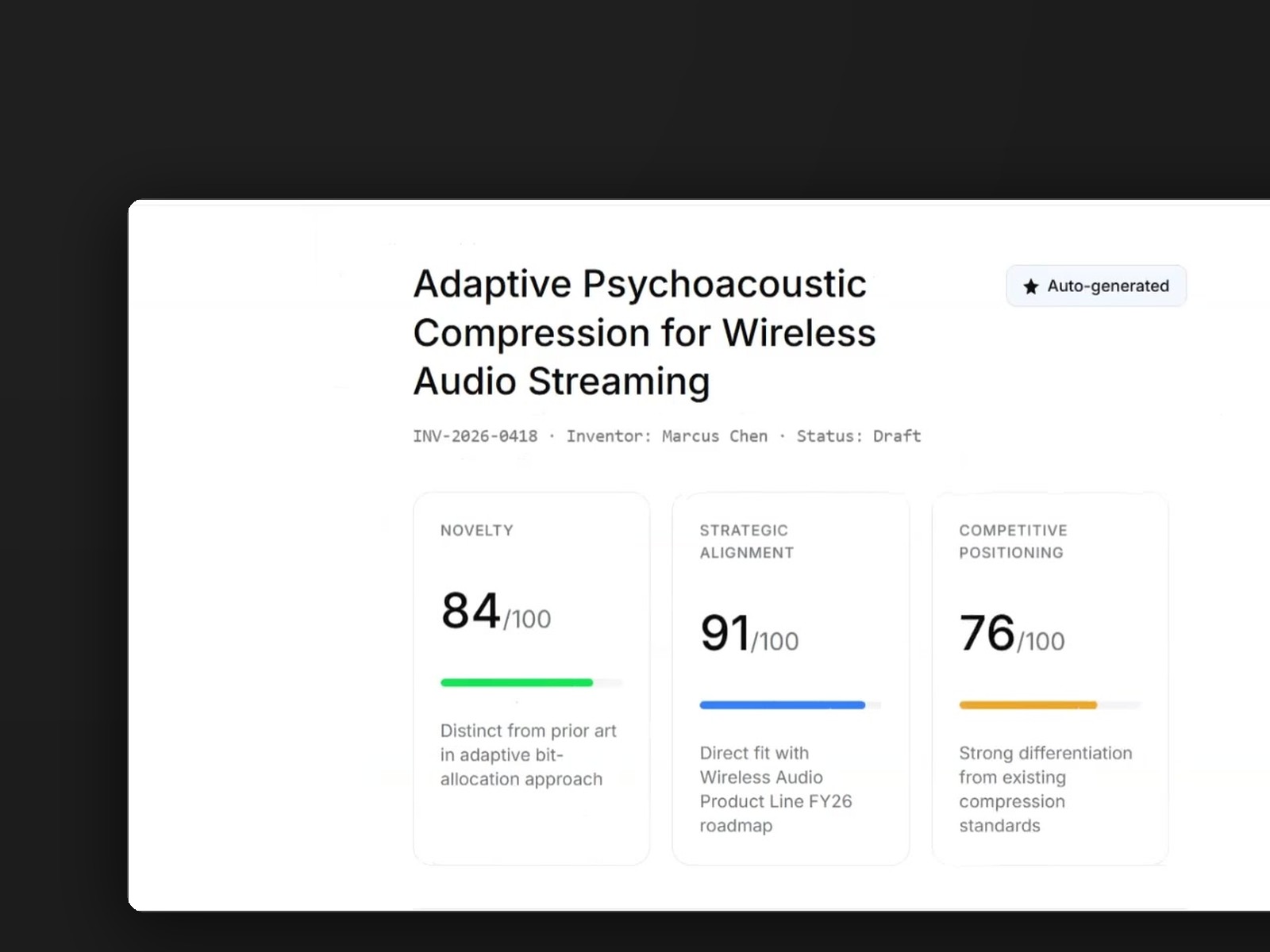
  • Automated abandonment-candidate flagging. Assets that do not map to a current product, do not block a known competitor product, and have not been flagged as optionality surface automatically when their annuity deadlines approach.
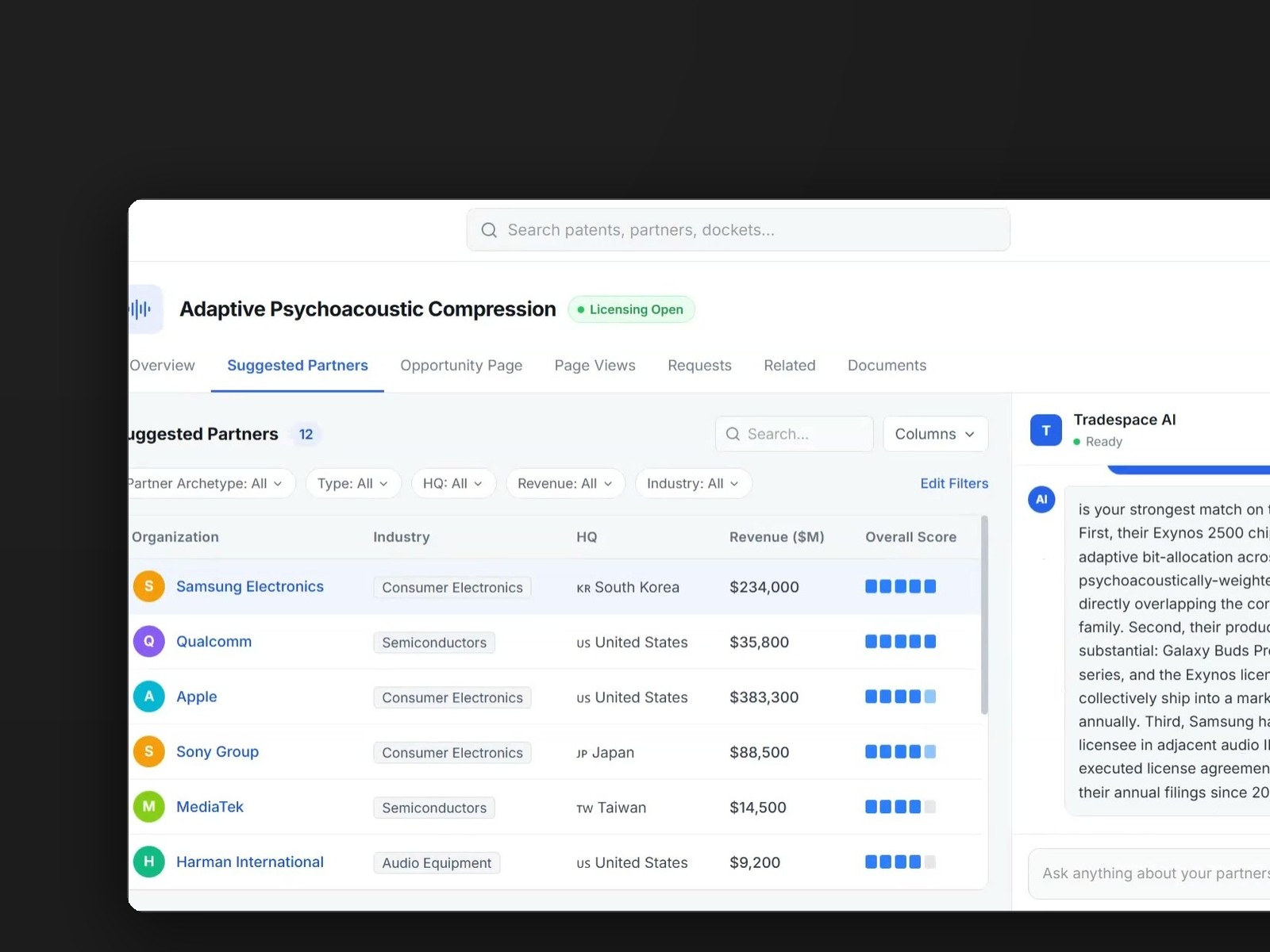
  • AI-assisted product and competitive mapping refresh. The portfolio’s product and competitive context refreshes on the same cadence as the annuity review, so decisions are made against current data instead of last year’s mapping.
  • On-demand attorney review for close calls. When an annuity decision needs legal or strategic input — continuation strategy, freedom-to-operate implications, licensing potential — the same on-demand attorney network that handles drafting and filing can review the asset without spinning up a new outside counsel engagement.
  • Annuity provider integration. Tradespace plugs into the existing annuity provider for payment execution. The IP team keeps the relationship and the per-payment economics it has already negotiated. What changes is who owns the decision data.
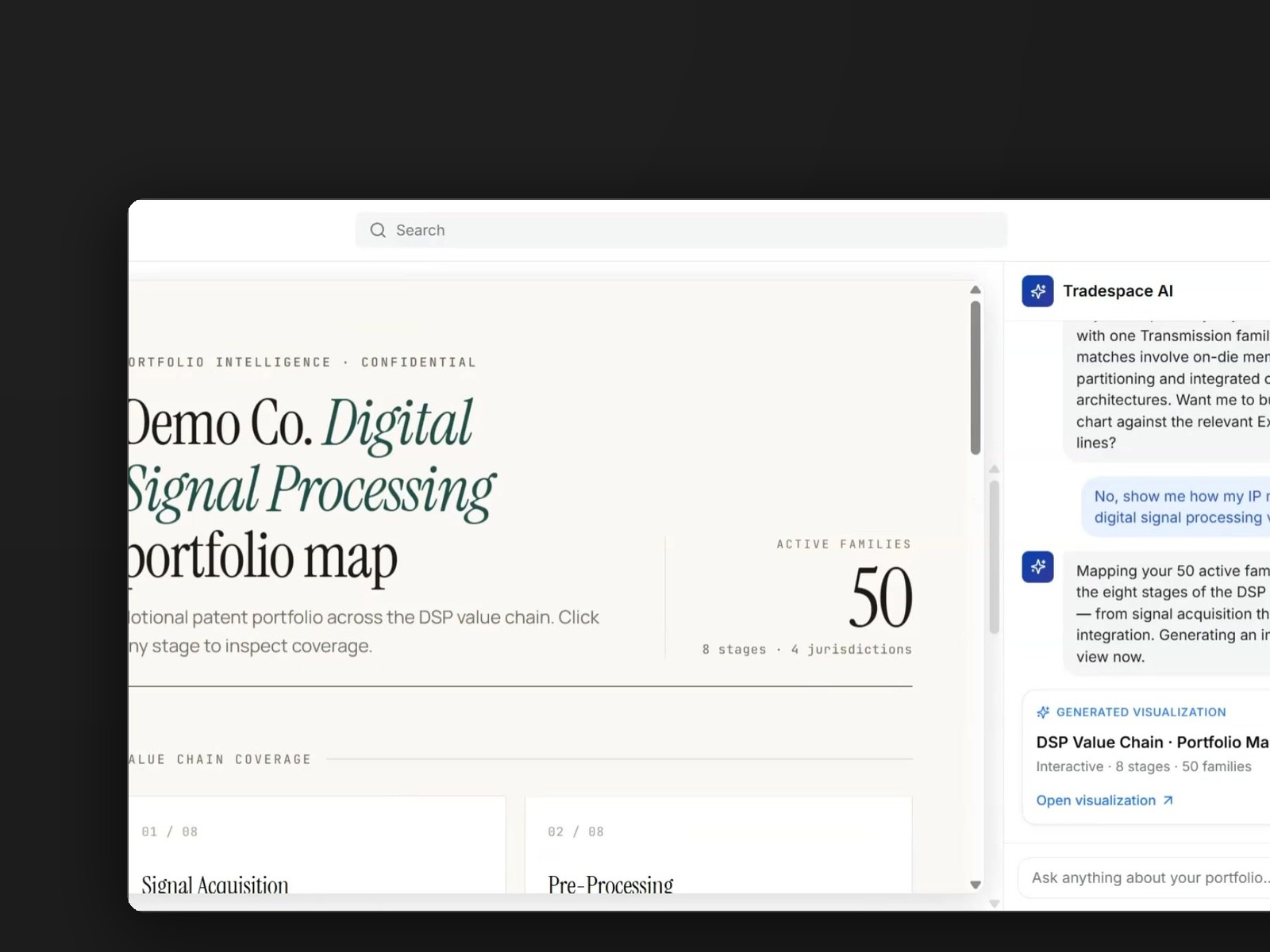
  • Reporting at the level finance actually wants. Quarterly annuity spend by family, jurisdiction, and strategic role. Trend on per-maintained-asset cost. Coverage map showing which products are covered by which families, with annuity status overlaid.

The shorthand: annuity work stops being a calendar-driven scramble and becomes a quarterly strategy exercise with the operational details handled in the same system.

How to implement an annuity strategy in practice

For a team starting from a default-to-pay posture, the implementation arc below has been the fastest path to a working annuity operating model. Compressing it shorter usually means the pruning happens without proper stakeholder review. Stretching it longer means another year of overpaid annuities.

Phase 1: Assessment (months 1-2)

The first two months are exclusively diagnostic. The goal is an honest picture of where annuity spend is going and what it is buying.

  • Pull a complete twelve-month annuity payment history, broken down by family, jurisdiction, and payment amount
  • Map every maintained asset against current products, named competitors, and any explicit optionality decisions
  • Identify the abandonment-candidate set — assets failing all three of the above tests
  • Surface the close-call set — assets where the strategic role is unclear and a stakeholder conversation is needed
  • Quantify the savings opportunity at the family and jurisdiction level

Phase 2: Foundational investment (months 3-6)

Months three through six convert the diagnostic into an operating model. This is the phase where stakeholder relationships, decision rhythms, and reporting cadence get established.

  • Run the first cycle of structured annuity review, with explicit decisions documented for every asset coming due in the next six months
  • Process the abandonment-candidate set, including a licensing-pass filter where appropriate
  • Establish the quarterly review cadence with product and finance stakeholders, including a documented escalation path for close-call decisions
  • Build the reporting template that will go to finance and the executive team — per-family, per-jurisdiction spend, trend over time, and coverage status
  • Migrate the annuity decision data into the system of record, so the next cycle starts from a complete picture rather than reconstructing it

Phase 3: Continuous operation (month 7 and beyond)

By month seven the cycle should be running quarterly without heroics. Phase three is operations: cadence, refinement, and ongoing pruning.

  • Quarterly annuity review tied to portfolio segmentation refresh
  • Annual deep pruning pass during the broader portfolio review
  • Monthly finance reporting on annuity spend trend and coverage status
  • Continuous monitoring for product pivots that change the strategic role of underlying assets

Common implementation pitfalls

The pitfalls below show up at most teams attempting the transition from default-to-pay to disciplined annuity strategy. None are fatal individually. Together, they stall the program.

  • Trying to prune everything in the first cycle. The first cycle should catch the obvious candidates, not the marginal ones. Aggressive first-cycle pruning generates internal pushback that slows the next cycle and the one after.
  • Skipping the stakeholder escalation path. Abandonment decisions on assets with any commercial implication need product and business development input. Without that input, decisions get either over-cautious or over-aggressive, and the IP team owns the consequences either way.
  • Letting the annuity provider’s portal stay the system of record. Decisions documented in the provider’s system are not portable. The next provider contract, the next IP leader, or the next platform migration will inherit a hole where the institutional knowledge should be.
  • Reporting on payments, not on strategy. A quarterly report that lists what was paid is administrative. A quarterly report that shows trend on per-maintained-asset cost and coverage status is strategic. The same data produces both. Only one of them defends the IP budget.
  • Reactive close-call handling. Close calls that surface a week before the deadline produce default-pay outcomes regardless of the strategic case. Move the review cycle ahead of the deadlines and the close calls actually get decided properly.

Measuring annuity strategy effectiveness

Most IP functions report on annuity activity as raw spend. The metrics below tell the executive team whether annuity work is producing strategic value or just executing payments.

  • Per-maintained-asset annual cost. The right direction is down over time, especially through the middle years of the portfolio’s age curve. Flat or rising per-asset cost on a stable portfolio size suggests pruning discipline has slipped.
  • Maintained portfolio mapped to current products. What percentage of currently maintained assets map to an active product, an active competitor, or an explicit optionality decision. Below 70%, the portfolio is over-maintained. Above 95%, the team may be pruning aggressively enough to lose optionality.
  • Annuity spend as a percentage of total IP spend. A useful directional metric. Trending up suggests the function is shifting from filing to maintenance — appropriate as the portfolio matures, but worth interrogating if filing volume is also high.
  • Time from review to decision on abandonment candidates. A working cycle decides candidates within the quarter. A struggling one defers decisions repeatedly, producing default-pay outcomes by accident.
  • Revenue from divested or licensed annuity-candidate assets. Most candidates abandon to zero, but tracking the revenue from the small percentage that monetize keeps the licensing-pass step honest.

Building your annuity strategy

For a team starting from a default-to-pay posture, the sequence below has been the fastest path to a defensible annuity operating model.

  1. Pull the twelve-month annuity payment history before doing anything else. Until the spend is visible, the case for change is invisible too.
  2. Segment the maintained portfolio against current products and competitors. Even a crude first pass will identify the obvious abandonment candidates.
  3. Establish a quarterly review cadence with finance and product, ahead of deadlines, not at them.
  4. Treat the first cycle as a learning cycle. Catch the obvious candidates, escalate the close calls, and refine the rules for the next cycle.
  5. Build the reporting that goes to the CFO before anyone asks for it. A quarterly half-page on annuity spend, per-asset cost, and coverage status defends the IP budget in advance.

A pressure-test for your current annuity posture

The questions below are diagnostic. The honest answers reveal where annuity discipline is mature, where it is leaking budget, and where the next quarter’s work should focus.

  • For every annuity paid in the last twelve months, can you name the strategic role the asset plays — current product, competitor block, explicit optionality?
  • When was the last time an annuity decision was made because of a documented product or competitive change, not because of a deadline?
  • How many of the assets paid this year still cover products the company actually sells?
  • When you abandon an asset, who outside the IP team is consulted before the decision is final?
  • If your annuity provider doubled its per-payment fee tomorrow, would the impact on your total IP budget be visible or buried in noise?

The takeaway

Patent annuity payments look like a back-office discipline. They are a strategic one. The IP teams that handle annuities well are not the ones with the best annuity provider contract. They are the ones running a quarterly strategy cycle that surfaces the right pruning decisions before the deadlines hit, with the stakeholder context to defend each call, and the reporting to make annuity discipline visible to finance as a value-creation exercise rather than a cost line.

The default-to-pay alternative compounds in the wrong direction. Every quarter spent on autopilot adds maintenance fees on assets that should have been let go, makes the next cycle’s pruning harder, and erodes the IP function’s standing with finance. The fix is not glamorous. It is a quarterly cadence, a real segmentation, and a system of record that does not live in someone else’s portal. The teams that build that fix recover six figures of annual spend and earn the next budget conversation while they’re at it.

What are patent annuity payments?

Patent annuity payments are the periodic government fees required to keep a granted patent in force. They are called maintenance fees in the US, renewal fees in most other jurisdictions, and annuities by IP practitioners. The fees escalate over the life of the patent, are jurisdiction-specific, and must be paid on a strict deadline schedule to keep the patent enforceable.

How much do patent annuity payments cost over the life of a patent?

A US utility patent maintained through its full 20-year term incurs approximately $13,000 in maintenance fees at large-entity rates, payable at 3.5, 7.5, and 11.5 years after grant. A foreign-filed family with coverage in major jurisdictions can incur $40,000 to $60,000 or more in cumulative annuity costs per family over the full term, depending on which countries are maintained.

What happens if a patent annuity payment is missed?

Most jurisdictions allow a six-month grace period after the original deadline with a late-payment surcharge. After the grace period, the patent fully lapses in that jurisdiction and cannot be reinstated. Lapsing is permanent in most countries; a small number of jurisdictions offer narrow reinstatement procedures with strict requirements, but the practical assumption should be that a missed annuity past the grace period is a permanent loss of rights.

When should a company abandon a patent rather than pay the annuity?

A patent is a strong abandonment candidate when it does not cover a current or planned product, does not read on a known competitor product, and does not preserve a specific optionality the company has explicitly decided is worth paying for. A useful screening question: if this patent expired tomorrow, would anything in the business change? Where the honest answer is no, the asset is a candidate for abandonment after a quick licensing-pass review.

Should companies use a patent annuity service provider?

Most companies should. Annuity service providers handle the operational mechanics — receiving instructions, paying fees, confirming payments, and managing the calendar across jurisdictions. Doing this in-house at scale is operationally fragile. What companies should not outsource is the strategic decision of which annuities to pay. That decision should stay with the IP team and the broader portfolio strategy.

How often should an IP team review the annuity payment schedule?

Quarterly. Annual reviews are too infrequent — product pivots and competitive shifts move faster than annual cycles, and decisions made under deadline pressure default to “just pay it.” A quarterly cycle that runs two quarters ahead of upcoming deadlines gives the team time to refresh segmentation, consult stakeholders, and document close-call decisions without time pressure.

What's the difference between patent maintenance fees and patent annuity payments?

They refer to the same category of fee. “Maintenance fees” is standard US terminology and refers to the three post-grant payments due at 3.5, 7.5, and 11.5 years. “Renewal fees” is standard in Europe and most other jurisdictions and refers to annual payments. “Annuity payments” is the practitioner term used across jurisdictions to refer to all of these collectively. The economic and strategic logic is the same regardless of terminology.

Can a company reduce patent annuity costs without abandoning patents?

Yes, but the savings are smaller than from disciplined pruning. Options include qualifying for small-entity or micro-entity status in the US, taking advantage of fee reductions for explicit licenses-of-right in some European jurisdictions, and renegotiating annuity service provider per-payment fees. These are worth doing but are typically 5-15% savings at most. Pruning saves 20-40% of total annuity spend in a typical portfolio.

How does annuity strategy fit into broader patent portfolio management?

Annuity strategy is the operational consequence of portfolio segmentation. A portfolio with a clear five-role segmentation produces annuity decisions automatically — assets in active strategic roles are paid, assets without roles become abandonment candidates. A portfolio without segmentation produces ad hoc annuity decisions made under deadline pressure. The complete guide to patent portfolio management covers the broader operating model annuities slot into.

Should small companies and startups pay every annuity by default?

Early-stage companies often default to maintaining everything because the portfolio is small and abandonment feels permanent. This is reasonable through the first two or three years post-grant. By the time the portfolio has 50 or more granted assets and the first set of US maintenance fees comes due at 3.5 years, the default-pay posture starts to leak budget on assets the company has pivoted away from. Disciplined annuity review should start no later than the year before the first batch of maintenance fees comes due.