Patent Portfolio Management: A Complete Guide
June 18, 2026Key Takeaways
Patent portfolio management is an operating discipline, not a filing strategy. The job is to keep every asset earning its keep — covering a product, blocking a competitor, generating revenue, or being deliberately let go.
A portfolio without an audit is a budget with no general ledger. Most IP teams inheriting 50-500 patents discover that 20-30% of maintained assets no longer map to anything the company sells or plans to sell.
Claim mapping is the single highest-leverage exercise in portfolio management. Patents that map to your products defend revenue; patents that map to competitor products generate it.
Jurisdiction strategy should be a budgeting decision, not a habit. The “file in the US, Europe, China, and Japan by default” reflex burns 30-40% of foreign filing spend on coverage that does not match commercial reality.
The portfolios that perform well belong to teams running on a system of record, not on a person. When prosecution history lives in a partner’s filing cabinet and strategic context lives in someone’s inbox, the portfolio loses value every time anyone leaves.
The IP function at a Series C company cannot scale the way a Fortune 500 IP department scales — more headcount, more outside counsel, more software. It has to compound: every filing should make the next one faster, cheaper, and more strategically informed.
What “managing the portfolio” actually means at a Series C company
There is a version of patent portfolio management that lives in textbooks. It involves five-year strategic plans, dedicated portfolio analysts, and quarterly steering committees. It is not the version anyone reading this is doing.
The real job, at a company with 80 to 400 patents, a one-to-five-person IP function, and three to five outside firms doing the prosecution work, looks different. It is reactive. It is dictated by docket deadlines, the next funding round, an unannounced product launch, and a CFO who just realized outside counsel spend has grown faster than revenue. The strategic five-year plan exists, somewhere, in a slide deck that has not been opened since the last all-hands.
What separates the IP leaders who keep their seat at the table from the ones who become the company’s most expensive administrative function is whether they have built an operating cadence around six questions: What is in the portfolio? What does each asset do? What is it costing us? What do we not have that we should? What do we have that we should not? And who else is reading the answers?
The rest of this guide is built around making those questions answerable on demand, not once a year during diligence.
What patent portfolio management actually is
Strip the vendor language away and the discipline reduces to four jobs that have to be running concurrently, not sequentially. None of them is a one-time project.
- Inventory and segmentation. Every asset has to be cataloged with enough metadata to be queried later. Filing date, jurisdiction, family, technology area, product mapping, claim breadth, prosecution status, maintenance window, and a strategic role — defensive, offensive, licensing, design-around insurance, abandoned-but-not-yet. Without segmentation, every decision is one-off.
- Prosecution and docket management. Every filing decision, office action response, continuation strategy, and deadline has to be tracked and executed across however many firms are doing the work. This is where most of the day-to-day operational risk lives.
- Portfolio health and pruning. Periodically, every asset gets re-examined against the segmentation. Some get more investment. Some get continued. Some get sold or abandoned. This is the function most often skipped — and it is the one that quietly drives the cost-per-strategic-asset down.
- Stakeholder reporting. The CFO needs to see spend per filing. The board needs to see exclusivity windows on lead products. The CEO needs to see what investors will see in diligence. The R&D team needs to see what got filed and what did not. The reporting cadence determines whether IP is treated as a value driver or as an overhead line item.
Each of these jobs has its own tooling implications, its own metrics, and its own failure modes. The most common mistake is conflating “we have an IP management system” with “we are doing portfolio management.” A docketing tool tracks deadlines. It does not, by itself, tell you which 18 of your 240 assets are doing the actual work of protecting your moat.
The five pillars of a working patent portfolio
A patent portfolio in active use rests on five operational pillars. Treat them as parallel workstreams, not as a checklist. If one is missing, the others compensate for a while and then they don’t.
The portfolio audit
Before any strategy conversation matters, the portfolio has to be inventoried in a form that can be filtered and queried. Cataloging is not glamorous. It is the work that makes every subsequent conversation grounded in reality instead of in someone’s memory of what got filed three years ago.
What an audit produces, at minimum, is a row per asset with the following columns: application or patent number, family, filing date, priority date, jurisdiction, current status, technology area, mapped product or product line, mapped competitor product if any, next deadline, maintenance fee schedule, prosecution firm, total spend to date, and a strategic role. That last column is the one most teams skip. It is also the one that makes the audit useful instead of decorative.
A useful audit also produces a “do not know” column. Assets where the mapping is unclear, the strategic role is undefined, or the original inventor has left the company are not failures of the audit — they are the output. They are the work backlog.
Strategic segmentation
Once the audit exists, every asset gets a role. The simplest segmentation that works:
- Core defensive. Patents that cover current revenue-generating products or features. If a competitor copied this and you had to enforce, you would.
- Core offensive. Patents that read on competitor products. These are the licensing-conversation and litigation-deterrent assets, whether or not you ever assert them.
- Patents covering products that have not shipped yet. These need active claim shaping as the product evolves.
- Patents covering directions the company explored but did not commercialize. Worth maintaining only if the optionality has plausible monetization (licensing, divestiture, design-around insurance).
- Pruning candidates. Patents that do not cover current products, do not cover competitor products, and do not protect optionality the company is willing to pay to keep open. These are abandonment or sale candidates.
A 240-asset portfolio at a Series C robotics company will typically segment roughly 35-50% Core Defensive, 5-15% Core Offensive, 20-30% Pipeline, 10-15% Optionality, and 10-25% Pruning Candidates. If your numbers are wildly different — particularly if Pruning Candidates is near zero — the segmentation has not actually been done. It has been described.
Claim mapping
Claim mapping is where portfolio management starts to generate business value rather than just track legal status. The exercise is: take each Core Defensive and Core Offensive asset and map its independent claims against the specific product features or competitor product features it is supposed to cover. Write it down. Update it as products evolve.
Three things fall out of claim mapping that nothing else surfaces. First, gaps — features your product team treats as core differentiators that no claim in the portfolio actually covers. Second, dead weight — claims drafted around a product that pivoted, where the granted scope no longer reads on anything the company makes. Third, leverage — claims that unexpectedly read on a competitor product, which is the start of a licensing or business development conversation rather than a litigation question.
Claim mapping is also the exercise that exposes whether prosecution counsel has been drafting for grant or drafting for strategic value. A patent with 38 claims that all narrow to a specific implementation is grant-optimized. A patent with three independent claims at different breadth tiers, each mapped to a different commercial scenario, is strategy-optimized. The pieces on how to draft patent claims effectively and patent intelligence software for competitive analysis cover the prosecution-side and competitive-mapping work that makes this exercise reproducible.
Jurisdiction strategy
Most companies file in the US, Europe (via EPO), China, and Japan by reflex. For a robotics company that ships to North America and sells to industrial customers in Germany, that reflex is roughly correct. For a fabless semiconductor company whose customers manufacture in Taiwan and Korea, it is leaving leverage on the table. For an enterprise software company with no physical product, it is burning maintenance fees on jurisdictions that will never matter.
A jurisdiction strategy worth having starts from two questions: where does the company make money, and where do competitors manufacture or sell. For each Core Defensive and Core Offensive asset, the answer should drive PCT national phase entry decisions, not the default list. The savings, in our experience working with IP teams managing 50-500 assets, run between 25% and 40% of foreign filing spend without reducing the coverage that matters.
Jurisdiction strategy also has to account for the secondary jurisdictions companies forget — Brazil for agricultural-tech, India for any digital service exposed there, Israel for cybersecurity competitors, Mexico for manufacturing-side claims. The default list misses these. A questions-driven approach catches them.
Prosecution quality and continuation strategy
Most portfolio decisions get made one filing at a time, in a vacuum. The team filing today is not thinking about whether the parent application should have a continuation pending in five years. The result is portfolios that look adequate at any single point in time but lack continuity — when a product evolves, there is no pending application to amend claims into.
A portfolio in good operational shape keeps continuations pending on every Core Defensive and Core Offensive family until the underlying product line is mature or abandoned. It treats continuation strategy as a portfolio-level decision, not a per-filing decision. It also tracks claim breadth across the family — the first patent in a family may have broad claims that issued; subsequent continuations should be pushing for different breadth, different statutory categories (method, system, computer-readable medium), and different commercial scenarios.
This is also the area where outside counsel quality varies the most. A senior partner who has prosecuted in your technology area for fifteen years will spot continuation opportunities a junior associate misses. The mistake most lean IP functions make is not budgeting for that senior judgment on every filing — they budget for it on litigation and skimp on it for prosecution, then wonder why the portfolio does not perform under enforcement scrutiny.
Reporting and stakeholder cadence
The pillar that is least often called a pillar is the one that determines whether the IP function gets resources or gets cut. A portfolio that no one outside the IP team understands cannot be defended in a budget cycle. A portfolio with monthly dashboards going to the CFO and quarterly reviews going to the board does not lose its budget to a marketing initiative.
The reporting cadence that works for most Series C IP functions: weekly internal docket review, monthly outside counsel spend report, quarterly business-aligned portfolio review with product and finance, semi-annual board report with portfolio coverage mapped to lead products and competitor activity, and ad hoc diligence-ready exports when fundraising or M&A activity calls for them.
The diligence-ready piece matters disproportionately. The companies that emerge from a fundraise or acquisition with the cleanest IP narrative are not the ones with the most patents — they are the ones whose IP leader was already producing the slide their board needed, every quarter, before anyone asked for it.
Where patent portfolio management commonly falls short
The failure modes cluster. In ten years of looking at Series B to pre-IPO portfolios, the same five patterns recur, and they almost always travel together — a portfolio with one of these problems usually has at least three.
- No system of record the company owns. Prosecution history sits in three outside firms’ systems. Strategic context lives in the IP leader’s email. When the IP leader leaves, 40% of the institutional knowledge walks out with them.
- Filing volume outpaces strategic review. New disclosures get filed because the inventor pushed; old assets get maintained because no one reviewed them. The portfolio grows linearly. Strategic value grows much slower.
- Outside counsel selected for relationship, not for fit. The firm that handled the founding team’s first filing is still doing semiconductors, robotics, and ML claims six years later. Some of it well, some of it not. The IP leader knows this but does not have the bandwidth to switch firms.
- No claim mapping anywhere in the operating model. The portfolio is treated as a list of granted patents instead of as a structured argument about what the company protects. When the board asks “are we covered on the new product line,” the answer requires a two-week analysis.
- Reporting reactive, not proactive. Spend reports surface in budget cycles. Coverage maps surface during diligence. The IP leader is always responding to a question rather than running ahead of it.
The pattern matters because the failure modes compound. A team without a system of record cannot run efficient claim mapping. A team without claim mapping cannot prune intelligently. A team that does not prune burns budget that should have funded better prosecution. A team paying for mediocre prosecution cannot produce diligence-ready exports. The single highest-leverage intervention is putting a real system of record in place — everything else becomes possible once that exists.
What to look for in patent portfolio management in 2026
The fundamentals have not changed in twenty years. The operational environment has. Three shifts in particular reshape what working portfolio management looks like in 2026.
AI-augmented prosecution is now the baseline, not the differentiator
Two years ago, an IP team asking outside counsel whether they used AI in prior art search was making a sophisticated request. Today, every serious prosecution firm is running AI-augmented prior art and patentability research as standard. The question has shifted: who is capturing the savings? In most firm relationships, the answer is the firm — billable hours stay flat, internal margin goes up. Portfolio management in 2026 means contracting for AI-driven efficiency to show up as cost-per-filing reduction, not as opaque firm productivity.
The same dynamic applies to drafting. An attorney drafting a utility patent with structured AI assistance is meaningfully faster than the same attorney three years ago. The structure of the deal has to reflect that — flat-fee filing, predictable cost, and the savings flowing to the IP team’s budget rather than the firm’s margin.
Portfolio data as a strategic asset, not a docketing input
The market has spent twenty years treating IP management software as a docketing tool with reporting bolted on. The companies that compound IP value in 2026 are treating their portfolio data as a queryable strategic asset — competitive landscape analysis, freedom-to-operate signals, white space identification, all run against the team’s own filing history and the broader landscape.
This is a material shift. It means the portfolio is not just a thing being managed; it is a source of intelligence that informs R&D direction, M&A targeting, and competitive positioning. Teams that treat the portfolio this way report being asked to brief the board on competitor activity, not just on filing volume.
The compounding IP function model
The Fortune 500 IP function scales by adding headcount and software. The Series C IP function cannot scale that way — the budget does not exist and would not be approved if it did. What replaces it is an operating model where every filing makes the next one faster, cheaper, and better informed. AI structures disclosures from materials engineers already produce. On-demand attorneys handle filings without long inventor interviews. Prosecution history accumulates in a system the company owns. Each filing leaves more leverage behind than the last.
Teams that operate this way report a different set of metrics. Not patents per year. Not filings per dollar. Time from invention to filed application, percentage of disclosures that turned into filings, percentage of filed patents that map to a current or planned product, and outside counsel spend per filed patent on a downward trend over time.
How Tradespace approaches patent portfolio management
Tradespace was built for IP leaders running portfolios of 50 to 500 patents at companies that need to scale IP output without scaling headcount or outside counsel spend. The product combines three things most teams have to assemble separately — an IP management platform, on-demand patent attorneys who draft and file inside the system, and AI that handles the work that does not need a human in the loop.
The reason the three are combined matters. An IP management system that does not file patents is a filing cabinet. A patent attorney network that does not capture the prosecution history is the same outside counsel relationship in a different package. AI without an attorney is a research assistant. The combination is what produces a portfolio that compounds.
Specifically, Tradespace gives an IP leader:
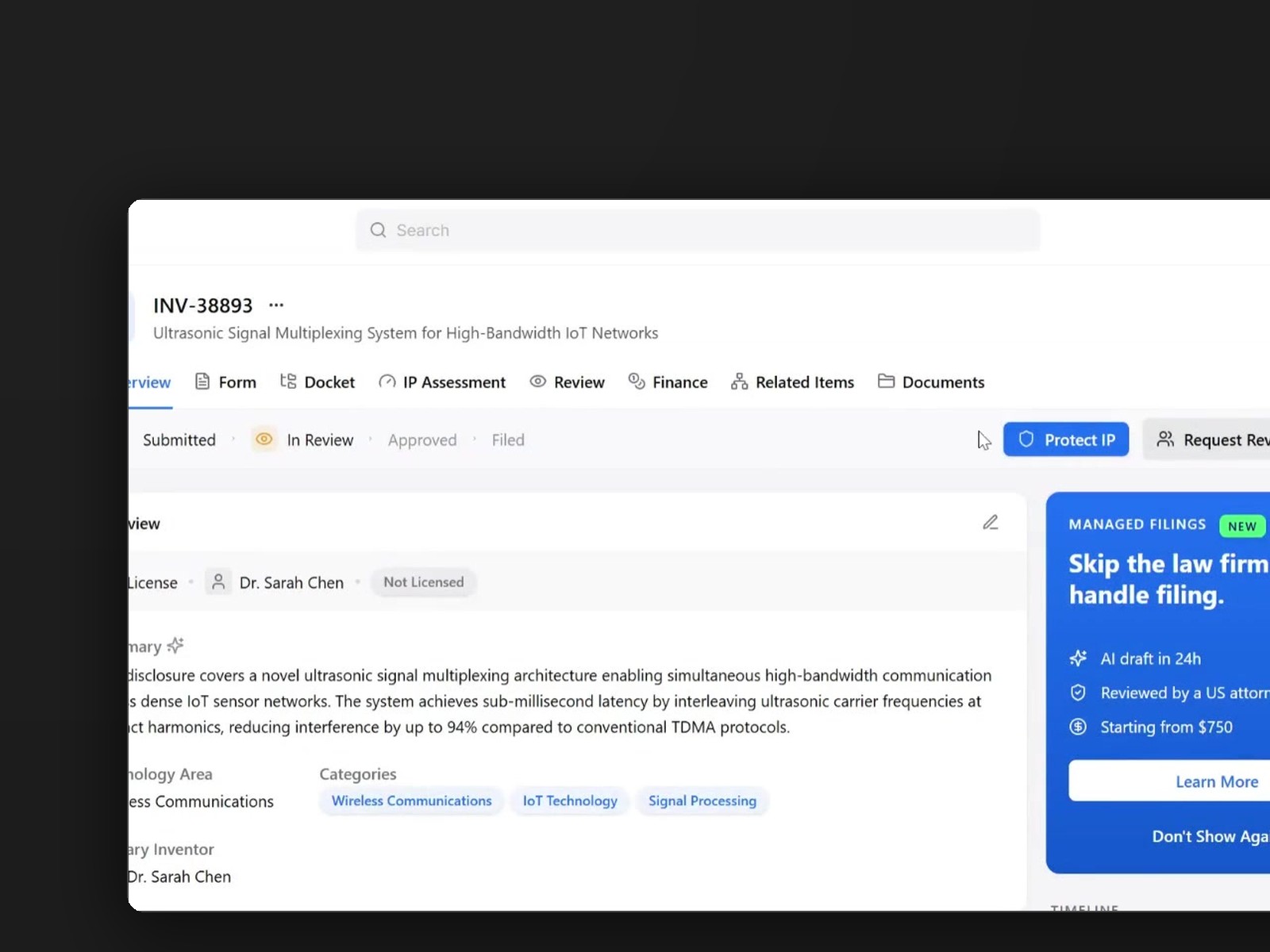
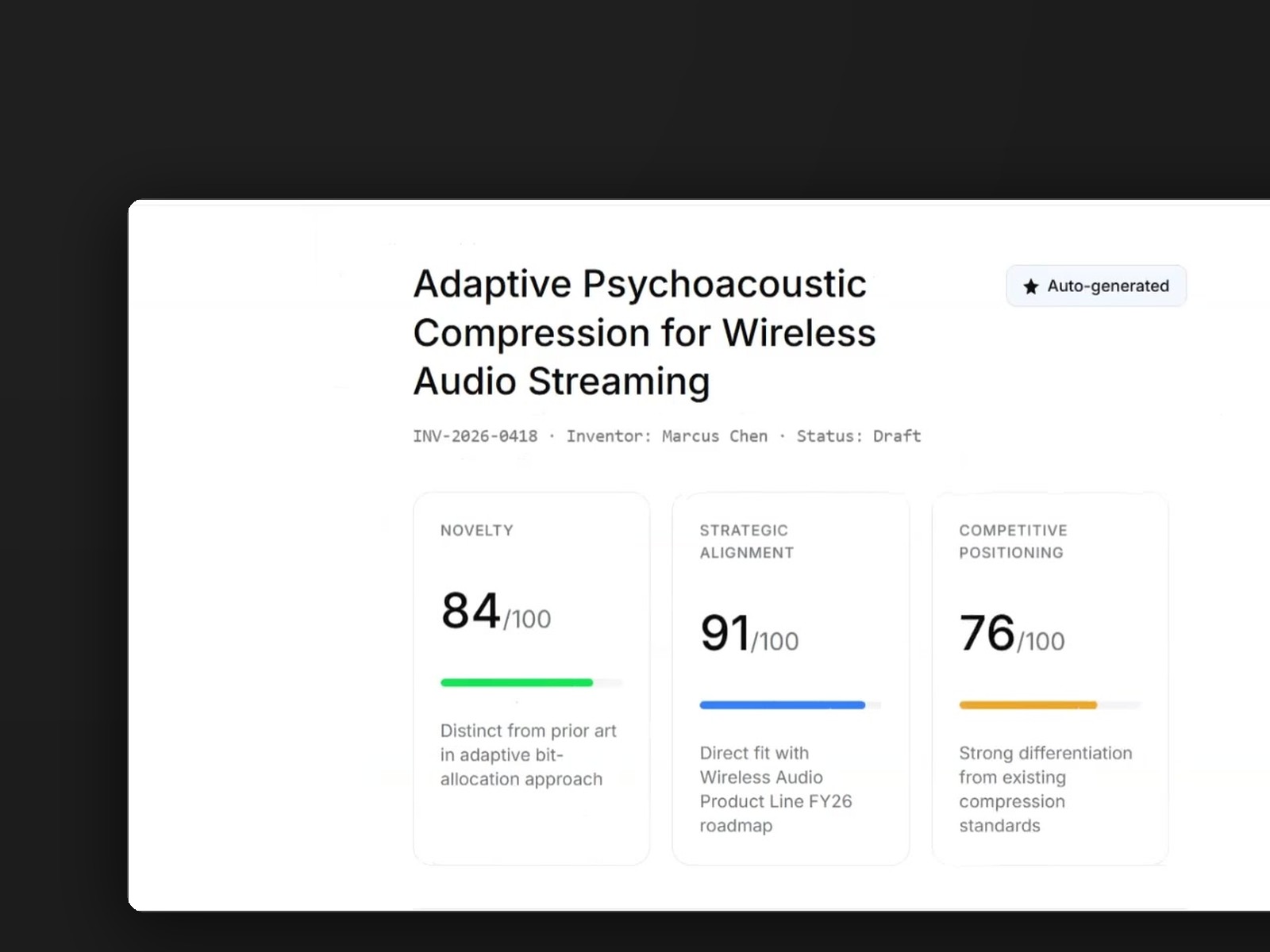
- Structured invention capture. AI turns what engineers already produce — slides, Jira tickets, voice memos, design docs — into structured invention disclosures in minutes. The IP leader stops chasing inventors and starts evaluating attorney-ready disclosures.
- On-demand attorneys inside the system. A senior patent attorney drafts and files a utility patent in under five days for a flat fee. The work happens in the platform. The IP leader sees every step, every decision, and every artifact in real time.
- A single portfolio view. Every filing, prosecution decision, office action, deadline, and dollar lives in one system. Across families, jurisdictions, and any outside firms the team chooses to keep on for specialized work. The board report, the diligence export, the spend benchmark, and the coverage map all come from the same data.
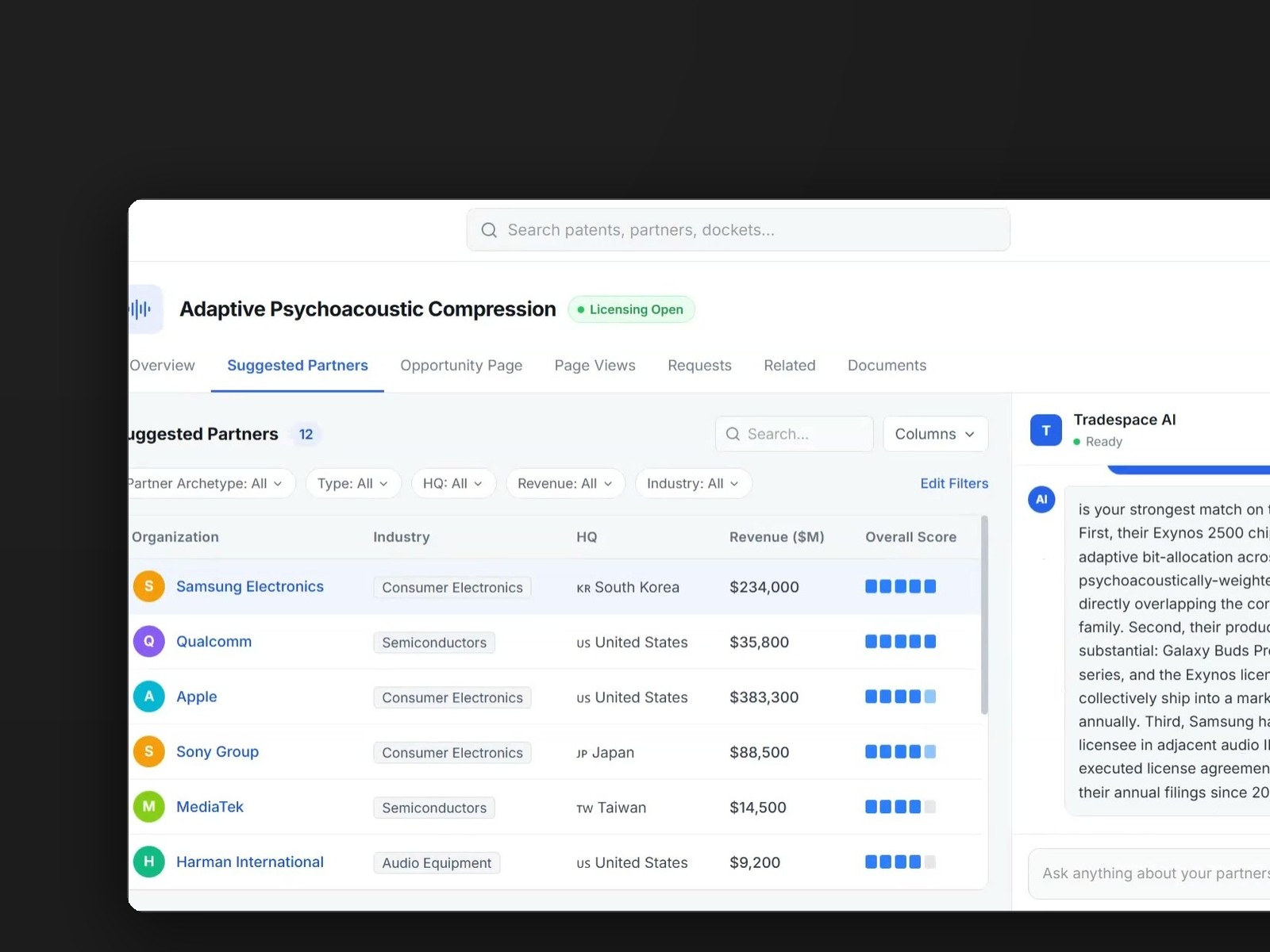
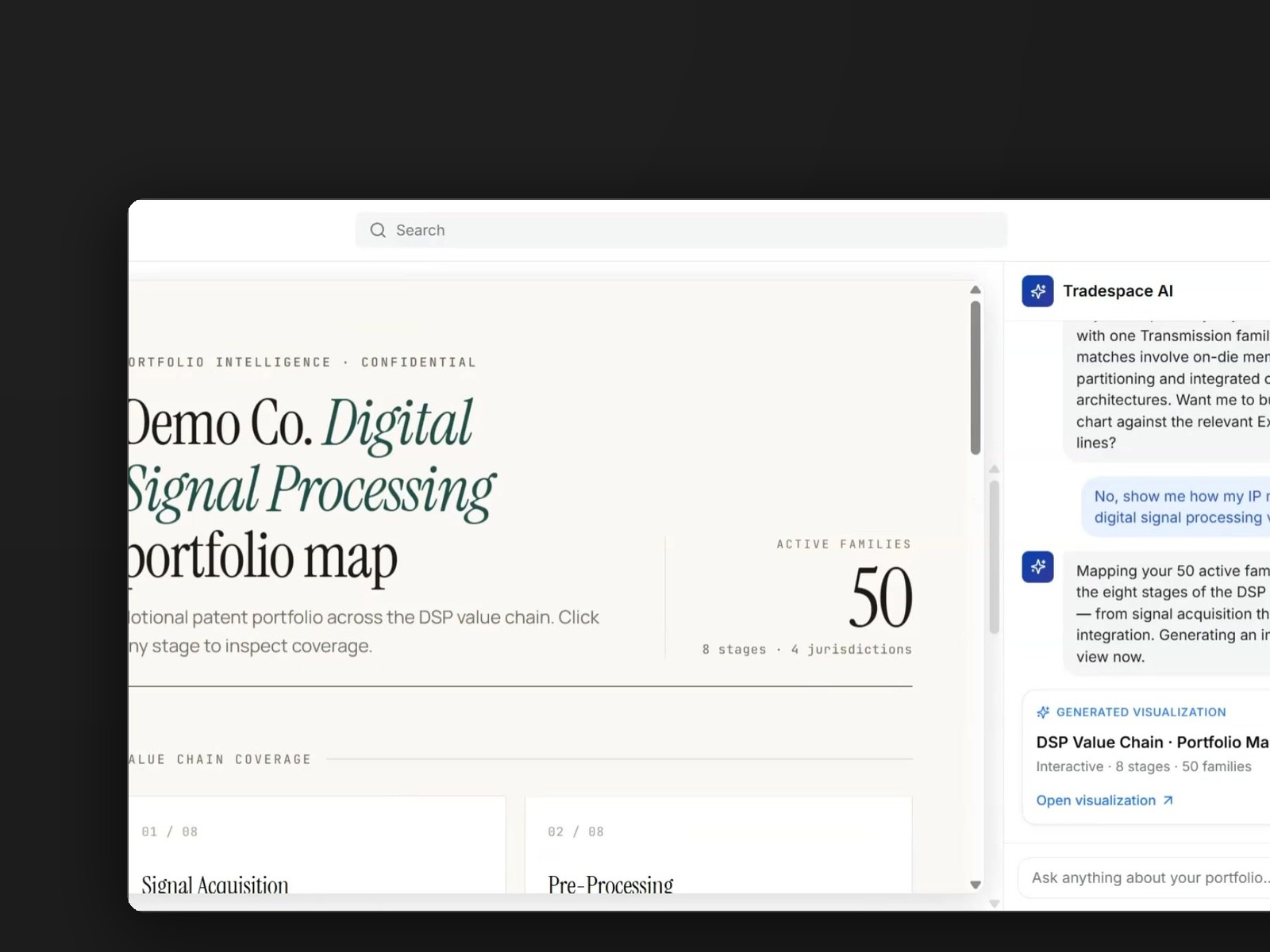
- Portfolio-level AI. As the portfolio grows, the team can query it for competitive analysis, claim mapping signals, white space, and gap analysis. The system gets more valuable the longer it runs.
- A flat-fee, predictable cost model. Filings are priced on output, not on hours. The IP leader can forecast next quarter’s IP spend the same way the head of marketing forecasts ad spend.
- A system of record the company owns. When the IP leader leaves, the next leader inherits a working portfolio, not a forensic investigation. The data, the context, and the prosecution history stay with the company.
The shorthand: Tradespace is the function and the infrastructure, delivered as one product. Not software a team has to staff to operate. Not a law firm that keeps the data. Not an AI tool that still needs a firm to do the filing.
How to implement patent portfolio management in practice
The implementation arc that works at a Series C company is sequenced over roughly nine months. Compressing it shorter usually means foundation work gets skipped and resurfaces six months later. Stretching it longer means the IP leader keeps firefighting and the portfolio never gets ahead of the work.
Phase 1: Assessment (months 1-2)
The first eight weeks are reconnaissance. Nothing strategic gets decided yet. The deliverables are an honest picture of where the portfolio is and where the operating model breaks.
- A complete asset inventory across all outside firms — every application, patent, family, jurisdiction, status, and current docket position
- A prosecution-spend audit covering at minimum the trailing twelve months by firm, by family, and by activity type (new filing, office action, continuation, maintenance)
- A stakeholder map — who owns what decision, what reports go to whom, where the gaps are between R&D, IP, and the executive team
- An honest list of what is broken — missed deadlines, families without continuations, products without coverage, claim mapping that has not been done
Phase 2: Foundational investment (months 3-6)
Months three through six are where the operating model actually changes. This is the phase teams skip because it does not feel urgent, and it is the phase that determines whether the rest of the work compounds.
- Segmentation of the full portfolio against the five-role framework (Core Defensive, Core Offensive, Pipeline, Optionality, Pruning Candidates)
- Claim mapping for all Core Defensive and Core Offensive assets against current and planned products and against named competitor products
- A jurisdiction strategy review — country-by-country reassessment of where the company makes money, where competitors manufacture, and which national phase entries are actually worth the spend
- A decision on the system of record — whether the team is consolidating into one platform, what data needs to be migrated, and what the cutover looks like
- An outside counsel review — which firms stay, which work moves, and what flat-fee or capped engagements replace open-ended hourly billing where possible
Phase 3: Continuous operation (month 7 and beyond)
By month seven the function should be running on a cadence, not on heroics. Phase three is operations, not project work. The cadence is what produces the compounding effect.
- Weekly docket and decision review across all active prosecution
- Monthly outside counsel spend dashboard, with cost-per-filing tracked over time
- Quarterly portfolio review with R&D and product, refreshing claim mapping and pruning recommendations
- Quarterly portfolio review with finance and the executive team, with spend benchmarked against output
- Semi-annual board-ready coverage report, with portfolio mapped to lead products and competitor activity
- Annual jurisdiction strategy refresh tied to the company’s commercial footprint
Common implementation pitfalls
The pitfalls below show up at most companies attempting this transition. None of them are catastrophic individually. Together, they stall the program for a quarter or two and erode executive confidence in the IP function.
- Trying to migrate everything before pruning. Moving 240 assets into a new system before deciding which 40 are abandonment candidates burns migration budget on dead weight. Prune first, migrate the survivors.
- Skipping claim mapping because it feels like analyst work. Without claim mapping, segmentation is guesswork. Without segmentation, pruning is guesswork. Claim mapping is the foundation, not the optional follow-on.
- Underestimating the change management with outside counsel. Firms that have been getting open-ended hourly work for six years do not enjoy flat-fee conversion conversations. The transition has to be planned, not improvised on a Friday call.
- Treating the system of record as a software decision. It is an operating-model decision. The software that hosts the data is downstream of the decision about what data, in what structure, owned by whom.
- Letting the audit go stale. A portfolio audit is a snapshot. Without monthly maintenance, the snapshot is out of date in a quarter and useless in two. Build the maintenance into the operating cadence from day one.
Measuring patent portfolio management effectiveness
Most IP functions report on filing volume and outside counsel spend, then wonder why the executive team treats IP as a cost center. The metrics below tell a different story — they measure whether the portfolio is doing the strategic work it was supposed to do.
- Time from invention disclosure to filed application. A working function moves from disclosure to filing in days to weeks, not months. Good benchmark: median under 30 days for utility filings, under 60 days for PCT.
- Percentage of disclosures that convert to filings. A high conversion rate suggests either rigorous patentability triage upstream or insufficient triage downstream. Typical healthy range: 50-70% in IP-intensive industries with active R&D programs.
- Coverage ratio against current product line. What percentage of currently shipping products are covered by at least one Core Defensive claim. Below 70%, the portfolio is not actually defending the moat. Above 90%, the team is likely over-filing.
- Outside counsel spend per filed patent. Direction matters more than absolute number. A function moving from $18K per filing to $14K per filing over twelve months is doing portfolio management. A function flat or trending up is not.
- Diligence-readiness lead time. How long, from a board ask, to produce a complete portfolio export with coverage mapping. A working function produces it in hours. A struggling one produces it in weeks.
Building your patent portfolio management strategy
For a team starting from a reactive posture — firefighting docket deadlines, no segmentation, no claim mapping, multiple outside firms — the sequence below has been the fastest path back to a working operating model.
- Run the asset inventory before anything else. Until you know what you have, no other decision is grounded in reality.
- Segment everything against the five-role framework, even crudely. The first pass will be wrong in places. That is fine. It will be more right than no segmentation.
- Claim-map the Core Defensive and Core Offensive assets first. Pipeline and Optionality can wait one cycle.
- Make a system of record decision in the first quarter, not the second. Every quarter the team operates without one is a quarter of institutional knowledge leaking into outside counsel systems and personal inboxes.
- Establish the stakeholder reporting cadence in parallel with everything else. Do not wait for the data to be perfect. Imperfect data shipped on a schedule beats perfect data shipped never.
A pressure-test for your current portfolio posture
The five questions below are diagnostic, not rhetorical. The honest answers tell an IP leader where the function is mature, where it is fragile, and where the next quarter’s work should go.
- If the head of IP left next month, how much institutional knowledge about the portfolio leaves with them?
- If the CEO asked tomorrow which lead products have at least one Core Defensive claim mapped against them, how long would the answer take?
- If a competitor filed a patent that read on something your team built first, would you find out from a search, from a customer, or from a lawsuit?
- If outside counsel raised rates 15% next quarter, would you have the data to challenge it on a per-filing basis or would you just absorb it?
- If the next funding round started a diligence sprint tomorrow, how many weeks of work separates the current state of the portfolio from a clean diligence export?
The takeaway
Patent portfolio management is not a project. It is an operating discipline that runs every week, with cadence, on a system that is not held together by any one person. The IP leaders who do this well do not necessarily have more patents than their peers. They have a clearer answer to the question of why each one is there.
The mistake most lean IP functions make is treating portfolio management as something to do once the firefighting is over. The firefighting is the symptom. The operating model is the cause. Build the operating model, and the firefighting recedes — not because the work got smaller, but because the system absorbs it.
If your portfolio cannot answer the five pressure-test questions in less than an hour, you are not managing it. You are storing it. The companies whose IP becomes a real strategic asset are the ones whose IP leader treats every filing as one more entry in an operating system that compounds. The rest are just paying maintenance fees.
What is patent portfolio management?
Patent portfolio management is the ongoing operational discipline of inventorying, segmenting, prosecuting, pruning, and reporting on a company’s patent assets so they continue to do strategic work — protecting products, blocking competitors, generating revenue, or being deliberately released. It is not a one-time project or a software category. It is the operating model that ties an IP team’s filing decisions, prosecution work, maintenance budget, and stakeholder reporting into a single coherent system.
What's the difference between patent portfolio management and IP management?
IP management is the umbrella discipline covering patents, trademarks, trade secrets, copyrights, and licensing. Patent portfolio management is the subset focused specifically on the patent estate. A company with a mature IP management function will have related but distinct operating models for trademark portfolio management and for trade secret protection. The patent portfolio is usually the most data-intensive of these and the one most commonly tied to product strategy in IP-intensive industries.
How often should an IP team audit the patent portfolio?
A full top-to-bottom audit makes sense annually. Continuous incremental maintenance of the audit data — new filings logged, status changes captured, segmentation updates applied — should be a weekly operating rhythm. The mistake to avoid is treating the audit as a project that happens every year or two. By the time the next audit starts, the previous one is too stale to be useful.
What does it cost to manage a patent portfolio properly at a Series C company?
The total cost of an IP function at Series C — counting headcount, outside counsel spend, software, and maintenance fees — typically runs between $400K and $2M annually depending on portfolio size and filing velocity. Outside counsel spend is usually the largest line item. The teams that operate efficiently spend a smaller percentage on outside counsel and more on infrastructure, software, and senior in-house judgment. The teams that operate inefficiently are the inverse.
How do you decide which patents to abandon?
Abandonment candidates are assets that do not cover a current or planned product, do not read on a competitor product, and do not preserve optionality the company is willing to pay to maintain. The fastest screening cut is to ask, for each maintained asset: if this expired tomorrow, would anything in the business change? Where the honest answer is no, the asset is a candidate. The decision should be reviewed against potential sale or licensing value before final abandonment.
Do you need IP management software to manage a patent portfolio?
You need a system of record. Whether that is enterprise IP management software, a platform that combines software with legal services, or a structured set of spreadsheets and shared documents matters less than whether the data is consistent, queryable, and owned by the company. The most common operational failure is portfolios where the system of record is implicit — distributed across outside counsel portals, personal inboxes, and tribal knowledge — rather than explicit.
How do you measure the ROI of patent portfolio management?
ROI on portfolio management shows up in four places. Reduced outside counsel spend per filed patent. Improved time-from-disclosure-to-filing. Higher percentage of products covered by at least one Core Defensive claim. And reduced lead time on diligence-ready exports. Asset-level financial ROI on individual patents is harder to measure cleanly and often misleading. The function’s ROI is more visible at the portfolio level and over multi-year windows.
What's the role of outside counsel in patent portfolio management?
Outside counsel handles work that requires deep specialist expertise — high-stakes prosecution, complex continuation strategy, litigation, jurisdiction-specific filings. In the operating model that works at Series C and above, outside counsel handles the work in-house cannot or should not, while a platform handles the operating cadence and the volume work. The trap is using outside counsel for everything, which is expensive and gives the firm structural ownership of the company’s prosecution history.
How does AI change patent portfolio management?
AI changes three things materially. It compresses the time from disclosure to filing, by structuring inventor materials into attorney-ready disclosures. It compresses prior art and patentability research from days to hours. And it turns the portfolio into a queryable asset, allowing the team to ask landscape and gap questions that previously required outside analysis. AI does not replace senior patent attorney judgment on claim drafting or filing strategy. It removes the manual work around it and lets the senior judgment apply at scale.
When should an IP team replace its existing portfolio management system?
The signals are usually operational, not technical. When the team cannot produce a board-ready coverage report in hours. When the CFO cannot get a clean spend breakdown by family. When a new hire takes more than two months to become productive because institutional knowledge lives in too many places. When the diligence sprint for the next fundraise will require weeks of manual data assembly. Each of these is a signal that the current system has become the limiting factor. Replacing it is operationally disruptive — which is why teams delay it — but the cost of operating around a broken system of record compounds faster than the cost of the transition.